

Prompt-Space Research: How People Ask AI vs How They Google
People type keyword fragments into Google and full task-framed questions into AI. Here is how to mine real prompt phrasings and write content shaped for question-style intent.
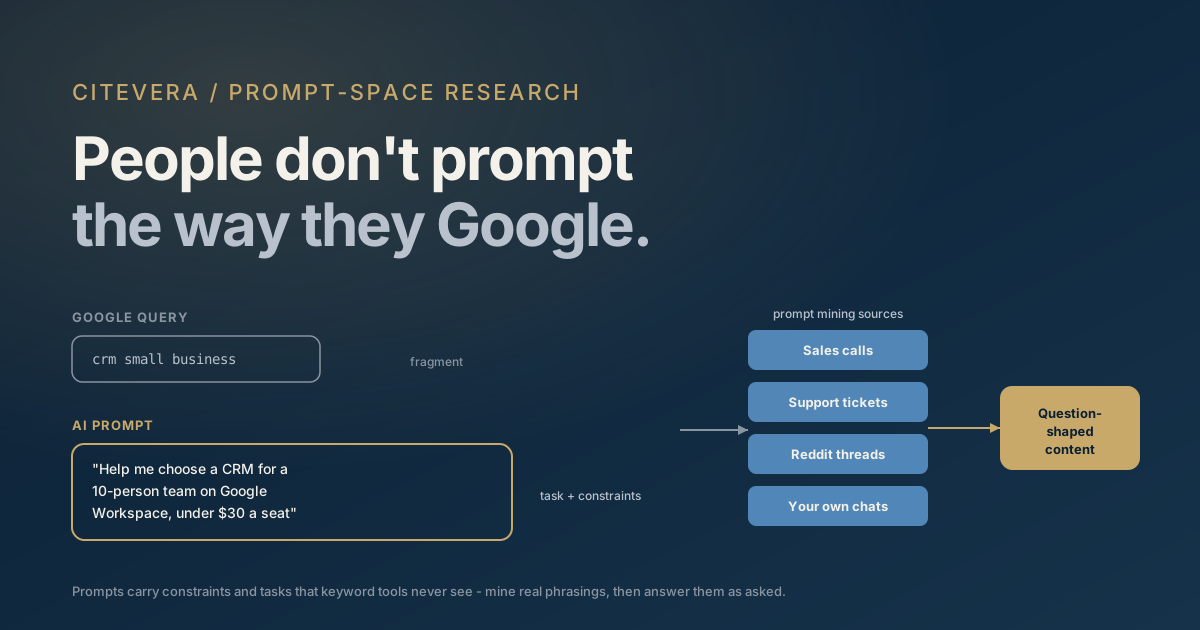
Nobody types "crm small business" into ChatGPT. They type "help me choose a CRM for a 10-person sales team that already lives in Google Workspace and won't pay more than $30 a seat." Same underlying need, completely different query artifact - and if your content strategy is still built purely from keyword-tool exports, you are optimizing for the first phrasing while buyers increasingly ask the second.
This matters because AI engines decompose and match queries differently than a keyword index does. A conversational prompt carries constraints (team size, budget, existing stack), a task frame ("help me choose"), and an implied follow-up conversation. The pages that win citations for it are the ones that answer the question as asked - which is why prompt-space research, mining how people actually phrase requests to AI, is becoming a discipline parallel to keyword research rather than a footnote to it.
How prompts differ from keywords, concretely
Search behavior trained people to compress: strip the grammar, keep the nouns, let the ranking engine guess intent. Chat behavior does the opposite, because the interface rewards specificity. Four differences show up consistently.
- Length and grammar. Keyword queries average a few words; prompts run to full sentences and often full paragraphs. The prompt is closer to what the user would say to a knowledgeable colleague.
- Context and constraints. Prompts carry situational detail Google never sees: "for a solo accountant", "we're already on HubSpot", "needs to be GDPR-compliant", "under $50/month". Every constraint is a filter your content either addresses or fails.
- Comparative framing. "X vs Y" exists in search, but prompts go further: "compare X and Y for my use case and tell me which one to pick." The user is delegating the evaluation, not just requesting raw material for it.
- Task framing. Prompts are verbs: help me choose, write me a checklist, explain whether, build me a plan. The user wants an outcome, and the engine assembles that outcome from sources that map onto the task's steps.
There is a second-order effect too: the engine rewrites the prompt before retrieving. A long prompt gets decomposed into several sub-queries fanned out to search indexes - a mechanism we cover in answer engine fan-out. Your page does not need to match the whole paragraph; it needs to be the best answer to one or more of the sub-questions inside it, while addressing the constraints the model carries through from the original phrasing.
Why keyword tools underrepresent prompt demand
Keyword tools are built on search-engine query logs and clickstream panels. Prompt traffic largely bypasses both, so the demand it represents is structurally invisible to your existing stack.
- No public query logs. OpenAI, Anthropic, and Perplexity do not publish query-volume data. There is no "prompt planner" equivalent of Google's keyword data, and any tool claiming exact prompt volumes is estimating from thin proxies.
- Volume-zero mirage. A phrasing like "is llms.txt worth it for a small documentation site" shows zero volume in keyword tools. That does not mean nobody asks it - it means nobody asks Google. Long, specific phrasings that each occur rarely add up to a large share of AI queries precisely because chat interfaces invite them.
- Aggregation hides the shape. Keyword tools cluster phrasings into head terms, which destroys the constraint and task information that decides AI answers. "crm small business" as a bucket tells you nothing about whether askers care about price, integrations, or ease of migration - the prompt tells you all three.
Keyword research still matters: head terms proxy topic demand, and classic search is far from dead. But treat tool volumes as a floor on interest in a topic, not a map of how the topic is asked.
Mining real prompt phrasings
You cannot buy prompt logs, but you are probably sitting on several sources of them.
Your own AI conversations. You and your team already research your own market through ChatGPT, Claude, and Perplexity. Export and reread those threads as data: how did you phrase things when you were the buyer? Which follow-ups did you ask? Your phrasings are closer to your customers' than any tool output.
Sales calls and demos. The questions prospects ask in a first call are prompts with a human on the other end: "we're comparing you against X, what's actually different", "will this work if we're on WordPress multisite". Call transcripts are a corpus of exactly the comparative, constraint-laden phrasings buyers now type into AI. Tag them by question type for a quarter and you have a content roadmap.
Support tickets and chat logs. Post-sale questions reveal the task-framed phrasings ("how do I get X to do Y with Z") that drive both retrieval queries and long-tail citations. Tickets that recur are prompts that recur.
Reddit, forums, and communities. Reddit threads are prompts in public: full-sentence questions with constraints, answered by peers. They matter twice - as phrasing data, and because AI engines heavily retrieve from these platforms, a dynamic we unpack in Reddit, Quora, and forum citations. The way a subreddit phrases a problem is very close to the way its members phrase it to ChatGPT.
Ask the engines themselves. Prompt ChatGPT or Claude with "what are 20 ways someone might ask an AI assistant for help choosing [category]" and critique the output against your call transcripts. Models are decent at generating plausible phrasings and better still at expanding a seed list of real ones. Treat this as brainstorming, not evidence.
From these sources, build a simple prompt inventory: the phrasing, the constraints it carries, the task verb, and the stage of the buying journey. Patterns emerge fast - and they rarely match your keyword map. B2B journeys especially run on multi-turn, constraint-heavy research sessions, a pattern we document in how B2B buyers use AI search.
Writing for question-shaped intent
Once you know how the questions sound, shape the content to match them. The mechanics are unglamorous and they work.
- Use questions as h3 headings, verbatim where possible. "### Does this work on WordPress multisite?" beats "### Multisite compatibility" because retrieval matches the asker's phrasing and the heading tells the engine exactly which sub-question this passage answers.
- Answer in the first sentence under the heading. Direct answer first, qualification after. A passage that opens with the answer is quotable as-is; a passage that builds to the answer forces the model to reconstruct it, and models prefer sources that require no reconstruction. This is the same first-words discipline covered in direct answer density in the first 150 words, applied per section instead of per page.
- Address constraints explicitly. If real prompts say "for a small team" and "on a budget", your page needs passages scoped to team size and price - not because of keyword density, but because the answer to "which CRM for a 10-person team" genuinely differs from the generic answer, and the engine is looking for the scoped version.
- Cover the task, not just the topic. A "help me choose" prompt wants selection criteria, trade-offs, and a recommendation shape. A "help me fix" prompt wants steps and failure modes. Map each cluster of mined prompts to the deliverable the asker wants, and structure the page as that deliverable.
- Build definitional coverage for the vocabulary prompts use. When askers use terms they only half understand, engines lean on pages that define them cleanly - which is why glossary pages remain an AEO strategy rather than SEO nostalgia.
Closing the loop: test your prompts, not your keywords
The final step is measurement, and it changes what you track. Rankings tell you about keywords; only prompt-level testing tells you about prompts.
Take the highest-value phrasings from your inventory - real ones, with their constraints intact - and run them against ChatGPT, Claude, and Gemini on a schedule. Track whether you are mentioned, whether you are cited, and what the engines say about you versus competitors. Phrasings where competitors get recommended and you do not are your content gaps, stated in the customer's own words. The full measurement setup, including how to pick a stable prompt panel, is in how to measure AI search visibility.
Frequently asked questions
Are keyword tools useless for AEO?
No - they remain the best available proxy for topic-level demand and for classic-search traffic, which still matters. They are just blind to phrasing: they cannot tell you the constraints, comparisons, and task frames buyers put in prompts, because prompt traffic never reaches the query logs those tools are built on. Use keyword tools to pick topics and prompt mining to shape the pages.
Where do I get prompt data if I have no sales calls or support volume?
Start with communities: Reddit and niche forums in your category are public archives of full-sentence, constraint-rich questions. Add your own research conversations with AI assistants, and use the engines to expand a seed list of phrasings you have verified against at least a few real examples. Even a 30-prompt inventory built this way beats a 3,000-row keyword export for deciding page structure.
Should headings literally be questions?
For sections answering a mined question, yes - a question heading in the asker's phrasing, followed by a direct first-sentence answer, is the most retrievable structure you can build. Not every heading needs to be a question; use them where a real prompt maps to the section, and keep normal descriptive headings elsewhere.
How many prompts should I track?
Enough to cover your core buying questions in their real variations without drowning in noise - for most teams that is a panel of 20 to 60 phrasings spanning discovery, comparison, and task-framed questions. Keep the panel stable so trends mean something, and rotate in new phrasings from your mining sources quarterly.
Do AI engines see the whole long prompt or just keywords from it?
Both, effectively. The engine typically decomposes a long prompt into several shorter retrieval queries, but the model composing the answer still holds the full prompt with its constraints. So your page competes on the sub-query for retrieval and on constraint coverage for selection - which is why scoped, specific passages outperform generic ones even when both get retrieved.
Find out which prompts you already lose
Prompt-space research tells you how buyers ask; the uncomfortable second half is finding out what the engines currently answer. Citevera's bundled monitoring runs your prompt panel across ChatGPT, Claude, and Gemini and tracks mentions and citations over time, so your mined phrasings become a standing scoreboard instead of a one-off experiment - see how it works or the pricing plans that include it. Start with the ten prompts your sales team hears most; the gaps those reveal are rarely the ones your keyword tool predicted.