

Answer engine fanout: one query, ten sources
When a user asks an AI answer engine a single question, the engine decomposes it into several underlying retrievals. Understanding fanout explains why AEO targeting single queries is insufficient and how to write for the broader set.
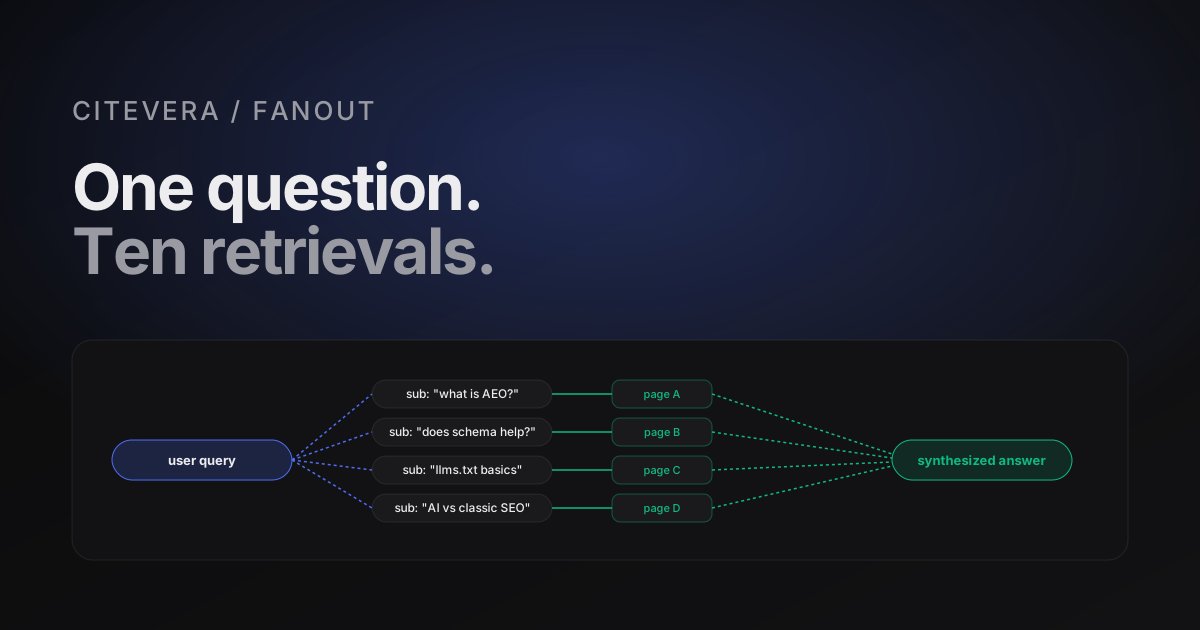
What fanout actually is
When you ask ChatGPT "how do I optimize a blog post for AI citations", the engine does not run one retrieval and return one answer. It decomposes the query into several underlying sub-queries, runs each against its retrieval backend, assembles the results, and then composes a single response that cites several sources. A typical fanout for a modest question pulls 5 to 15 sources. A complex question can pull 30 or more.
Fanout is the reason AEO targeting a single query is insufficient. Your page might be perfect for the user-visible query "how do I optimize for AI citations" and still not get cited, because the sub-queries the engine actually ran were "what is AEO", "does schema markup help AI search", "what is llms.txt", and "how do answer engines pick sources". Your page needs to be a strong answer for the sub-queries, not just the top-level query.
Understanding fanout changes how you write. You stop thinking about "ranking for a keyword" and start thinking about "being a high-value source across a cluster of related questions". The two mindsets produce very different content.
The shape of a typical fanout
For a question like "how do I optimize for AI citations", an engine typically fans out in this pattern (simplified):
- Definitional sub-queries: "what is AEO", "what is AI citation", "what is an answer engine".
- Technique sub-queries: "how does schema markup help AI search", "what is llms.txt", "how do I write for AI answer engines".
- Evidence sub-queries: "does AEO actually work", "case study for AI citation", "AEO benchmarks".
- Adjacent sub-queries: "how does AEO differ from SEO", "AI search vs traditional search".
Each sub-query returns its own retrieval set. The engine then scores each retrieved page by how well it answers the sub-query, weighs the top picks, and synthesizes the answer. A page that scores well across multiple sub-queries gets cited multiple times in the answer (or gets a single citation with higher confidence). A page that scores well only on the top-level query often loses to pages that nail the sub-queries.
The practical implication
Write for the cluster, not the query. When you plan a pillar post, list the sub-questions a reader would need to understand before, during, and after reading. Your post - or the combination of your post and its internal-linked siblings - should have clean answers for all of them.
This is why pillar-plus-cluster internal linking works for AEO and why single-page silos do not. A pillar post on AEO that links to tight child posts on FAQ schema, llms.txt, direct-answer density, and so on provides the engine with a network of cleanly-extractable answers. A single 6,000-word megapost attempts to answer everything in one place and, paradoxically, answers each sub-query less cleanly than a small focused post would.
How to design for fanout
Four heuristics we use with Citevera customers.
1. Every pillar post has 5 to 10 sibling posts
For every pillar topic, identify 5 to 10 sub-topics that would be natural sub-queries. Write a post on each. Link them from the pillar. The engine sees a cluster and can pick the right source for each sub-query; the cluster also compounds in organic search.
2. Each sibling post answers one sub-query cleanly
A sibling post is not a pillar. It is a narrow, deep answer to one sub-question. 1,000 to 1,500 words is usually right. The direct-answer lede is essential here because the sub-query routing is more mechanical than pillar-query routing.
3. Use consistent entity language across the cluster
Every post in a cluster should reference the topic with the same canonical name. "AEO" consistently, not sometimes "AEO" and sometimes "answer engine optimization" and sometimes "AI search optimization". Entity consistency is what lets the engine connect the cluster.
4. Make the internal links specific
Link from pillar to sibling with anchor text that matches the sub-query. "For more on FAQPage schema specifically, see when it lifts citations and when it backfires." The engine reads the anchor as a hint about what is on the other side.
The anti-pattern: the megapost
Many teams, when they discover AEO, respond by writing a single 6,000-word "ultimate guide to AEO". This is usually worse for citation than 6 focused 1,000-word posts covering the same ground.
Reasons:
- Extraction cost. The engine has to scan a lot of content to find the specific answer to a specific sub-query. Extraction budgets often time out before that.
- Arbitration clarity. On any given sub-query, the megapost competes with a focused post on the same sub-topic. The focused post is usually cleaner and more specific. Focused wins.
- Freshness granularity. You cannot keep a 6,000-word post fresh in one move. A cluster of 6 smaller posts lets you refresh one sub-topic at a time without destabilizing the others.
The megapost has one benefit: it performs well for the vanity top-level query in traditional organic search. But for AEO that traditional-ranking signal is exactly the one that matters less.
The reverse: when a single post is right
Some topics genuinely belong in one post. Short, narrow topics that can be fully answered in 1,500 to 2,500 words without implying sub-topics. A post on "how to add BreadcrumbList schema" is self-contained; you do not need a cluster for it.
The test: can you imagine a reader needing to read two or three separate articles to fully understand your post? If yes, your post is a pillar and wants siblings. If no, your post is a standalone.
How this shows up in the audit
Citevera does not explicitly score "cluster design" - that is a content-strategy question, not a single-page signal. But several of the 35 checkpoints reward the outcomes of good cluster design: internal linking, entity consistency, topical depth in the first 150 words, direct-answer ledes on sub-topic pages. Sites with thoughtfully-designed clusters score better on these axes than sites without.
The correlation we see in practice: sites with 3+ well-linked pillar clusters tend to score 10 to 15 points higher on AEO than comparable sites with a flat collection of posts. The compounding effect is real.
Measuring fanout for your own queries
You cannot see the fanout directly, but you can infer it. For a target query:
1. Ask the question in ChatGPT or Perplexity and read the answer. 2. Look at the sources cited. These are your fanout hits. 3. For each source, click through and identify the specific sub-topic it covers. 4. Map those sub-topics to questions a user might separately ask. Those are the sub-queries.
Do this for 5 target queries. You now have a map of the sub-topics the engine thinks matter for your topical space. Check which ones you cover, which ones you cover weakly, and which you have no content for. Plan the cluster accordingly.
Run a free audit to see which pillar pages on your site have strong cluster support
How Citevera leverages fanout thinking
The audit checks for cluster signals indirectly: internal linking density around pillar content, presence of sub-topic pages with cross-links to the pillar, and consistency of entity references across related posts. Sites that score well on these tend to have been designed with fanout in mind, whether the team used that specific term or not.
The audit cannot design your content strategy for you, but it can tell you where the cluster coverage is thin. That plus a manual sub-query inventory (the exercise above) gives you a clear editorial roadmap.
Frequently asked questions about answer engine fanout
Does every engine fan out the same way?
No. The general pattern is similar - decompose, retrieve, synthesize - but the decomposition heuristics differ. Perplexity fans out more aggressively than ChatGPT. AI Overviews fans out less because Google's ranking already does some of the work. The variation matters less than you might think for AEO design; writing to the sub-query cluster serves all the engines.
How many sub-queries should I plan for per pillar?
5 to 10 is the range we see working. Fewer than 5 and the cluster is too thin to be noticeable; more than 10 and you spread your authoring effort too thin.
Can I use AI to plan the fanout?
Carefully. You can ask an engine to "list the sub-questions a user might ask when researching [topic]" and use the list as a starting point. Cross-check with your actual product and audience - the engine's list is generic; yours should be specific to what your readers need.
What if my site is small and can only support one post per topic?
Write the best single post you can. Nail the direct-answer lede, nail the schema, nail the source density. A small site with 30 strong single posts is better than a small site with 5 sprawling megaposts. You can grow into cluster design later.