

FAQPage schema: when it lifts citations and when it backfires
FAQPage structured data is the highest-leverage schema type for AI citation in 2026, but only when the visible FAQ is genuine. Here is when to use it, when to skip it, and the three failure modes that turn a citation boost into a penalty.
Why FAQPage is the most-quoted schema in 2026
When an answer engine has to choose between lifting a paragraph of prose and lifting a structured question-answer pair, it reaches for the structured pair almost every time. The reason is mechanical: the query and the Question field have the same shape, so the match is straightforward; the acceptedAnswer.text field is guaranteed to be the right length and the right voice for quoting; and the engine knows where the answer ends, which a prose paragraph does not tell it.
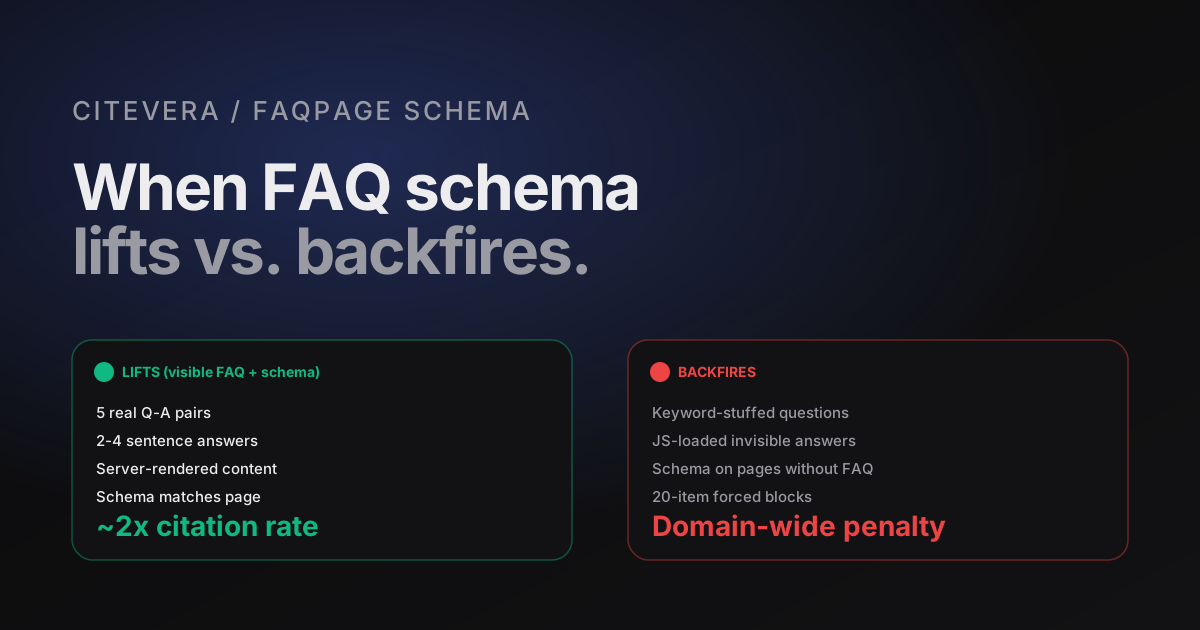
Across several hundred Citevera audits, FAQPage schema on pages with real FAQ content moves citation frequency up by a factor of roughly two to three for the queries those FAQs cover. No other single schema change touches that delta.
The rule: the visible page must match
The rule that governs whether FAQPage helps or hurts is simple. If the schema describes questions and answers that are visibly on the page, it helps. If it describes questions and answers that are not, it hurts.
Answer engines cross-check structured data against the rendered page. A FAQPage block claiming four Q-A pairs when the page shows zero is the single most reliable way to get the whole page down-weighted. Google has been enforcing this on organic FAQ-rich results since 2023, and the answer engines adopted the same check almost immediately.
The practical implication: do not add FAQPage schema to pages without a visible FAQ block. This sounds obvious. Many sites do it anyway, because schema generators default to sprinkling FAQ markup across product pages that have no FAQ in them. The results are consistently worse than not adding schema at all.
When to use it
FAQPage is the right choice when all of these are true:
- The page has a real FAQ section with three to eight question-answer pairs.
- The questions are ones real users actually ask, not keyword variants invented for the schema.
- The answers are two to four sentences each. Shorter than that reads like filler; longer than that is hard to quote.
- The questions and answers live in the main content flow, not in a hidden
<details>block or an accordion that JavaScript renders client-side.
Product pages with a genuine FAQ at the bottom are the highest-value placement. Pillar blog posts are second. Documentation pages answering a single question are often better served by HowTo or TechArticle schema than by FAQPage, because the page has one answer, not many.
When to skip it
FAQPage is the wrong choice when any of these are true:
- You only have one question-answer pair. Use
Questioninline or skip schema entirely. - The FAQ is behind a client-side-only render (React accordion, hidden
<details>that loads lazily). Models cannot see it, so the schema describes invisible content. - The FAQ was copied from a keyword tool and the questions are keyword variants, not real user questions. Common signatures: every question starts with "What is", all answers are exactly one sentence, the questions use filler words like "in 2026" that no human would say aloud.
- The page is a thin landing page whose main content is three paragraphs and a CTA. A four-question FAQ added to a 300-word page triples the page size and signals that the FAQ was added for schema rather than for readers.
The three failure modes
Three patterns account for most of the cases where FAQPage schema actively hurts a site.
1. Keyword-stuffed FAQ blocks
The generator pattern: a team takes a list of 20 related keywords, turns each into a "What is X?" question, and generates a two-sentence answer. The schema block claims 20 FAQ pairs. The model looks at the page, sees that every question is phrased identically, every answer is the same length, and every answer repeats the page title. That pattern is detected and the entire schema block gets discounted. Worse, the practice spreads to other pages on the domain and the engine starts treating the site as a thin-content signal across the board.
The fix: cut the FAQ back to five real questions users ask during sales conversations or in support tickets. Write answers in your own voice. The schema block shrinks but its power grows.
2. Invisible answers
The React pattern: an accordion component renders the questions on the server but only fetches the answers when a user clicks. The schema block has the full text of both, but a model viewing the server-rendered HTML only sees the questions. The schema therefore describes content the model cannot verify, which is the fast path to being ignored.
The fix: server-render the answers. If you want the UI to hide them initially, use CSS display: none with a <details> element - the content is in the DOM and visible to crawlers even when collapsed.
3. Schema on pages without FAQs
The plugin pattern: a WordPress or Shopify plugin adds schema to every page by default. Many pages have no visible FAQ block. The schema describes nothing real. Models detect this fast and begin treating the site's other schema as suspect too.
The fix: configure the plugin to only emit FAQPage schema on pages where an FAQ is present. Most modern plugins support this with a toggle per page; use it.
The minimum good FAQPage block
Here is the schema block Citevera emits on its pillar pages. Copy the shape and swap in your own content. Note that the Question IDs are stable slugs, the acceptedAnswer text matches what the reader sees on the page, and the mainEntity array length matches the visible question count.
{
  "@context": "https://schema.org",
  "@type": "FAQPage",
  "mainEntity": [
    {
      "@type": "Question",
      "name": "How long does a Citevera audit take?",
      "acceptedAnswer": {
        "@type": "Answer",
        "text": "A free audit typically completes in 1-3 minutes for most sites. Paid audits take slightly longer because they run more checks."
      }
    },
    {
      "@type": "Question",
      "name": "What is the difference between AEO and GEO?",
      "acceptedAnswer": {
        "@type": "Answer",
        "text": "AEO optimizes for being cited by answer engines. GEO optimizes the generative pipeline - structured data, llms.txt, crawler access - that makes AEO possible."
      }
    }
  ]
}
Keep the array to three to eight entries. Emit the schema inline in <script type="application/ld+json"> in the page head. Validate the JSON with the Schema.org validator before shipping; malformed blocks are silently ignored by most engines.
Run a free audit to see which pages on your site are missing FAQPage schema
How Citevera scores FAQ coverage
The AEO axis checks three things on every page: whether an FAQ block is visible in the rendered HTML, whether FAQPage schema is present, and whether the schema matches what the page shows. Pages that have all three in alignment score full credit. Pages with schema but no visible FAQ lose points. Pages with an FAQ but no schema lose less but still lose some, because the structured-data lift is real.
The median Citevera customer moves their FAQ coverage from 0 to 4 pillar pages in the first week after their first audit. That single change usually lifts the overall score by 3 to 6 points and is almost always the highest-return change available.
Frequently asked questions about FAQPage schema
Does FAQPage still work in 2026?
Yes. Google rolled back rich results for FAQPage in organic search in 2023, but the schema still drives behavior in answer engines. The structured data is consumed by Google AI Overviews, ChatGPT, Perplexity, and most other engines, even when it does not render a rich snippet on the SERP itself.
Should I add FAQPage to every page?
No. Only to pages with three or more real question-answer pairs. One-off questions belong in Question schema inline, and pages with no FAQ should have no FAQPage block at all.
How many FAQ items is too many?
More than eight starts to dilute. Engines appear to weight the first few heaviest; a 12-item FAQ is typically quoted from the first five. If you have more material, split it across topical pages rather than cramming it into one FAQ block.
Can I use HowTo schema instead of FAQPage for tutorial content?
Yes, and you should. HowTo is a better fit for step-by-step content because the structure matches the shape of the answer. FAQPage is for reference-style Q-A where the questions do not form a sequence.