

Glossary Pages: A High-Yield AEO Architecture Most Sites Skip
A well-built glossary is the most efficient AEO investment in dollars per citation. Here is the architecture, the entry pattern, and the linking strategy.
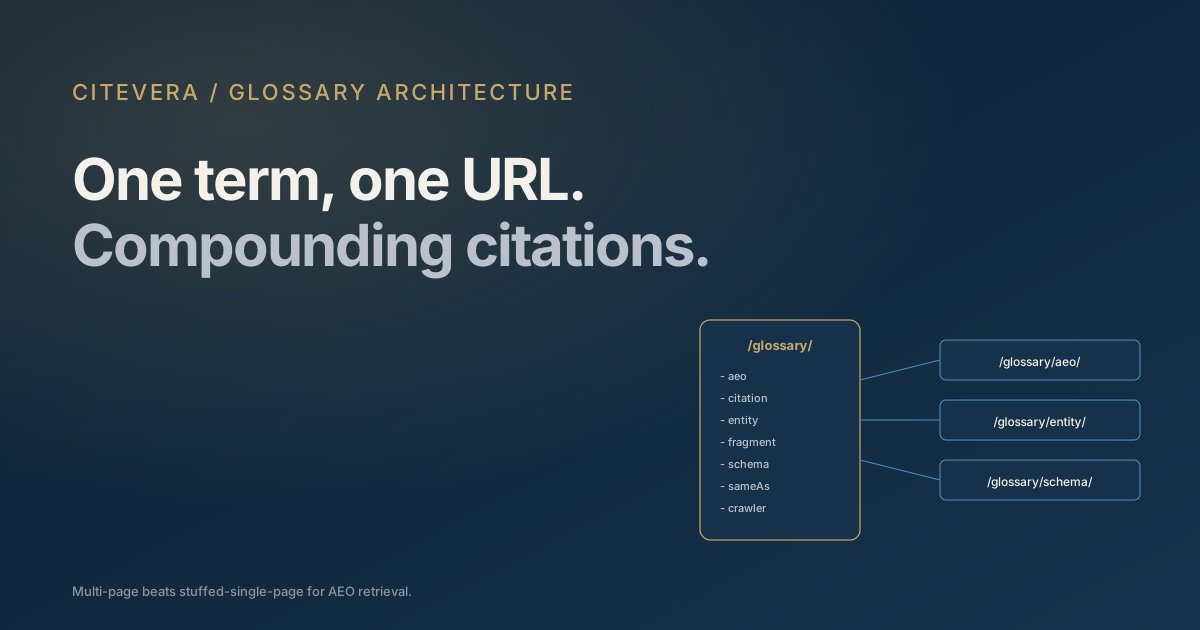
A glossary is one of the highest-yield content assets a site can build for AEO. The economics are uniquely good: each entry is short, each entry targets a specific "what is X" query, and the architecture compounds because every entry can link to and from related content. Yet most B2B and SaaS sites either have no glossary or have a single overstuffed page that fails the AEO test.
This post covers the right glossary architecture, the per-entry pattern, and the internal-linking strategy that turns 60 individual entries into a citation engine.
Why glossaries punch above their weight in AEO
Three reasons:
1. Direct match to "what is" queries. AI engines field a steady volume of definitional queries. A glossary entry is the canonical answer shape. 2. Compounding internal links. Every other post on your site can link to glossary terms in passing, creating dense topic-cluster signal. 3. Low writing cost per entry. A glossary entry is 200 to 500 words. A pillar post is 2,500 words. The cost-per-citable-asset on a glossary is ~5x better.
The math is even better when you consider that buyers researching a topic encounter both your pillar content and your glossary, reinforcing brand exposure across the buying cycle.
One page or many: the architectural decision
The single biggest mistake glossary projects make is putting all 60 terms on one page. This is the wrong architecture for AEO.
Single-page glossary
- One URL, all terms.
- Each term is an H2 or H3 anchor.
- Easy to scan as a reader.
The problem: AI engines retrieve at the page level for most queries. A user asking "what is fragment extractability" gets your single glossary page returned, but the engine has to extract one paragraph out of 60. The retrieval signal is diluted, and the citation rate per term is low.
Multi-page glossary
- One URL per term (
/glossary/fragment-extractability). - An index page listing all terms.
- Each term page is 200 to 500 words.
This is the correct architecture for AEO. Each term page is a focused citable asset for one query. The index page provides discoverability and internal-linking surface.
The exception: very small glossaries (under 10 terms) can stay on one page because the dilution is manageable.
The per-entry pattern
A strong glossary entry has six elements in order:
A 60 to 80 word definition paragraph at the top
This is the citation anchor. Same pattern as the definition paragraph recipe: term as subject, functional definition, contrast, 3 to 4 subtopics, no hedges.
A "where you encounter this term" subsection
A short paragraph naming the contexts where readers run into the term: in conversations with vendors, in pricing pages, in technical documentation. This grounds abstract terms in usage.
A "how it relates to nearby concepts" subsection
Two or three sentences contrasting the term with adjacent concepts. "Fragment extractability is related to but distinct from semantic chunking, which..." This contrast helps engines disambiguate when terms have overlapping meanings.
A short example or scenario
A 40 to 80 word concrete example showing the term in practice. Models cite examples often.
Two or three internal links to related glossary entries and related blog posts
These links build the topical web. A glossary entry that links to nothing is an island.
A "see also" or "related terms" footer
A short list of 3 to 5 related glossary entries with one-line descriptions.
A glossary entry that hits all six elements lands at 300 to 450 words. Substantial enough to compete for citations, focused enough to retrieve cleanly.
The index page as a navigational hub
The glossary index page serves three purposes:
1. Alphabetical or topical browse for human readers. 2. Crawl efficiency by linking to every term page from one location. 3. Topical breadth signal by showing the depth of vocabulary coverage.
The index should include:
- All terms grouped alphabetically or by topic
- A 1 to 2 sentence preview of each term's definition
- Search or filter UI if the glossary is large
The index page is a candidate for citation in its own right when the query is "list of [topic] terms" or "what are the key concepts in [topic]". A well-designed index can rank for terminology-list queries that individual term pages cannot.
Schema markup for glossary entries
Two schema patterns work:
DefinedTerm + DefinedTermSet
{
  "@context": "https://schema.org",
  "@type": "DefinedTerm",
  "name": "Fragment extractability",
  "description": "The property of a content fragment that allows it to be extracted and cited verbatim by an AI engine without surrounding context.",
  "inDefinedTermSet": {
    "@type": "DefinedTermSet",
    "name": "AEO Glossary",
    "url": "https://acme.example/glossary/"
  }
}
This is the schema.org-canonical approach. Engines that parse DefinedTerm markup get a clean signal.
Article + FAQPage
A simpler approach: each term page carries Article schema and a FAQPage with a single entry: "What is [term]?" with the definition as the answer.
Either pattern works. DefinedTerm is more semantically precise; Article + FAQPage gives you Google rich results eligibility for FAQ snippets in addition to AEO benefit.
Internal-linking strategy
A glossary's compounding power depends on linking. Three rules:
Rule 1: Link from blog posts to glossary entries on first mention of jargon
Every blog post should link the first instance of a defined term to its glossary page. Subsequent mentions in the same post need not link. This drives topic-cluster signal without overlinking.
Rule 2: Link glossary entries to each other
A glossary entry should reference 3 to 5 related entries in its body and "see also" footer. This builds an internal web that engines can traverse for entity resolution.
Rule 3: Link glossary entries to relevant pillar pages
Every glossary entry should link to the pillar post or product page that covers the term in depth. This creates a two-way flow: pillars send signal to glossary, glossary sends signal to pillars.
The result is a tight topical cluster where every page reinforces every other page.
Maintenance and freshness
A stale glossary is worse than no glossary. Two practices:
- Quarterly review of definitions, especially for fast-moving domains. Term meanings drift.
dateModifiedupdates on each entry when you make material edits. The freshness signal helps both AEO and SEO.
Glossaries that get reviewed once and then ignored start losing citations to fresher competitor content within 6 to 12 months.
What not to put in a glossary
Three categories to avoid:
- Brand-specific product features. "Acme Smart Sync is when our platform..." belongs in product documentation, not the glossary.
- Trivially obvious terms. "API stands for application programming interface" is fine as one entry; defining "click", "user", or "page" is filler.
- Overlapping near-duplicates. "Semantic chunking" and "passage chunking" probably belong in one entry with a disambiguation paragraph, not two thin entries.
A 60-term glossary of substantive concepts beats a 200-term glossary half full of filler.
When to ship a glossary in your AEO program
Two trigger conditions:
- You publish content in a domain with established jargon (any technical vertical, finance, healthcare, legal, B2B SaaS).
- Your blog post drafts repeatedly include "as we'll explain" references to terms you have not yet defined.
If both apply, a glossary is overdue. Start with 20 to 30 of your most-mentioned terms and grow from there.
Key takeaways
- A multi-page glossary with one URL per term is the right architecture for AEO.
- Each entry should hit 300 to 450 words with a 60 to 80 word definition paragraph at the top.
- Use DefinedTerm or Article + FAQPage schema; either pattern works.
- Internal linking from blog posts to glossary entries on first mention of jargon is the highest-leverage compounding move.
- Maintain quarterly to keep definitions current and citations flowing.
What to do next
Run a free audit at scan.citevera.com to see whether your existing content references jargon you have not formally defined - those gaps are the candidate entries for your first glossary release.
For more on the underlying citation pattern, definition paragraphs and the 60-word recipe covers the structural recipe for the entry's anchor paragraph.