

Definition Paragraphs: The 60-Word Pattern That Wins AI Citations
Definition paragraphs are the single highest-yield citation pattern in AI search. Here is the structural recipe and the placement rules that make them work.
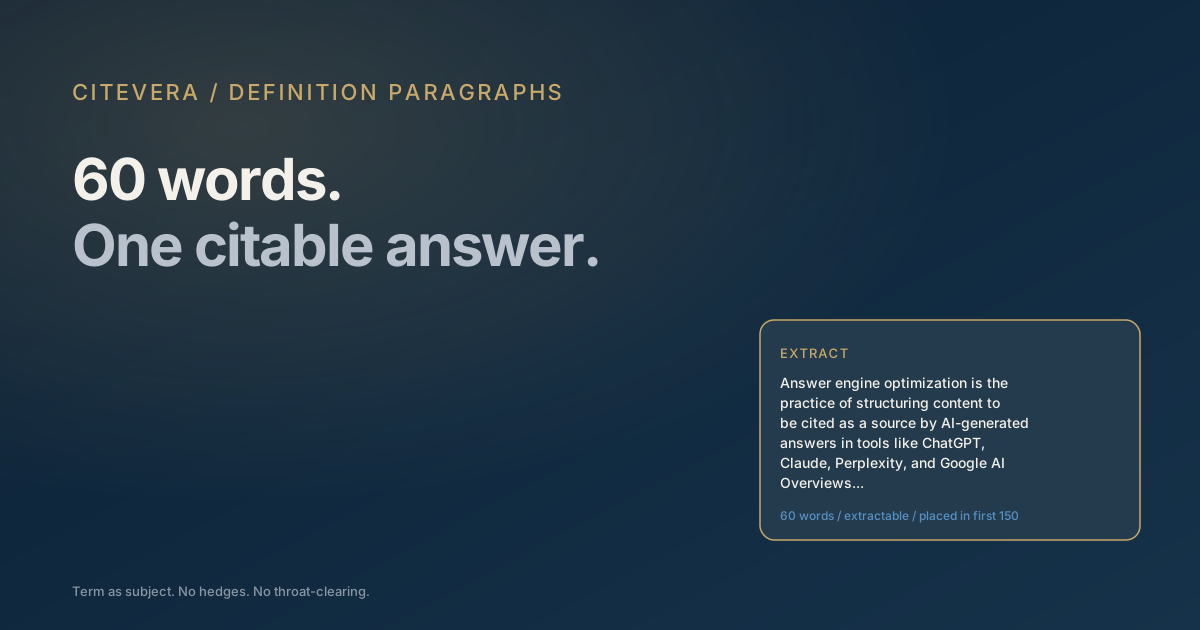
If you read citation logs from any of the major AI engines, one pattern dominates: short, self-contained definition paragraphs that answer "what is X" in 40 to 80 words get pulled verbatim more often than any other content shape. The definition paragraph is the AEO equivalent of the SEO meta description but with stricter structural rules and bigger payoff.
This post covers the structural recipe, the placement rules, and the common mistakes that turn high-potential definitions into citation failures.
What a definition paragraph is in the AEO context
A definition paragraph is a single paragraph, typically 40 to 80 words, that answers a "what is X" question for a specific term. It must be self-contained: a reader unfamiliar with the rest of the article should be able to read just that paragraph and walk away with a usable definition.
The classic shape:
> Answer engine optimization (AEO) is the practice of structuring content to be cited as a source by AI-generated answers in tools like ChatGPT, Claude, Perplexity, and Google AI Overviews. Unlike traditional SEO, which optimizes for blue-link rankings, AEO targets the answer pane itself by emphasizing fragment extractability, entity alignment, and inline source attribution.
That is 60 words. It defines the term, names the engines it applies to, contrasts it with a known reference, and surfaces three substantive subtopics. An engine retrieving the page for "what is AEO" can extract that paragraph verbatim and cite the source.
Why definition paragraphs win citations more than other shapes
Three reasons:
1. Self-containment. The paragraph does not rely on the previous paragraph for context. The model can extract it without ambiguity. 2. Direct phrasing. It answers the question in the first sentence, not the third. AI models trained on instruction-following bias toward content that opens with the answer. 3. Length match. 40 to 80 words is the sweet spot for AI answer panes. Shorter paragraphs feel thin; longer paragraphs get truncated.
Other content shapes (long expository sections, lists, tables) also get cited, but the definition paragraph is the most reliable single pattern. Most posts that get cited heavily have at least one strong definition paragraph somewhere in the first 200 words.
The structural recipe
Five elements in order:
1. Subject and predicate naming the term explicitly. "Answer engine optimization is..." not "It is..." 2. A 1 to 2 sentence functional definition. What does it do or what is it for. 3. A contrast or comparison. Reference a known peer concept ("unlike SEO", "similar to Y but with..."). 4. Three or four substantive subtopics named at the level of nouns, not full sentences. 5. No throat-clearing. No "in this article we'll cover", no "great question", no "as you might know".
A paragraph that hits all five elements at 50 to 70 words is structurally optimized for citation.
Where to place definition paragraphs on the page
Three placements matter, in priority order:
Within the first 150 words
The most-cited slot. AI models that retrieve passages weight content that appears early in the document. The direct answer density principle covers the placement logic in detail. A definition paragraph in your opening section is the highest-leverage AEO investment per word on the page.
Immediately under an H2 that names the term
If your post has a section called "What is X", the first paragraph under that H2 should be the definition. Models that retrieve by heading-and-paragraph pairs love this pattern.
In a glossary or terminology subsection
Long posts benefit from a "key terms" or "glossary" subsection that defines 5 to 10 terms used in the post. Each definition follows the same recipe. This is especially valuable for technical content with established jargon.
What disqualifies a definition paragraph
Six recurring mistakes I see in audits:
- Pronoun starts. "It is the practice of..." breaks self-containment. The reader (or model) does not know what "it" is without the prior paragraph.
- Buried in a long paragraph. A definition embedded in the middle of a 200-word paragraph is hard to extract. Break it into its own paragraph.
- Overhedged. "AEO is sometimes thought of as a kind of approach to..." is unciteable. Engines penalize hedge words because the claim becomes unverifiable.
- Self-referential. "AEO is what AEO experts do" is circular and gets ignored.
- Brand-specific. "AEO is when companies use Acme Cloud to..." is product copy, not a definition. Models filter these aggressively.
- Multi-sentence runs without periods. Run-on sentences with semicolons and commas instead of periods are extractable but lose against clean three-sentence variants.
How definition paragraphs interact with FAQ schema
Definition paragraphs and FAQ schema are complementary, not redundant. The definition paragraph lives in the body and gets retrieved as a passage. The FAQ schema gives engines a structured-data signal that the page covers specific questions.
A common pattern that works:
- Open with a 60-word definition paragraph in the body.
- Include a "frequently asked questions" section with FAQ schema near the bottom of the page.
- The FAQ schema includes the same "what is X" question with a slightly differently worded answer.
Engines see both signals and triangulate. The page becomes more retrievable than either pattern alone.
The expanded definition pattern for ambiguous terms
For terms that have multiple meanings (like "AEO" can also mean "Affirmative Action Equal Opportunity"), the definition paragraph should disambiguate explicitly:
> Answer engine optimization (AEO), in the context of search and content marketing, is the practice of structuring content to be cited by AI-generated answers. The acronym AEO is also used in HR contexts to mean Affirmative Action Equal Opportunity; this article uses the search-marketing meaning throughout.
The disambiguation lengthens the paragraph but resolves the entity-confusion risk that would otherwise cause AI engines to discard the page or cite it for the wrong meaning.
Extending the pattern into "what is" subsections
Long pillar posts often have multiple definition paragraphs covering related sub-terms. The pattern scales:
- An "AEO playbook" post can have 6 definition paragraphs: "what is AEO", "what is an answer engine", "what is a citation", "what is fragment extractability", "what is entity alignment", "what is direct answer density".
- Each lives under its own H3 inside the appropriate H2 section.
- Each follows the same 40 to 80 word recipe.
This converts a single 2,500-word pillar post into 6 high-density citation surfaces. The post earns citations on the headline term and on the sub-term queries.
Editorial checklist for definition paragraphs
Before publishing, run each definition through this checklist:
- Does the paragraph open with the term name as the subject?
- Is the paragraph 40 to 80 words?
- Does it work without surrounding context?
- Does it include a contrast or comparison anchor?
- Does it name 3 to 4 subtopics?
- Are there any hedge words ("might", "could", "sometimes", "in some sense")?
- Could the paragraph be cited as-is in an AI answer without confusing the user?
Six "yes" answers and one "no" on hedges is the target. Anything less and the paragraph leaves citation potential on the table.
Key takeaways
- Definition paragraphs are the single highest-yield citation pattern in AI search.
- The structural recipe is 40 to 80 words, term-as-subject, functional definition, contrast, 3 to 4 subtopics, no throat-clearing.
- Placement in the first 150 words is the highest-leverage slot.
- Avoid pronoun starts, hedges, brand-specific phrasing, and run-on sentences.
- Pair definition paragraphs with FAQ schema for complementary retrieval signals.
What to do next
Run a free audit at scan.citevera.com to see whether your top pages have a clean definition paragraph in the first 150 words and where the structural disqualifiers are.
For more on citation structure, anatomy of a cited blog post breaks down a full citation-winning page from intro to FAQ.