

Direct-answer density: the first-150-word rule for AEO
Answer engines lift content that answers the title in the first 150 words of a page. The mechanics behind the rule, how to rewrite a buried-lede post in 20 minutes, and three opening patterns that consistently out-cite the alternatives.
The rule in one sentence
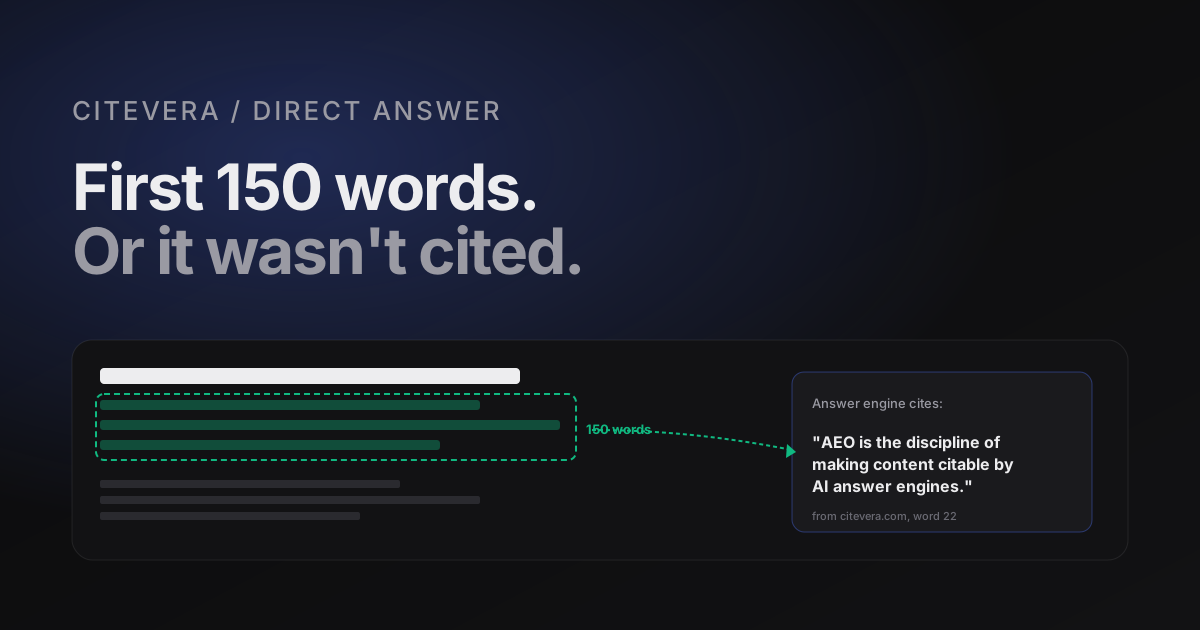
Pages that answer their own title within the first 150 words get quoted by AI answer engines at roughly double the rate of pages that do not. This is the most reliably measured content-level effect we have seen across 2025 and 2026. It is also the easiest change to ship, because it is a rewrite, not a site-wide engineering project.
Why the first 150 words
Answer engines select content in a two-stage process. The first stage is a cheap relevance scan: fetch a page, tokenize it, and decide whether the page is likely to contain a quote for the query. That scan usually looks at the page title, the first heading, and the opening paragraph. Pages that fail the scan are dropped before any slower extraction runs. Pages that pass are sent to the extraction stage, where a model reads the full body and picks a sentence.
Everything you want in the extraction stage depends on surviving the scan. The scan has a tight budget - often one to three hundred tokens - which in practice is the first 150 to 250 words of readable text. If the answer to your page title is not in that window, the page still might pass on keyword match, but its extraction priority gets down-weighted against pages where the answer was right there. Your page has to earn attention it could have been given for free.
This is why traditional journalism's "inverted pyramid" - the most important information first, details after - tracks exactly with what AI search rewards. The engines are optimizing for the same thing a human reader is: get to the answer fast.
What "answering the title" actually means
If your title is "What is AEO?", the first paragraph should contain a sentence of the shape "AEO is X." Not "AEO has become important because Y" or "Many teams wonder about AEO." Those are preambles, not answers. The engine reading the page needs a token sequence that reads like a definition or a direct claim, because that sequence is what it can lift without editing.
Three patterns consistently work:
1. Definition-first
Used when the title is a "what is" or "what does X mean" query. Lead with a one-sentence definition, then a second sentence that anchors it with a concrete example or a number. This post does that: the rule is stated in the first paragraph, followed by the mechanics in the second.
2. Answer-then-why
Used when the title is a "how do I" or "should I" query. State the recommendation, then explain why. "You should add FAQPage schema to pages with visible FAQ content. It lifts citation frequency by roughly 2x." The answer runs first. The supporting argument follows.
3. Takeaway block
Used when the title is a comparison or list query. Open with a three-line block summarizing the finding, then expand. Think of it as an executive summary the engine can lift as a single unit. Many AEO-optimized posts put this in a styled "Key takeaways" box; that visual framing makes it easier for humans to scan and does not hurt AI extraction.
The opening patterns to avoid
Three opening patterns consistently bury the answer deep enough that citation rates drop.
The "landscape" opening
"The world of AI search has changed rapidly in recent years." This is a reflex, especially in business writing. It does not answer anything. The model reading it sees 30 tokens of throat-clearing before any content. By the time the real answer arrives at word 300, the page has already been down-weighted in the relevance scan.
The rhetorical-question opening
"Have you ever wondered what AEO is?" No model has ever wondered anything. The rhetorical question sets up an answer that comes later, but the scanning model treats the opening as content-free and moves on to check the heading.
The credential opening
"After 15 years in the industry, I can tell you..." This is a human-reader convention that does not survive the cheap-scan stage. The credential might build trust in a 2,000-word read; in the first 150 words it takes up room the answer should occupy. Put the credentials in the author bio, not the lede.
A 20-minute rewrite recipe
Most existing posts were written before AEO mattered and have buried answers. The rewrite is mechanical:
1. Read your own title out loud as a question. 2. Read the first 150 words of the post. Did you answer the question? Write down what the actual answer is, in one sentence. 3. Delete the current opening paragraph entirely. Put the one-sentence answer in its place. 4. Add a second sentence that grounds the answer with a concrete number, example, or source. 5. Stitch the rest of the post back together. If the post had a longer setup, that setup can often become a "why this matters" section further down.
This is a 20-minute exercise per post. Do it on your top 10 organic pages first. The audit delta will show up in 4 to 8 weeks.
Measuring the rule
The simplest measurement is manual: pick 20 queries your site should rank for, ask each of the major answer engines, and record whether your site is cited. Run this monthly. Before-and-after rewrites typically show a clear step change within two re-crawl cycles.
For sites with traffic to spare, a cleaner test is to A/B at the folder level. Rewrite half your blog posts with direct-answer leads, leave the other half alone. Measure citation share across both halves over a month. The rewritten half should outperform on every query where direct-answer applies.
Note what does not measure cleanly: raw word count, time-on-page, and bounce rate. Those metrics were proxies for relevance in classic SEO. For AEO they are confounded by the fact that a well-answered reader often leaves fast because they got what they needed. Use citation share as the north-star metric, not engagement.
Run a free audit to see how many of your pages pass the 150-word rule
How this shows up in Citevera's audit
The AEO axis checks every scanned page for three things: is the title a question or a claim, is an answer present in the first 150 words, and does the answer match the title by topic. Pages that pass all three lift their AEO score by roughly 4 points on average. On a 10-page scan of a marketing site, fixing this on every page moves the overall score by 6 to 10 points.
It is the highest-leverage rewrite category because it requires no new content - just reordering what you already wrote. Most teams ship their first batch of rewrites in an afternoon.
Frequently asked questions about direct-answer density
Does this apply to every page or just blog posts?
Mostly blog posts and documentation. Pricing pages and product pages have different structural conventions where the first 150 words are usually value proposition, not definition. For those pages, the rule bends: the "answer" is "what does this product do" and it should be answered fast, but in marketing-copy voice, not definition voice.
What about pages that answer multiple questions?
Pick the most important one and answer it first. A page that tries to answer five questions in its opening ends up answering none of them cleanly. Split into separate pages or use clear H2 sections that each pass the same first-150-word rule within their own section.
Does "first 150 words" count the headline?
Headlines, H1, and subheadings do count. But relying on them alone is weak - the content scan weighs body text heavier. Use the H1 to frame the question and the opening paragraph to answer it.
How does this interact with a "Key takeaways" box at the top?
It complements it. A takeaways block is an explicit answer-up-top structure. Engines read it, but they also read the prose that follows. You get credit for both.