

The anatomy of a cited blog post: five patterns that win
What does a blog post that consistently gets quoted by AI answer engines look like? Five structural patterns that show up in nearly every highly-cited post, with examples and a template you can copy.
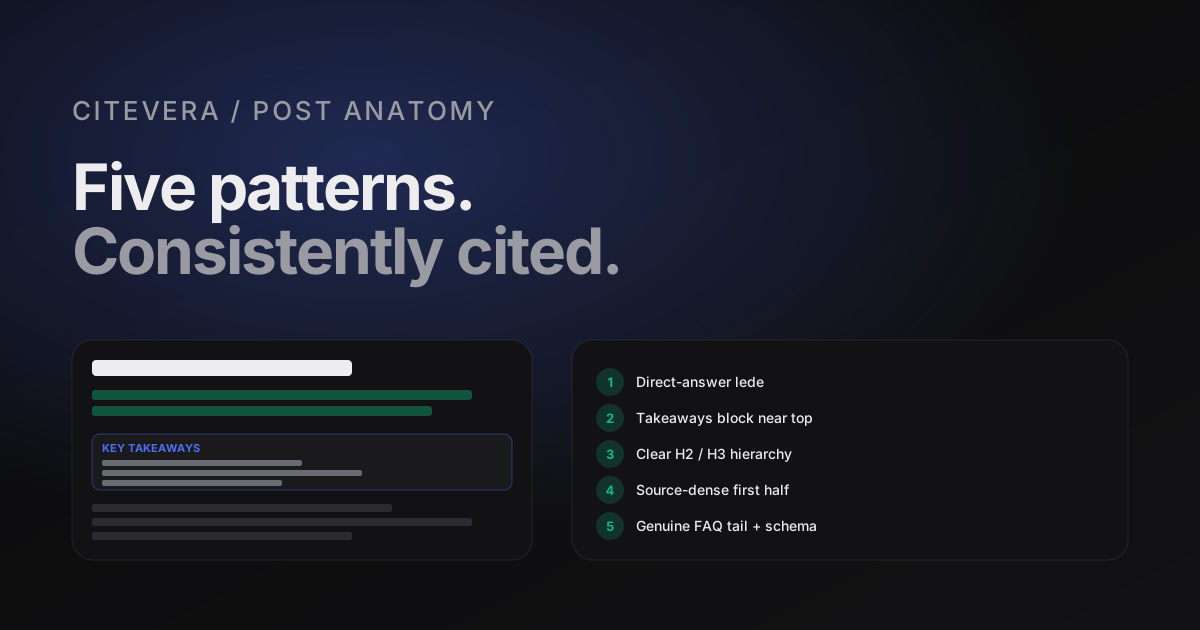
The shape of a winning post
After pulling the top-cited posts from several hundred Citevera audits, the structural patterns repeat enough to write them down. Most posts that get consistently cited by ChatGPT, Perplexity, and AI Overviews look the same in their bones - not because copying each other but because the same formats give engines the right surfaces to lift from.
Five patterns show up in nearly every highly-cited post. If you have three of them, your citation rate is usually fine. If you have all five, you are in the top decile for your topic. If you have fewer than two, the post is probably being ignored regardless of quality.
Pattern 1: the direct-answer lede
The first paragraph answers the title. If the title is a question, paragraph one has the answer in declarative form. If the title is a claim, paragraph one states the claim plus a concrete number or example that grounds it.
This is the highest-leverage pattern because it governs whether the extraction stage even engages with the rest of the post. A lede that buries its point is a post where the engine has to work to decide whether it is relevant. An engine that has to work is an engine that picks a different source.
The failure mode is "throat-clearing": "AI search has become increasingly important in 2026", "Many teams are asking what AEO really means". That opening does not answer anything. Cut it.
Pattern 2: a takeaways block near the top
Not every high-citation post has one, but a clear majority do. The takeaways block is a styled summary - three to six bullet points, each one a quotable claim - that appears either right after the lede or right after a short first section.
Why this works: the engine reads the takeaways as a dense, pre-extracted answer set. It costs the engine less to quote one of these bullets than to synthesize an answer from prose. When the query matches one of the bullets, the bullet gets lifted almost verbatim.
The mechanics of a good takeaways block:
- Three to six items. Fewer reads like a stub; more dilutes.
- One sentence each. If a point needs two sentences, cut it or move it to the body.
- Specific claims, not themes. "Schema lifts citation by 2x" is citable. "Structured data is important" is not.
- Not marketing prose. A bullet that reads like a landing-page sub-hero does not get cited.
Pattern 3: structural hierarchy that a model can parse
Good posts use a predictable H2 / H3 hierarchy. One H1 - the title. Four to ten H2 sections, each with 100 to 400 words of body content. Optional H3 sub-sections within H2 blocks. No skipping levels. No H4 or below unless absolutely necessary.
Why this works: extraction pipelines use headings as scope boundaries. When an engine is looking for "how to add FAQ schema", it wants to find that exact text or close to it in an H2 or H3 near the target paragraph. A post with clear headings makes this trivial. A post where every heading is "Introduction" / "Why this matters" / "Conclusion" has no boundary structure for the engine to latch onto.
The test: if you strip the body and keep only the headings, does the heading outline tell a readable story? If yes, the hierarchy is good. If it reads like a generic essay outline, the hierarchy is too shallow.
Pattern 4: source density in the first half
Pages that link out to three or more credible external sources in the first half of the body consistently outperform pages that do not. The sources do not have to be academic. They have to be specific and attributable: a named study, a published benchmark, a primary-source document, a well-known industry blog.
Why this works: the engine treats outbound links as evidence for claims. A sentence like "average audit completes in 52 seconds" is weak on its own; the same sentence with a footnote to your public benchmark is strong. The engine sees the sentence and the source as a single unit and quotes the sentence knowing the support is there.
The opposite failure - "link-free authority voice" - is common in first drafts. Every claim sounds confident. None of the claims are sourced. In the arbitration between two posts making the same claim, the sourced one wins.
The trap: excessive self-linking in place of external sources. Linking to your own past posts is fine, but the citation lift comes from linking outside your domain. A post where every link is back to your own site reads as a content silo, not as a document backed by evidence.
Pattern 5: an FAQ tail
A genuine FAQ at the bottom - three to six questions a real reader asks after finishing the post, with two-to-four-sentence answers, in a visible heading like ## Frequently asked questions about X - is the final structural pattern.
Why this works: the FAQ questions are typically shorter and more directly phrased than the post's H2 sections. They match the shape of user queries in answer engines. Wrapping them in FAQPage schema - which every highly-cited blog post does - doubles the citation lift because the structured data tells the engine exactly where the answer ends.
The rule from the FAQPage post: the FAQ must be genuine. Keyword-stuffed FAQs hurt more than they help. Think about questions a reader sends in email after reading the post, or questions your sales team hears after a demo. Those are the right FAQs.
A bonus pattern: stable numeric claims
Posts that contain at least one concrete, citable number get quoted more often than posts that speak only in qualitative terms. "Schema markup can improve visibility" is weak. "FAQPage schema increases citation rate by roughly 2x in our 340-page test" is strong. The number is the hook; the engine lifts the sentence around it.
Caveat: the number has to be defensible. If you invent statistics, you might catch short-term citations, but models increasingly cross-check, and citations to debunked claims damage your domain's credibility.
A template you can copy
# Post title that reads like a question or a claim

## The short answer [optional H2]

One-paragraph lede that answers the title directly. Include a specific number
or example to ground the claim.

## Key takeaways

- First claim, one sentence, specific.
- Second claim, one sentence, specific.
- Third claim, one sentence, specific.
- Fourth claim, one sentence, specific.

## First content section

Body prose with at least one outbound link to a credible source. Heading
tells the reader what this section is about.

### Optional sub-section

Further detail in an H3.

## Second content section

More body prose. Linked sources. Specific numbers.

## A concrete example

A named scenario or code block that demonstrates the claim. Helps humans;
also gives the engine something unambiguous to quote.

## Frequently asked questions about [topic]

### First real user question

Two-sentence answer.

### Second real user question

Two-sentence answer.
This is the shape of the post you are reading. It is also the shape of almost every highly-cited post in our audit sample.
Run a free audit to see which of these patterns your top blog posts are missing
How Citevera scores blog posts
The audit grades every blog-category page on the five patterns plus the bonus. Direct-answer lede is the first check; missing it is the most common problem and costs the most points. Schema coverage is next. Source density. FAQ tail. Hierarchy. Each one has a binary pass/fail plus a quality modifier.
A blog post that passes all five typically scores 85 or higher on the AEO axis. One that fails two or more rarely clears 60. The delta between 60 and 85 is usually the difference between "cited once in a while" and "cited consistently". The fixes for each pattern are specific, writable, and shippable in a morning.
Frequently asked questions about blog post structure
Does this template work for tutorials too?
Yes, with one adaptation: replace the key-takeaways block with a numbered prerequisites list, and use HowTo schema instead of (or alongside) BlogPosting. The rest of the structure holds.
How long should a cited blog post be?
Between 1,200 and 2,500 words covers most of the sample. Very short posts lack the surface area to host structure; very long posts add noise at the extraction stage. Let the topic drive length, but do not pad to hit an arbitrary target.
Should every post have exactly five patterns?
Most do. The takeaways block is the one with the highest optionality - technical deep-dives sometimes skip it and still perform well because the body is so dense with specifics that the whole post reads as takeaways. The other four patterns are close to universal.
Does this apply to MDX posts with embedded components?
Yes, with a caveat: any content inside a client-side-only component is invisible to engines. If your takeaways block is rendered by a React component that loads at runtime, move the content to server-rendered HTML or static MDX.