

How B2B Buyers Actually Use AI Search: What the Data Shows
Citation clicks in AI answers are rarer than the hype claims - which raises the stakes on being named at all. How B2B buyers actually use AI search through a purchase decision.
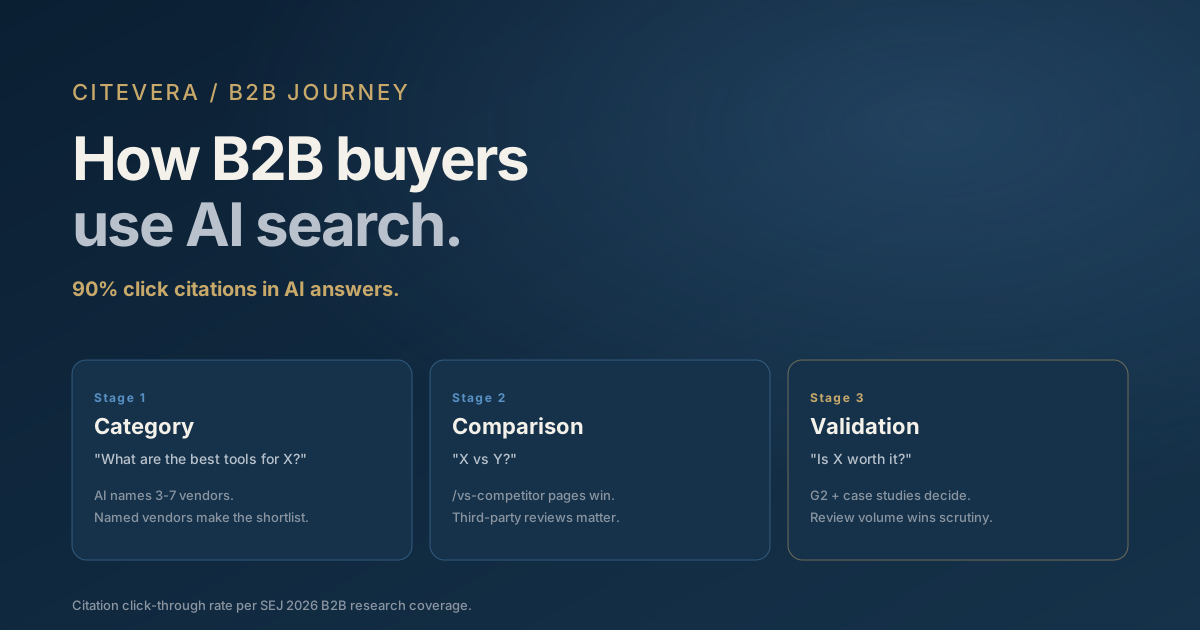
The shift of B2B research from Google to AI chat is one of the fastest behavioral changes in recent B2B marketing history. Every major industry survey in 2025 and 2026 has found that B2B buyers use AI search somewhere in their purchase process, and B2B AI citations increasingly drive which vendors make the shortlist.
This post walks through the three-stage B2B AI search journey and the data that describes each stage. The goal is to help B2B marketers decide where on the journey their content investment matters most.
The headline number on B2B AI citations
A "90% of B2B buyers click citations" figure circulates widely in AEO arguments. Treat it with caution: it is vendor-survey data, and the most independent measurement we have points the other way. Pew Research Center's July 2025 panel of ~900 US adults' actual browsing found that when an AI summary appears, users click any search result just 8% of the time (vs 15% without one) - and only ~1% click sources inside the AI answer itself.
Those two numbers can coexist: Pew measured consumers on general queries; B2B buyers researching a purchase behave differently from someone asking a trivia question. But the honest baseline is that citation clicks are rare, which raises the stakes on the clicks that do happen. Semrush's 10M-keyword analysis (vendor analysis) found AI-search visitors converted at ~4.4x the rate of traditional organic visitors - fewer clicks, further down the funnel.
The practical implication survives either reading: if your brand is not named in the answer or its citation list, you are absent from the summary the buyer anchors on. Being mentioned matters even when the click never comes; the AI answer IS the first touch.
Stage one: category definition
B2B buyers typically open an AI search query with broad category exploration. "What are the top tools for X?" or "How do companies solve Y?" The AI engine returns a summary of the category with 3 to 7 vendors cited as examples.
Data from multiple B2B research studies (Forrester, Gartner, TrustRadius) converges on the same pattern: the vendors that appear in the AI category summary are 3 to 5 times more likely to make the buyer's shortlist than vendors not cited, even when the non-cited vendors objectively match the buyer's requirements better.
The mechanism is anchoring. The AI summary gives the buyer a starting set. Adding a vendor to the list is harder than removing one. If you are not in the initial summary, you fight from behind for the rest of the evaluation.
This is where B2B AI citations do the most commercial work. It is also where the least content investment typically happens because this stage is not about detailed product features; it is about category-level presence.
Stage two: comparison and differentiation
Once the buyer has a shortlist, they use AI search to compare. "What is the difference between Vendor A and Vendor B?" or "Which is better for teams under 50 people?"
The AI engine now cites more specific pages: comparison pages, pricing pages, case studies, independent reviews. The B2B AI citations at this stage are weighted toward third-party sources: G2 reviews, Gartner reports, independent blog comparisons.
Two observations from Citevera's audits:
- Sites with head-to-head comparison pages (/vs-competitor formatted) get cited at stage two significantly more than sites without.
- Sites with explicit third-party review platform presence (G2, Capterra, TrustRadius) get cited at stage two regardless of their own comparison content.
The takeaway: own your comparison narrative. If an AI engine pulls comparison data from a third-party page that misrepresents your product, you cannot easily correct it. If it pulls from your own comparison page, you control the framing.
Stage three: purchase validation
The final stage is purchase validation. "Is Vendor X worth it?" "What are the downsides of Vendor X?" "Who is using Vendor X successfully?"
At stage three, AI engines lean hardest on review platforms, case studies, and social proof. The citations are often to G2 breakdowns, Trustpilot aggregate scores, LinkedIn posts by existing customers, and case study pages on the vendor's own site.
B2B AI citations at stage three are the most defensive in nature. You are not trying to get added to the list; you are trying to survive scrutiny. A vendor with 4.6 stars on G2 and 15 detailed case studies survives AI validation queries better than a vendor with 4.8 stars on G2 and no case studies, because the volume of citable review content determines how much detail the engine can present.
The three stages in tension
One tension worth flagging: the content that wins stage one (broad category-level authority) is different from the content that wins stage three (specific proof points and reviews). Many B2B marketing teams over-invest in one stage and under-invest in the others.
A diagnostic:
- If your site has deep thought-leadership content but weak third-party reviews, you likely win stage one and lose stage three.
- If your site has strong G2 presence but thin editorial content, you likely win stage three and lose stage one.
- The winners across all three stages publish in all three registers: category-level thought leadership, explicit head-to-head comparisons, and third-party validation links.
How to audit your B2B AI citation surface
A practical four-step audit you can run on your own site in 30 minutes.
1. Category-level test. Ask an AI engine a category-level question in your domain. "What are the best tools for X?" Note which vendors are cited. If you are not cited, your stage one is failing. 2. Comparison test. Ask "What is the difference between my product and competitor product?" See which sources are cited. If the cited source is a third-party page that mispositions you, or if only your competitor is cited, your stage two is failing. 3. Validation test. Ask "Is my product worth it?" or "What are the downsides of my product?" The AI will cite reviews and case studies. If the cited sources are weak or your product gets a negative read, your stage three needs reinforcement. 4. Competitor test. Run the same three tests on your top three competitors. The gaps you see are the commercial cost of your current B2B AI citation surface.
What to optimize for each stage
Matching content to stage:
- Stage one: publish broad thought leadership with clear entity alignment. Organization JSON-LD with complete sameAs linking is the table stakes.
- Stage two: ship explicit comparison pages for your top 3 competitors. Pattern: /vs-[competitor] with a clear framework. These pages get cited in comparison queries because they contain the exact information the AI engine is trying to summarize.
- Stage three: invest in third-party review presence and case studies. G2, Capterra, Trustpilot, or industry-specific platforms plus 5 to 10 detailed customer case studies on your own site.
Key takeaways
- The AI answer is the new top of the funnel: citation clicks are rare (~1% per Pew), so being NAMED in the answer is the prize; the few clicks that come convert at ~4.4x organic (Semrush, vendor analysis).
- The B2B AI search journey has three stages: category definition, comparison, and purchase validation.
- Category winners are cited in broad "what are the best X" queries; comparison winners own their /vs-competitor narrative; validation winners have deep review and case study presence.
- Most B2B marketing teams over-invest in one stage and under-invest in the others.
- A 30-minute diagnostic against your top 3 competitors tells you which stage is weakest on your site.
What to do next
Run a free audit at scan.citevera.com to see which signals on your site are passing for AI citation readiness across all three stages. The report scores entity alignment, comparison content, and review-platform presence.
For B2B sites with mature SEO stacks looking to layer GEO on top, the generative engine optimization guide covers the cross-engine stack. For the full funnel view, see the AEO complete playbook.