

Answer Engine Optimization 2026: The Complete Playbook
Answer engine optimization 2026 is a five-stage discipline of making your site citable by ChatGPT, Claude, Perplexity, and Google AI Overviews. Here is the complete playbook.
Most marketing teams still think of AI search as a 2027 problem. It is not. Pew Research Center measured real user behavior in July 2025: when an AI summary appears, users click a search result 8% of the time versus 15% without one. And in February 2026, Duda analyzed 858,457 sites (a single-platform, correlational dataset) and found that sites allowing AI crawling averaged 527.7 sessions per month, against 164.9 on sites that did not - a 3.2x gap.
Answer engine optimization 2026 is the discipline of closing that gap. This playbook covers the five stages that determine whether your site shows up in an AI answer, the signals each stage depends on, and the order you should fix them in.
What answer engine optimization actually is
Answer engine optimization (AEO) is the practice of structuring a website so AI answer engines will cite it when summarizing an answer for a user. The practice is separate from classic SEO. Classic SEO optimizes for ranking in a list of blue links. AEO optimizes for being quoted as a source inside an AI-generated answer.
The two disciplines share infrastructure: crawlability, schema markup, site speed, freshness. They diverge on intent. A great SEO page can lose in AEO if it is written as a long, flowing essay that buries the specific answer a model would extract. A modest SEO page that opens with a clear, extractable answer can outperform it.
The 2026 version of AEO has five named stages, each of which must function for the next one to matter. Skipping a stage is the most common reason a site with great content fails to show up in AI answers.
The five stages of AEO in 2026
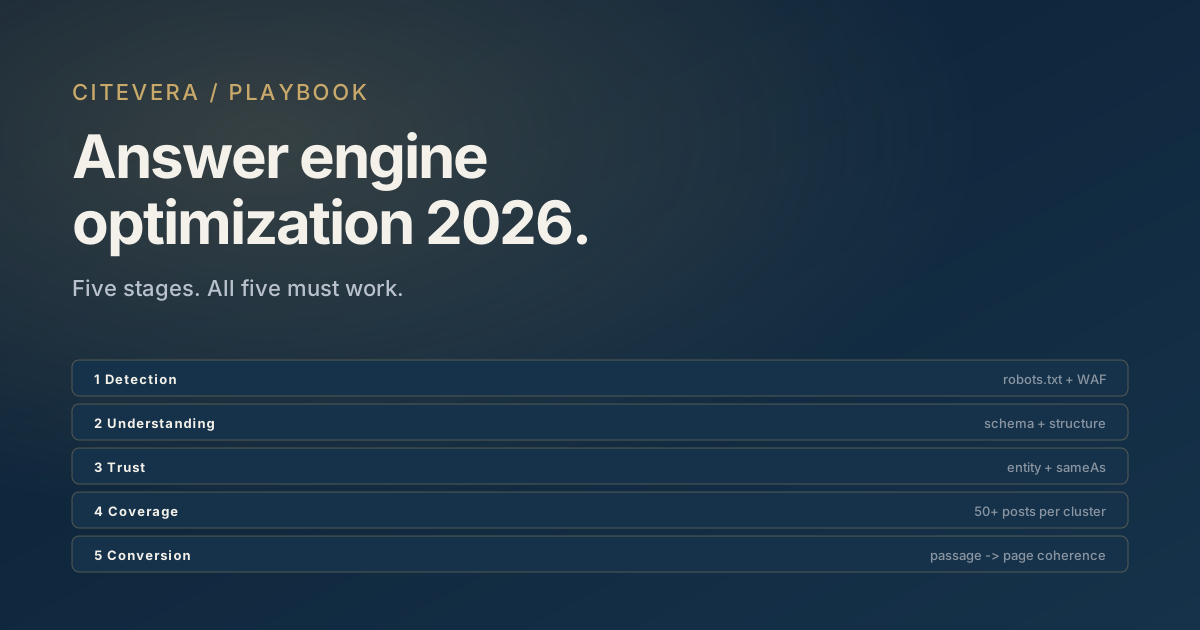
Every audit in answer engine optimization 2026 should work through five stages in order. Think of them as a funnel. If any stage fails, every stage below it is wasted effort.
1. Detection. Can AI crawlers reach your pages at all? This is the access layer. GPTBot, ClaudeBot, PerplexityBot, and Google-Extended each have distinct rules in robots.txt. WAFs and CDNs often block unknown user agents by default. 2. Understanding. Once fetched, can the model parse your page? Schema markup, heading hierarchy, paragraph structure, and semantic HTML all determine whether the model can extract meaning. 3. Trust. Does the model have reasons to cite you specifically? Entity alignment through Organization schema, sameAs links, authoritative backlinks, and review platform presence all contribute. 4. Coverage. Do you have content on the specific topics buyers are asking about? Depth matters. Sites with 50 or more blog posts average 33x more AI crawler visits than sites with no blog (Duda, 2026). 5. Conversion. Once cited, does the click convert? Landing page coherence, CTA placement, and the match between cited passage and page content determine whether AI-referred traffic becomes revenue.
We break down each stage in the hybrid AI search funnel framework, which maps this model onto Citevera's audit.
Stage one: detection
Detection is the most common failure point. A recent Duda analysis showed 41% of sites received zero AI crawler visits in February 2026. Most of those sites had not explicitly blocked AI crawlers; they had failed to explicitly allow them, and their WAFs or CDNs did the rest.
The fix for detection has three parts:
- Explicit allow rules for GPTBot, OAI-SearchBot, ChatGPT-User, ClaudeBot, PerplexityBot, Google-Extended, and Applebot-Extended in robots.txt.
- Allowlist rules for those user agents at the WAF layer (Cloudflare, AWS WAF, similar).
- Verification that the access rules work by checking server logs for each crawler within 48 hours of the change.
Our 2026 AI crawler user-agent reference covers the exact robots.txt block, the WAF rules, and the three configuration mistakes that make sites think they have allowed crawlers when they have not.
Stage two: understanding
Once crawlers can fetch your pages, the next question is whether the model can extract structured meaning. Three signals drive this.
Heading hierarchy. One H1 per page, H2s that correspond to extractable sub-topics, H3s for details. Models use headings as the skeleton when breaking a page into citable fragments. A page with a single H1 and twenty paragraphs is harder to parse than a page with an H1, six H2s, and clear paragraphs under each.
Schema markup. JSON-LD for Organization, Article, FAQPage, HowTo, Product, and Review types gives the model a structured view of your content that complements the free-text extraction. Sites with comprehensive schema get cited more often in answer-engine results.
Paragraph shape. Short paragraphs (one to three sentences) are easier to extract as standalone fragments than long, flowing prose. AI citation is fragment-level, not document-level. A great sentence buried in a 400-word paragraph may never be pulled.
Stage three: trust
Trust is the stage where most marketing teams stop investing. The model can read your page; will it cite yours specifically over a competitor's? Three entity signals answer that question.
Organization schema with sameAs. Your homepage should publish an Organization JSON-LD block naming your company and linking via sameAs to your LinkedIn, Crunchbase, Wikidata, and Google Business Profile listings. This is how the model confirms you are a real entity with a verifiable identity graph.
Third-party review platform presence. Sites with review-platform integrations averaged 89.8% crawl rate in the Duda study, versus a lower baseline. Listings on G2, Capterra, Trustpilot, Clutch, or industry-specific platforms matter because the model treats them as independent confirmation.
Authoritative backlinks. Standard SEO territory, but the AEO implication is different: backlinks from recognized industry publications improve your entity score and raise your citation likelihood in adjacent queries.
Stage four: coverage
Coverage is about breadth. A site with five excellent posts on a topic loses to a site with 50 adequate posts on the same topic, because the 50-post site has more extraction surface. The model chooses from the fragments available. More fragments means more chances to be chosen.
The coverage stage is also where most sites underinvest. It is editorial work, not technical work, and it is slower to execute than a schema deployment. But the 33x content depth effect from the Duda study is the single largest multiplier in the dataset.
Coverage depth is not just post count. It is topical clustering: multiple posts on the same theme, interlinked, each answering a slightly different question. This is where traditional SEO topic-cluster architecture and AEO converge.
Stage five: conversion
Getting cited is necessary but not sufficient. The click from an AI answer has to convert. Two factors decide whether it does.
Landing page coherence. If a user arrives from an AI answer that cited a specific passage on your page, the page should deliver on that passage's promise. If the passage said "Citevera audits AI search readiness in 1-3 minutes for most sites" and the landing page buries that claim under three fold-deep sections, the user bounces.
CTA placement and clarity. AI-referred traffic is already informed. They have seen a summary. They need a clear next step. Vague CTAs like "Learn more" lose to specific ones like "Run a free audit" or "See pricing."
Citevera's audit scores the full funnel, from detection through conversion, with specific fixes per stage.
Key takeaways
- Answer engine optimization 2026 is a five-stage funnel: detection, understanding, trust, coverage, conversion. All five must work.
- Detection is the most common failure. 41% of sites receive zero AI crawler visits. Fix robots.txt and WAF rules first.
- Understanding depends on heading hierarchy, schema markup, and paragraph shape. Short paragraphs are more citable than long ones.
- Trust depends on Organization schema with sameAs, review platform presence, and authoritative backlinks.
- Coverage depth matters more than per-post quality. Sites with 50+ blog posts get 33x more AI crawler visits than sites with none.
What to do next
Run a free audit at scan.citevera.com to see where your site ranks across all five stages. The report surfaces detection-layer blockers first, then moves through understanding, trust, coverage, and conversion with ranked fixes.
If you are on WordPress, the Citevera WordPress plugin auto-applies most technical fixes in-admin. For agencies managing multiple client sites, the agency tier runs bulk rescans and white-label reports.