

Great Content Is No Longer Enough. Here's What Beats It in AI Search.
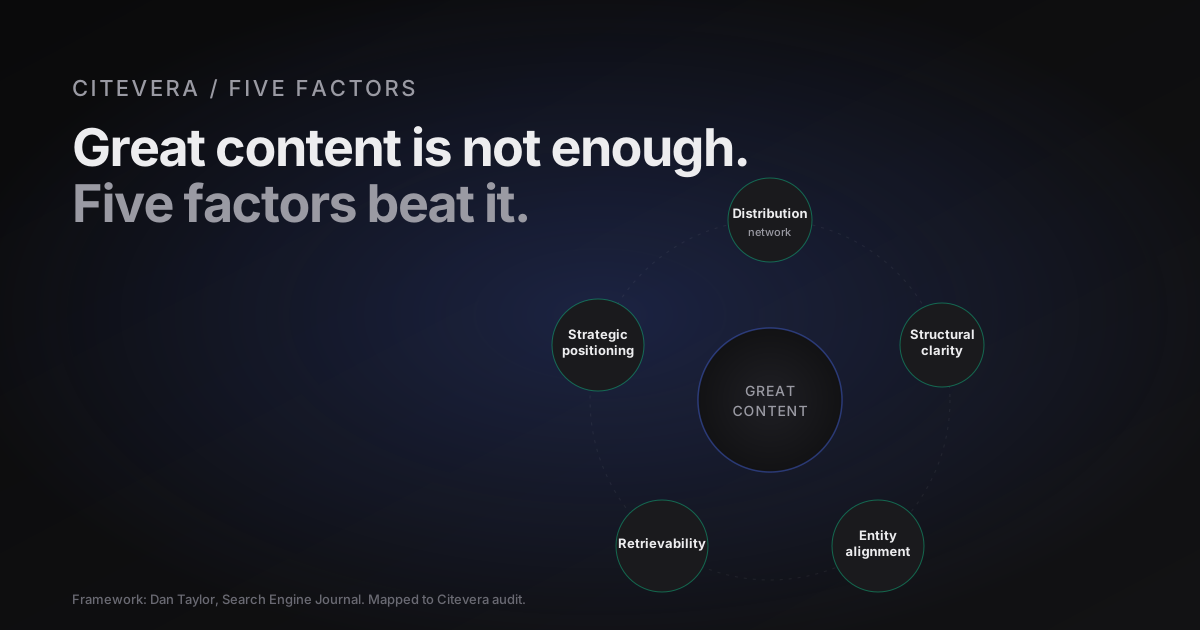
Exceptional content can still lose in AI search if it sits in isolation. The five factors that beat great content - distribution, structural clarity, entity alignment, retrievability, and strategic positioning - mapped to a live audit framework.
The quiet assumption that no longer holds
For twenty years the operating assumption behind content marketing was that quality eventually wins. Write the best piece on the topic, invest in it, and the rest - ranking, backlinks, trust, conversion - follows.
That assumption is breaking down. In a recent Search Engine Journal piece, Dan Taylor put it bluntly: "It is entirely possible to produce an exceptional piece of content and still underperform if it exists in isolation." The quality stopped being the constraint. The constraint moved.
The data says the same thing. Top results on queries that trigger AI Overviews are losing 32% of their clicks. Ninety percent of B2B buyers click citations inside AI-generated answers rather than clicking through to organic results. The reader is no longer arriving at your article; the model is. And the model selects for different things than a human reader does.
This post takes Taylor's five-factor framework, connects it to the data, and maps each factor to a concrete audit you can run on your own site today.
Two shifts in how answers get made
Before the factors, it helps to name the underlying shifts.
From authorship to retrieval. A traditional article is consumed top-to-bottom. An AI answer is assembled from fragments. What gets cited is a specific sentence or short passage the model could extract, verify, and attribute. The rest of your 2,000-word piece is not read; it is filtered.
From traffic to citations. Ranking in Google used to produce clicks. Now ranking in Google increasingly produces an AI Overview that summarizes you without sending the click. The 32% CTR drop measured across affected queries is not a prediction; it is observed behavior. The value has shifted from being read to being cited, because being cited is what registers as authority in the AI-native distribution layer.
If you accept those two shifts, the five factors below stop looking like a checklist and start looking like the real job.
Five factors that beat great content
Taylor's argument is that in AI search, these five beat quality on its own. Not because quality stopped mattering, but because these factors decide whether your quality ever gets seen.
1. Distribution network
The model chooses from what it can reach. Sites that are linked, quoted, cross-referenced, and syndicated across the open web enter the candidate pool for more queries than sites that sit alone. The Duda study of 858,457 sites (a single-platform, correlational dataset) found that sites with review integrations and external listing presence hit an 89.8% AI crawler rate versus a far lower baseline, and averaged 376.9 crawler visits. Distribution is not just a backlinks play anymore; it is a prerequisite for appearing at all.
Audit dimensions: backlink diversity, third-party review platforms, Google Business Profile sync, Wikidata or Crunchbase entity links, syndication of flagship content.
2. Structural clarity
Models prefer content that is easy to parse. Clean heading hierarchy, short paragraphs, explicit question-and-answer patterns, lists where lists belong. The shape signals extractability before the words are read. Long flowing marketing prose trained a generation of writers to value voice over structure; the citation layer rewards the opposite.
Audit dimensions: H1/H2/H3 hierarchy discipline, paragraph length distribution, presence of explicit Q and A patterns, FAQ schema, HowTo schema where relevant.
3. Entity alignment
A model that can confidently identify you as an entity - your company, your author, your product - cites you with higher confidence. Alignment means your Organization schema, Person schema, sameAs links, and the external graph (LinkedIn, Wikidata, G2, Crunchbase, Clutch, your listings) all agree on who you are. When any of those disagree, the model's confidence drops and your citation rate with it. The Duda data shows 92.8% crawl rate for sites with Google Business Profile sync versus 58.9% without. That is a structural entity signal doing work.
Audit dimensions: Organization schema presence and completeness, sameAs coverage, author schema, consistent NAP (name / address / phone), listing parity across review platforms.
4. Retrievability
Retrievability is about the individual fragment. Can a two-sentence excerpt stand on its own as an answer? Does it have a self-contained fact, a numeric value, a defined term? Is it quotable without surrounding context? Retrievability is the difference between "this site has great content on X" and "this site has a citeable passage on X". Only the second produces citations.
Audit dimensions: passage-level extractability analysis, numerical claim density, named entity density, presence of definitions and explicit answers near headings, content freshness (models prefer recent dates).
5. Strategic positioning
Strategic positioning is the unsexy one: are you writing on the specific topics where citation demand exists? Models tend to cite sources that have built topical depth on a subject, not sources that have one good page. A site with fifty articles on a theme signals commitment; a site with one signals opportunism. The Duda finding that sites with 50 or more blog posts get 33x more AI crawler visits than sites with none is the numeric face of this.
Audit dimensions: topical cluster depth, internal linking density inside clusters, content recency inside clusters, gap analysis against the queries your buyers are asking.
Map the five factors to an audit
Citevera's audit is organized around a five-stage funnel: Detection, Understanding, Trust, Coverage, Conversion. Each of Taylor's factors corresponds to one or two stages.
- Detection: can AI crawlers reach your pages at all? This is the access layer - robots.txt, WAF rules, rendering. Detection is the prerequisite to every one of Taylor's factors. If GPTBot cannot fetch the page, distribution and retrievability are moot.
- Understanding: does your markup make the page parseable? This is structural clarity plus part of entity alignment. Schema, heading hierarchy, FAQ blocks, Organization markup.
- Trust: does the model have reasons to stand behind you? This is the rest of entity alignment plus distribution. External listings, reviews, sameAs coverage, authority signals.
- Coverage: are you present on the specific topics being asked? This is strategic positioning and retrievability at the cluster level. Content depth, cluster coverage, internal linking.
- Conversion: once cited, does the click convert? This is CTA placement, landing-page coherence, and whether the cited passage actually matches the promise of the page.
The audit you should run on your own site is not five separate audits. It is one funnel with leakage at each stage.
Specific audit items
A concrete list of items an audit should produce for each of Taylor's five factors. These map roughly to what Citevera scans generate, though the principle is the same regardless of tool.
Distribution: third-party review platforms detected, Google Business Profile synced, Wikidata entry present, external backlinks from high-authority domains, syndication of cornerstone content, presence on industry listings.
Structural clarity: heading hierarchy respected, paragraph length within readable range, FAQ schema on pages with question-shaped queries, HowTo schema on procedural content, explicit answer within the first 150 words of each article.
Entity alignment: Organization JSON-LD present, sameAs list covers LinkedIn, Crunchbase, Wikidata, GBP, and G2, Person schema for named authors, consistent business name and address across all external listings.
Retrievability: passage-level extractability score, named-entity density above threshold, numeric claim density above threshold, definitions and explicit answers placed near their headings, datePublished and dateModified fresh.
Strategic positioning: topical clusters identified, cluster depth minimum met, internal linking within cluster, recency of content within cluster, gap against the twenty questions your ICP is actually asking AI models.
What "exceptional in isolation" actually costs
Return to Taylor's line: "It is entirely possible to produce an exceptional piece of content and still underperform if it exists in isolation." The cost of isolation is quantifiable once you connect the dots.
A site with 10 exceptional posts on a topic but no entity graph, no distribution, no cluster depth, and no structural clarity will see lower AI crawler coverage, lower citation rate, lower referral traffic, and lower conversion. In the Duda numbers, that profile corresponds to the sites averaging 164.9 sessions versus 527.7 for sites with the full picture - a 3.2x traffic gap - plus a 2.7x gap in form completions, and a long-tail drop in citation share that is harder to measure but consistent across the sites we audit.
Exceptional content with none of the five factors still wins the read-out-loud award. It does not win the citation.
The practical move
If you have read this far, the practical move is not "write better content". It is to run a diagnostic on the five factors and fix the two or three that are worst on your site. Most of the sites we scan at Citevera fail on entity alignment and strategic positioning, not on content quality. The fix is usually a few hours of schema work, a cluster audit against the queries buyers ask, and deciding which three external listings to build out.
If you want the specific failure list for your own domain, run the scan below. It covers all five factors with a graded fix list.
See which of these five factors your site is missing.
For the ranking-side detail on one of the five, the GPTBot access layer, see Why 81% of your AI traffic comes from ChatGPT. For the structural clarity layer, see the anatomy of a cited blog post.
Frequently asked questions
Is this just GEO rebranded?
Partly. Generative Engine Optimization (GEO) and Answer Engine Optimization (AEO) are terms of art for the same underlying problem Taylor names. The value of Taylor's framing is that it is not tool-focused; it names five factors that any audit needs to cover, regardless of which acronym you prefer.
Do I still need traditional SEO?
Yes. Traditional SEO and AI-search optimization share a large overlap - crawlability, schema, internal linking, freshness, authority. The delta is that AI search amplifies structural clarity and entity alignment specifically, because extraction and entity resolution are what the model does at query time.
Which factor matters most?
For most sites we audit, the two with the highest marginal return are entity alignment and strategic positioning. Distribution, structural clarity, and retrievability tend to improve as a byproduct of the first two being done well.
Credit
This article builds on Dan Taylor's piece in Search Engine Journal on why great content is not enough. His framework gave the structure of the five factors. All errors in extension or application are ours, not his.