

AEO vs Traditional SEO: What Actually Changes for Your Strategy
AEO vs traditional SEO is not either/or. Here is what each discipline optimizes for, where they overlap, and how to sequence the work without duplicating effort.
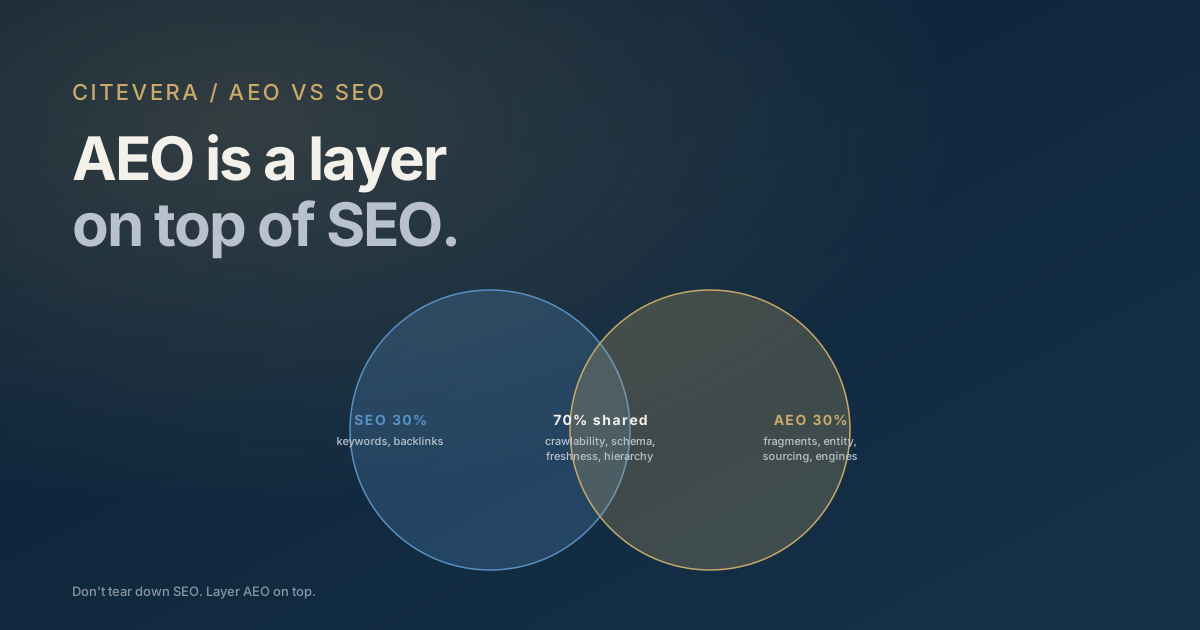
AEO vs traditional SEO is the question that shows up on every B2B marketing roadmap in 2026. Answer engine optimization is getting budget that used to go to SEO. Teams are worrying they need to tear down their SEO stack and rebuild for AI. That is usually wrong.
This post covers what AEO vs traditional SEO actually differ on, where they overlap, and how to sequence the work so you get compounding returns instead of duplicated effort. The short version: AEO is a layer on top of SEO, not a replacement, and most sites can add it for 20% more effort on top of a working SEO program.
What traditional SEO optimizes for
SEO optimizes pages to rank in a list of blue links. The target is the Google (or Bing, or DuckDuckGo) SERP. Ranking well produces clicks. Clicks produce traffic. Traffic converts.
The SEO tech stack in 2026 is mature:
- Keyword research (Ahrefs, Semrush, Moz)
- On-page optimization (titles, metas, H1, internal linking)
- Core Web Vitals and page experience
- Backlink acquisition
- Schema markup for rich results
- Technical crawlability (sitemaps, robots.txt for Googlebot)
- E-E-A-T signals (author profiles, authority indicators)
A site that does all of the above well ranks. The feedback loop is clear: Search Console shows impressions, clicks, and ranking positions. You know if you are winning.
What AEO optimizes for
AEO optimizes content to be cited as a source in AI-generated answers. The target is the AI answer pane in ChatGPT, Claude, Perplexity, or Google AI Overviews. Being cited produces a click only sometimes: Pew's July 2025 panel found only ~1% of users click sources inside an AI answer. The value of the citation is mostly the mention itself - the answer names you either way - plus the quality of the clicks that do arrive: Semrush's analysis (vendor data) found AI-search visitors converted at ~4.4x the rate of traditional organic visitors.
The AEO stack in 2026:
- AI crawler access (robots.txt + WAF allows for GPTBot, ClaudeBot, PerplexityBot, Google-Extended, Applebot-Extended)
- Entity alignment (Organization JSON-LD with sameAs)
- Extractable content structure (short paragraphs, clear headings, FAQ schema)
- Content depth (50+ posts in a topic cluster)
- Inline source attribution (showing your work to match AI engine preferences)
- Citation tracking and measurement
A site that does the AEO stack well gets cited. But the feedback loop is harder than SEO's because AI engines do not publish citation analytics. Measurement is the per-metric triangulation we covered in detail.
Where AEO vs traditional SEO overlap
The overlap is significant. Most of the AEO stack is built on top of the SEO stack.
- Crawlability. Both disciplines require reachable pages. The AEO twist is additional user agents to allow (GPTBot, ClaudeBot, etc.).
- Schema markup. SEO uses schema for rich results (star ratings, FAQ expanders, HowTo). AEO uses the same schema plus Organization with sameAs for entity resolution. Overlap at the type level.
- Heading hierarchy. Both disciplines reward one H1 and clear H2 structure. SEO wants it for content parsing; AEO wants it for fragment extractability.
- Freshness. Both disciplines reward datePublished and dateModified signals.
- Backlinks and entity authority. Both disciplines reward external citations from authoritative sources.
Roughly 70% of a well-executed SEO program is also AEO. If you already have strong SEO, much of the AEO investment is marginal additional work, not a rebuild.
Where AEO vs traditional SEO diverge
The 30% that differs is where most of the confusion lives. Four specific divergences matter.
Fragment vs document optimization
SEO ranks documents. AEO extracts fragments. A long, flowing SEO article that buries the answer under 800 words of introduction can still rank well. That same article loses in AEO because the model cannot extract a clean citable passage.
The practical implication: AEO wants short paragraphs with self-contained claims. A 2,500-word SEO essay can score high on SEO metrics and poorly on AEO metrics if every paragraph is four sentences and every sentence depends on the previous.
Authorship vs retrieval
SEO rewards authoritative authors with strong personal brands. AEO rewards pages that are easy to retrieve as fragments, regardless of author. A mid-tier author with clean structure beats a star author with a dense essay in AEO.
This does not mean ignore authors; it means that the author's presence on its own does not protect poorly structured content in AEO the way it sometimes does in SEO.
Traffic vs citation
SEO measures success in clicks. AEO measures success in citations and (eventually) clicks from citations. The distinction matters because the AI summary often answers the user's question without requiring a click. Click-through rates from AI answers run 10 to 30% typically, versus 40 to 60% for top-ranked Google results.
Engine-specific preferences
Classic SEO targets Google with modest variations for Bing. AEO targets four engines with distinct preferences: ChatGPT, Claude, Perplexity, Gemini. The cross-engine comparison covers the specific differences.
How to sequence AEO vs traditional SEO work
If you are running both programs in parallel, three sequencing rules save effort.
Rule 1: fix crawlability once, for both. When updating robots.txt for AEO crawlers, audit Googlebot rules at the same time. Same for WAF. One pass covers both disciplines.
Rule 2: schema serves both. Organization, Article, FAQPage, Product, Review, HowTo schema all benefit both SEO rich results and AEO entity resolution. Deploy once, reap both benefits. Our schema markup for AI search priorities covers the order.
Rule 3: content briefs should cover both. When writing a new post, design it for both fragment extraction (short paragraphs, attributed stats) and document ranking (target keyword, internal links, backlinks). The two goals are compatible when you plan for them from the start. Retrofitting later is more expensive.
What to deprioritize in AEO vs traditional SEO
A few SEO practices do not translate well to AEO and should not be forced.
Keyword stuffing. Already a bad SEO practice in 2026; worse in AEO because models penalize unnatural repetition more aggressively than Google does.
Thin comparison pages. SEO sometimes rewards thin "X vs Y" pages for long-tail queries. AEO wants substantive comparison content with explicit differentiation; thin comparisons get ignored.
Exact-match domains or anchor text. Neither matters in AEO. The engine resolves entities, not URL strings.
Pure keyword density targets. SEO tools sometimes recommend specific density percentages. AEO cares about whether the content reads naturally, not about density.
A practical 90-day AEO layer on top of SEO
If you have a working SEO program and want to layer AEO in 90 days:
- Week 1: Audit AEO crawler access. Update robots.txt and WAF.
- Week 2-3: Deploy Organization schema with complete sameAs. Audit existing schema for AEO-relevant types.
- Week 4-6: Restructure your top 20 pages for paragraph extractability. Add FAQ schema where the pages genuinely have FAQs.
- Week 7-9: Build out topical depth on your top three topic clusters. Target 50+ posts in each over the next two quarters.
- Week 10-12: Implement AEO measurement. Set up referral tracking, citation tracking, and monthly manual query tests.
This layers AEO on top of SEO without tearing down the SEO program. Most teams can run the layer with one additional half-time person for the 90 days, returning to normal capacity after.
Key takeaways
- AEO vs traditional SEO is not either/or; AEO is a layer on top of SEO.
- Roughly 70% of the SEO stack carries over; the remaining 30% addresses AI-specific divergences.
- Fragment extractability, inline sourcing, and cross-engine tuning are the biggest divergences.
- Crawlability, schema, and content briefs can serve both disciplines when designed that way from the start.
- A 90-day layer is realistic for most sites with a working SEO program.
What to do next
Run a free audit at scan.citevera.com to see where your existing SEO investment translates to AEO and where the gaps are. The report maps SEO-strong signals to AEO-readiness scores, so you can see the delta.
For teams weighing whether to reshape their SEO budget, the cost of AI search invisibility calculates the commercial case.