

The 33x Content Rule in AI Search: A Publishing Cadence Playbook
The 33x content rule AI search threshold requires 50+ posts in a topic cluster. Here is the publishing cadence that gets you there in 12 months.
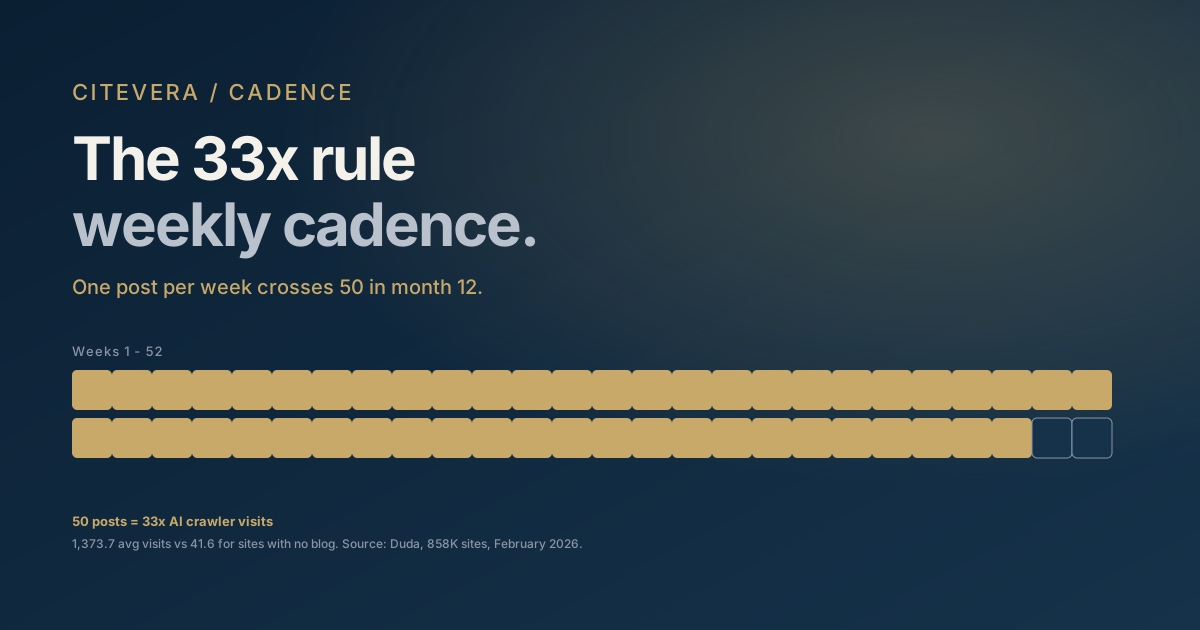
The 33x content rule AI search finding is the single largest association in the Duda study (a single-platform, correlational dataset): sites with 50+ blog posts averaged 1,373.7 AI crawler visits per month versus 41.6 for sites with no blog. A 33x multiplier. Most teams read that finding, nod, and then fail to actually reach 50 posts because they have no publishing cadence.
This post is a publishing cadence playbook. It covers how to reach the 50-post threshold per topic cluster in 12 months, how to scale the editorial operation without burning out, and how to validate each post against AI extractability standards as you write.
The 50-post threshold is per cluster, not per site
The 33x content rule AI search finding measured sites with 50+ blog posts in total. In practice, the compounding effect comes from topical clusters: 50 posts on one theme beat 50 posts scattered across 10 themes.
Why: AI engines assign topical authority to entities within topics. A site with 50 posts on "AI search optimization" builds authority for that topic. A site with 50 posts spanning unrelated topics builds weak authority in each.
Per cluster, not per site, is the right mental model. If you have three topic clusters, the goal is 50 posts each, 150 total. If you have one core topic, the goal is 50 posts in it.
Our content depth in AI search covers the underlying mechanics.
The weekly cadence math
At one post per week per cluster, 50 posts takes 50 weeks. Round to 12 months. This is the most common cadence for teams committing to the 33x content rule AI search investment.
The math:
- 1 post per week = 52 posts per year = threshold crossed in month 12
- 2 posts per week = 104 posts per year = threshold crossed in month 6
- 4 posts per week = 208 posts per year = threshold crossed in month 3
Most teams overestimate how fast they can sustain a 2x cadence. The weekly cadence is the realistic default. If you want to hit 50 faster, either expand the editorial team or accept quality compromises.
What "one post per week" actually takes
Running a weekly publishing cadence without breaking requires specific operational discipline. Three inputs matter.
Editorial capacity. One post per week per cluster at ~1,500 words each is 6,000 words per month. A full-time content lead can sustain this plus strategy and review. A freelance writer can deliver the drafts if the lead focuses on briefs and review.
Topic pipeline. Running out of topics is the most common failure mode. Maintain a rolling backlog of 20 to 30 briefed topics at all times. Stop accepting new topic suggestions until the backlog drops below 20.
Review process. A one-person-writing-and-publishing operation has no quality floor. Add a second set of eyes (editorial lead, subject-matter expert, or AI-assisted review) before publish.
Without all three, weekly cadence fails within 8 to 12 weeks.
Topic selection for the 33x content rule
Not all topics are equal under the 33x content rule AI search framework. Three criteria separate topics that compound from topics that do not.
1. Buyer-query alignment
The topic has to match what buyers actually type into AI engines. "Best tools for X" and "how to solve Y" queries produce 3 to 5x the citation rate of "10 tips for Z" style thought-leadership posts.
Run a sample of 20 queries your buyers would ask. Align your cluster to answering those queries specifically.
2. Differentiation from existing coverage
If 200 other sites have already written 50 posts each on the same topic, your 50 posts compete against existing authority. Either pick a specific angle (vertical-specific, audience-specific, depth-specific) or accept slower citation growth.
Our how B2B buyers actually use AI search post covers the category-definition, comparison, and purchase-validation stages where topical coverage matters most.
3. Depth the writer can sustain
Pick a topic the writer genuinely knows. 50 mediocre posts on a topic the writer is faking beat a competitor only on quantity, and AI engines increasingly penalize shallow content. Pick topics where the writer has real expertise or access to experts.
A weekly content operation template
A four-stage workflow that scales.
- Monday: brief. Editorial lead briefs the week's post. Title, target query, outline, 3 internal links, 1 outbound citation requirement.
- Tuesday-Wednesday: draft. Writer produces the post following the brief. Target 1,200 to 1,800 words.
- Thursday: review. Editorial lead reviews. Check for AI extractability: short paragraphs, clear H2s, attributed claims, FAQ if applicable.
- Friday: publish + promote. Post goes live. Social share, newsletter inclusion, internal linking updates to earlier posts in the cluster.
Four days of asynchronous work per post, one day of overhead. One writer can sustain this for one cluster. Two writers sustain two clusters.
Validation per post
Every post should pass a five-check quality gate before publishing, not just against standard SEO but against the 33x content rule AI search framework specifically.
1. Primary keyword in title and first 100 words. Standard SEO plus AI extractability. 2. 5 to 8 H2 headings. Structural clarity for fragment extraction. 3. Paragraph length below 3 sentences each. Extractability. 4. At least 3 internal links + 1 outbound citation. Entity graph and source attribution. 5. Key takeaways + What to do next sections. Summary and CTA for AI-referred traffic.
A post that fails any check gets sent back to revision. Five checks, every post, no exceptions. The consistency compounds: 50 posts all passing the same quality gate produces the topical authority that drives the 33x effect.
Measuring cadence performance
Track four metrics monthly.
- Posts published per cluster. Target 4 per month, 50 per year.
- Draft backlog count. Target 20+ briefed topics at all times.
- Review pass rate. Percentage of drafts passing review on first submission. Target 70%+. Lower means briefs need improvement.
- Cluster post count progression. Running total per cluster. Crossing the 50 threshold is the milestone.
Dashboards matter less than discipline. A simple Airtable or Notion tracking of the four metrics is sufficient.
When to add a second cluster
Most teams should commit to one cluster reaching 50 posts before expanding to a second. Premature cluster expansion dilutes editorial capacity and pushes both clusters to slower-than-weekly cadence.
A practical trigger: add the second cluster when the first reaches 30 posts, not when it reaches 10. By 30, the cadence is proven and the team has operational muscle for adding without breaking the first.
Common 33x cadence failures
Four patterns show up when cadence breaks.
1. Weekly becomes fortnightly becomes monthly. Slippage compounds. Fix by making Friday publish an immovable deadline, not a goal. 2. Topic exhaustion. The writer runs out of ideas. Fix by maintaining a 20+ backlog and sourcing topics from support tickets, sales conversations, and AI engine query samples. 3. Quality drops under pressure. Every post is 1,500 words but 500 of those words are filler. Fix by enforcing the five-check quality gate ruthlessly. 4. Clusters get abandoned mid-way. Team ships 15 posts in a cluster, then moves on to something new. Fix by committing to 50 before starting a new cluster, in writing.
Key takeaways
- The 33x content rule AI search finding applies per topic cluster, not per site.
- Weekly cadence crosses the 50-post threshold in 12 months. Anything slower dilutes the compounding effect.
- Sustainable cadence requires editorial capacity, a 20+ topic backlog, and a consistent review process.
- Topic selection matters: buyer-query alignment, differentiation, and genuine expertise.
- Validate every post against a five-check quality gate before publish.
What to do next
Run a free audit at scan.citevera.com to see your current content depth bucket and how many posts you need to reach the 50-post threshold.
For the commercial case behind content depth investment, see the cost of AI search invisibility. For the anatomy of individual posts that get cited, the anatomy of a cited blog post.