

AI Search for Marketing Agencies: A Service-Line Opportunity
AI search for agencies is a 2026 service-line opportunity. Here is how to productize AEO audits, price them, and scale across client portfolios.
For marketing agencies, 2026 is the year AI search for agencies goes from a research topic to a packaged service. Clients are asking about AI search visibility; agencies that can answer with a repeatable offer are winning retainer upsells. Agencies that cannot are losing relevance as content strategy shifts toward AEO.
This post covers how to productize AI search for agencies into a service line: what the offer looks like, how to price it, and how to scale delivery across a client portfolio. The patterns here come from agencies already running AEO services successfully in 2026.
Why AI search is an agency-shaped opportunity
Three structural factors make AI search for agencies a natural service-line fit.
Client awareness is rising faster than client capability. B2B clients know AI search matters - Pew measured search clicks nearly halving when an AI summary appears (8% vs 15%), and Semrush's data (vendor analysis) puts AI-search visitors at ~4.4x the conversion rate of organic - but most lack internal capability to execute. Agencies fill that gap.
The work is technical enough to need expertise. AEO is not "update a meta description"; it requires crawler access auditing, schema deployment, and content strategy. Clients hire specialists, and agencies that specialize capture the spend.
Delivery is repeatable. A 35-signal audit applied across client sites produces predictable output. Agencies can standardize the workflow and scale delivery without custom work per client.
The three-tier service offer
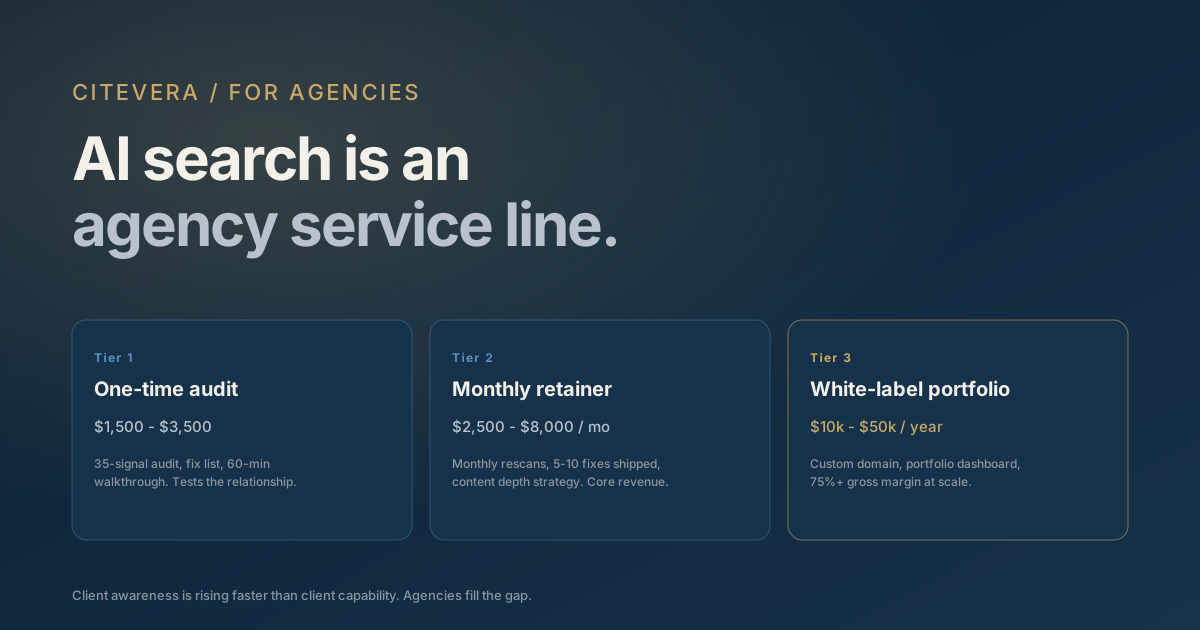
Most agencies running AI search for agencies services offer three tiers, each with different scope and pricing.
Tier 1: AI search audit (one-time)
A one-time 35-signal audit of a client site. Deliverables:
- Full audit report with scored axes (detection, understanding, trust, coverage, conversion)
- Ranked fix list with estimated effort per item
- 60-minute walkthrough call
- Copy-paste artifacts for quick wins (robots.txt block, llms.txt starter, Organization schema)
Typical price: $1,500 to $3,500 per site depending on site size and vertical. Delivery time: one to two weeks. This tier tests the relationship; clients see output and decide whether to engage further.
Tier 2: AI search monthly retainer
Ongoing AEO work. Deliverables:
- Monthly rescan with delta report against last month
- 5 to 10 fixes shipped per month
- Schema deployment and maintenance
- Content depth strategy per quarter
- Citation tracking setup
Typical price: $2,500 to $8,000 per month depending on site complexity and scope. This is the bulk of the revenue; audits often convert to retainers.
Tier 3: AI search white-label for multi-site clients
For agencies serving enterprise clients with multiple properties, or agencies serving other agencies. Deliverables:
- White-label audit reports branded to the agency (or the agency's client)
- CNAME custom domain for report hosting
- Portfolio dashboard with bulk rescan
- API access for integration with the agency's reporting stack
Typical price: $10,000 to $50,000 per year, often as an annual contract. Higher margin because delivery scales per-site rather than per-hour.
Citevera for agencies is built around this tier structure: one-time audits at the Tier 1 price point, monthly retainers at Tier 2, and white-label portfolio tooling at Tier 3.
Pricing the work
Three pricing frameworks to consider.
Per-site flat pricing
Simplest to quote. Each tier has a flat rate per client site. Predictable for the agency and the client. Good for standardizing delivery, harder to price for large or complex sites.
Tiered by complexity
Rate varies based on site size (under 100 pages, 100-1000 pages, 1000+ pages), platform complexity (static site, WordPress, headless CMS, enterprise platform), and content volume. Typical approach: 3 tiers within each service level.
Performance-linked
Some agencies offer base retainer plus performance bonus tied to AI search visibility metrics. Tricky to structure because measurement is still maturing (see how to measure AI search visibility). Works when the agency and client both trust the measurement methodology.
Most agencies in 2026 settle on tiered-by-complexity pricing. It handles variance without becoming unpredictable.
Scaling delivery across the portfolio
The main challenge in AI search for agencies is not the first client; it is the tenth. Three operational patterns that scale.
1. Standardize the audit
Every client audit runs the same 35-signal checklist in the same order. No ad-hoc audits. Every audit produces the same report format. This makes delivery repeatable and output comparable across clients.
2. Build a fix library
Catalog the recurring fixes: robots.txt templates by platform, Organization schema templates by industry, llms.txt starters by site type. Your team reuses the library per client rather than writing from scratch.
3. Automate rescans
Monthly retainers require monthly rescans. Doing that manually across 20 client sites consumes a junior team. Automated rescans with alert-on-regression lets one senior analyst oversee the portfolio. Citevera's agency tier includes scheduled portfolio rescans with delta reports.
Client education and expectations
A common failure mode in AI search for agencies engagements: the agency ships fixes, the client asks "where is the traffic?", and the agency has to explain why AI search results lag by months.
Three client expectations to set up front:
- Audit scores move quickly; citation rates lag by 2 to 3 months. Agency ships fixes this month; measurable citation change shows up next quarter.
- Not every signal has a traffic payoff. Some fixes are compliance (allowing AI crawlers); some are leverage (content depth). Explain which is which.
- Measurement requires triangulation. No single metric tells the full story. Agencies that report against a combined dashboard (measurement framework) avoid the "show me the Search Console report" trap.
Agencies that set these expectations at kickoff have smoother retainers than agencies that promise fast wins.
What to include in the sales pitch
When pitching AI search for agencies to a client, the structure that converts best is:
1. Run a sample audit on the client's site before the call 2. Present the top 3 findings with commercial impact framing (using the cost of AI search invisibility calculation framework) 3. Propose the tier that matches client scale: audit for small clients, retainer for mid-sized, white-label for enterprise 4. Set measurement expectations explicitly
Showing specific findings on the client's actual site beats abstract "AI search matters" pitches by a wide margin. The sample audit is the hook.
Key takeaways
- AI search for agencies is a real service-line opportunity in 2026 because client awareness outpaces client capability.
- Three-tier offer structure: one-time audit, monthly retainer, white-label portfolio tier.
- Pricing varies by complexity, not by hours. Most agencies converge on tiered-by-complexity pricing.
- Scale requires standardized audits, a fix library, and automated rescans.
- Set client expectations on measurement lag and triangulation early to avoid retainer friction.
What to do next
For agencies ready to productize AEO, see Citevera for agencies. The tier includes the white-label reporting, CNAME domain, and portfolio dashboard infrastructure you need to scale delivery.
For the measurement framework to share with clients, see how to measure AI search visibility.