

White-Label AI Search Audits: How Agencies Monetize AEO
White-label AI search audits let agencies deliver AEO audits on their own domain, with their own branding. Here is how to productize and price them.
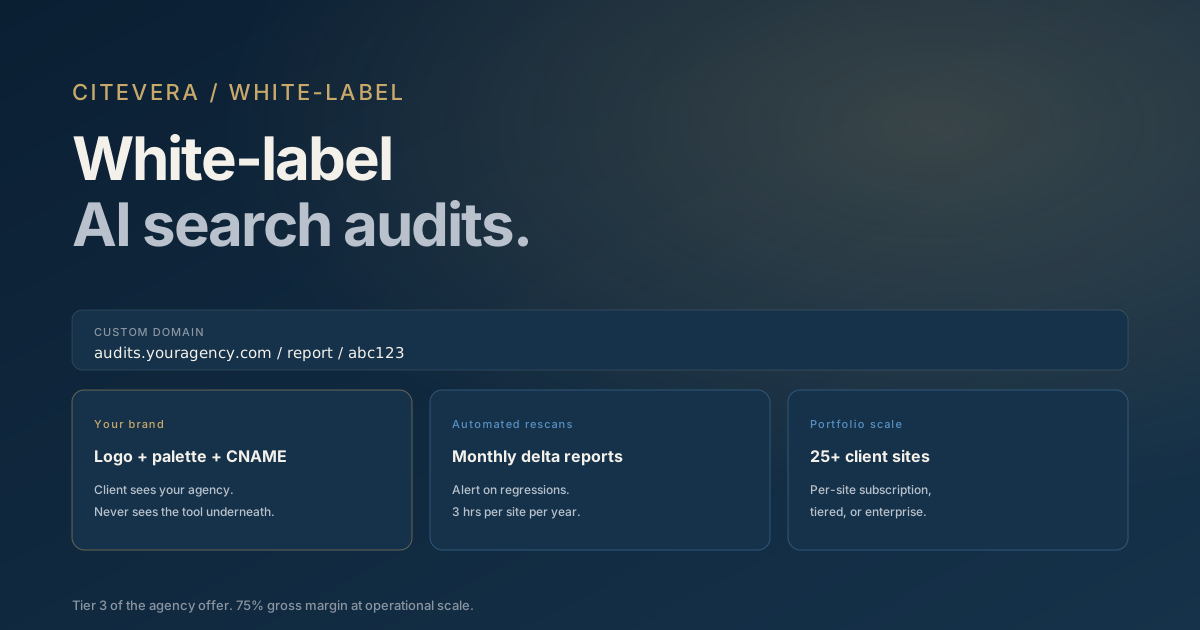
Most agencies thinking about AEO as a service line default to Tier 1 (one-time audits) or Tier 2 (monthly retainers). The highest-margin tier is the one they often skip: white-label AI search audits, where the agency delivers AEO audits on their own domain, under their own brand, at meaningful scale.
This post covers what white-label AI search audits are, how they structure as a service, the operational requirements to run them, and the pricing patterns that work in 2026. If you are already running Tier 1 or Tier 2 AEO work, white-label is the path to higher-margin growth.
What white-label AI search audits actually mean
White-label in the AEO context means three things, and all three have to be in place for the service to feel legitimate to end clients.
Custom domain. Audit reports are hosted on a subdomain of the agency (for example, audits.acmeagency.com), not on the underlying audit tool's domain. End clients see the agency's brand throughout.
Custom branding. Reports carry the agency's logo, color palette, and (optionally) footer copy. The underlying tool is invisible to the end client.
Custom delivery integration. Reports integrate with the agency's existing reporting stack: Notion, Airtable, a custom dashboard, or the agency's project management tool. End clients get AEO output inside their existing agency relationship, not as a separate vendor relationship.
Tools like Citevera's agency tier provide all three: CNAME custom domain, branding options, and API integration. The agency runs the AEO practice; the tool runs underneath.
Why white-label is higher-margin
Tier 2 retainers scale per hour. Tier 3 white-label scales per site. The economic difference is significant.
Tier 2 math. A monthly retainer at $5,000 might absorb 20 hours of agency time per month: 4 hours of rescan analysis, 10 hours of fix implementation, 4 hours of client communication, 2 hours of planning. Gross margin depends on blended hourly rate; usually 50 to 65% for well-run agencies.
Tier 3 math. A white-label portfolio serving 25 client sites at $15,000 per year total ($50 per site per month) absorbs maybe 3 hours per site per year for manual review, plus an automated monthly rescan. Gross margin often exceeds 75% because the per-site work is bounded.
The catch: Tier 3 requires the agency to serve enough sites to amortize the infrastructure. A single-client white-label is rarely profitable. Ten clients with ten sites each, or two enterprise clients with 50+ sites, is the sweet spot.
What white-label reports contain
The report format that lands best with enterprise clients has four sections.
1. Executive summary. One-page overview: overall AEO score, top three findings, recommended priority order. Decision-maker read. 2. Detailed findings. Per-axis scoring with evidence. What failed, why it matters, what to fix. Technical team read. 3. Fix list with artifacts. Ranked by impact. Each item has the copy-paste artifact (robots.txt block, schema template, llms.txt file) the implementation team needs. 4. Trend tracking. For ongoing relationships, each report shows delta against the last report. Score progression, new findings, closed issues.
Reports should be ~10 to 15 pages for a mid-sized client site, longer for enterprise. Shorter reports feel thin; longer reports lose executive attention.
Scaling white-label delivery
Three operational requirements.
Automation
Running white-label AI search audits across 25 client sites manually is not sustainable. Automated rescans on a monthly cadence with delta reports is the baseline. Most agencies build this on top of a tool's API; the agency orchestrates delivery and branding, the tool runs the audits.
Citevera's agency tier includes automated monthly portfolio rescans with alert-on-regression and custom-branded report generation.
Escalation process
Automated reports are a floor. The ceiling is an agency analyst who reviews the report before it goes to the client, flags high-impact changes, and adjusts the commentary. A 20-minute review per site per month is a reasonable cadence; it preserves the relationship quality without consuming the economics.
Clients with regressions or complex findings get a 30-minute follow-up call. Normal months are report-delivered-automatically.
Client education at onboarding
White-label reports require baseline client understanding to land well. A 60-minute onboarding session covering:
- How AEO works and why it matters for their business
- What the reports will contain and how to act on findings
- The measurement lag (2 to 3 months) between fixes and citation changes
- Who on the client side will own implementation
Agencies that skip onboarding have higher churn because clients do not understand the output. Agencies that invest 60 minutes upfront see meaningfully higher retention.
Pricing white-label AI search audits
Three pricing patterns work in practice.
Pattern 1: per-site subscription
Each client site gets an annual subscription at a flat rate. $500 to $2,000 per site per year depending on site complexity. Simple to quote, simple to invoice.
Pattern 2: tiered portfolio pricing
Agency pays for access to white-label tools plus per-site usage. A typical structure: $500 per month for platform access plus $50 per site per month. Better economics for agencies running 20+ client sites.
Pattern 3: annual enterprise contract
Single annual fee covering unlimited client sites up to a cap. Starts at $15,000 per year, scales by cap. Works for established agencies with stable client rosters.
Which one fits depends on the agency's client base. A growing agency with fluctuating client count prefers per-site subscription. An established agency with steady clients prefers enterprise contracts.
Client billing structure
White-label AI search audits get billed by the agency to the end client, not directly by the underlying tool. Two structures work.
Bundled with retainer. AEO monitoring is part of the monthly digital marketing retainer. Client sees one invoice; AEO is called out as a line item or bundled in the overall scope.
Standalone retainer. Clients who do not have a broader agency retainer get a standalone AEO monitoring retainer. Usually $500 to $2,500 per month per client depending on portfolio size.
The bundled approach has better retention; clients do not separately evaluate AEO spend. The standalone approach has cleaner attribution; it is easier to track AEO-specific economics.
Differentiating on quality
With commoditized audit tools under the surface, white-label AI search audits compete on agency-side differentiation. Three common angles:
1. Vertical specialization. Agency focuses on one vertical (B2B SaaS, ecommerce, legal, etc.). Reports speak the vertical's language; fixes come with vertical-specific examples. 2. Implementation depth. Agency does not just report findings; it ships fixes. Clients pay a premium for done-for-them execution. 3. Cross-channel integration. AEO reports connect to traditional SEO reports, paid search reports, and analytics dashboards. Clients get one unified view of search performance.
Agencies that compete on generic audit delivery (no specialization, report-only, standalone reports) struggle. Agencies that pick a specific differentiation angle retain and grow.
Key takeaways
- White-label AI search audits are the highest-margin AEO service tier for agencies, with 75%+ gross margins when operated at scale.
- Requires custom domain, custom branding, and integration into the agency's existing reporting flow.
- Scaling needs automated rescans, a structured analyst review process, and client education at onboarding.
- Three pricing patterns: per-site subscription, tiered portfolio, annual enterprise.
- Differentiate on vertical specialization, implementation depth, or cross-channel integration.
What to do next
For agencies ready to run white-label AI search audits at scale, see Citevera for agencies. The tier includes CNAME custom domain, white-label reports, portfolio dashboard, and the automation infrastructure required to serve 25+ client sites profitably.
For the broader service-line framework, see AI search for marketing agencies.