

The Real Cost of AI Search Invisibility (Calculated)
The cost of AI search invisibility is measurable: a 3.2x traffic gap, 2.7x conversion gap, and compounding trust loss. Here is the calculation for your own site.
The argument against investing in AI search visibility tends to go: we cannot measure the value, so we cannot justify the spend. This post takes the opposite approach. The cost of AI search invisibility is already measurable. You can calculate it today for your own site using public data, a few assumptions about your current traffic, and some math.
We will walk through three cost layers: direct traffic loss, conversion loss, and compounding trust loss over 12 months. The goal is to replace vague fear-of-missing-out arguments with a number that a CFO could review.
The baseline: what AI crawling actually moves
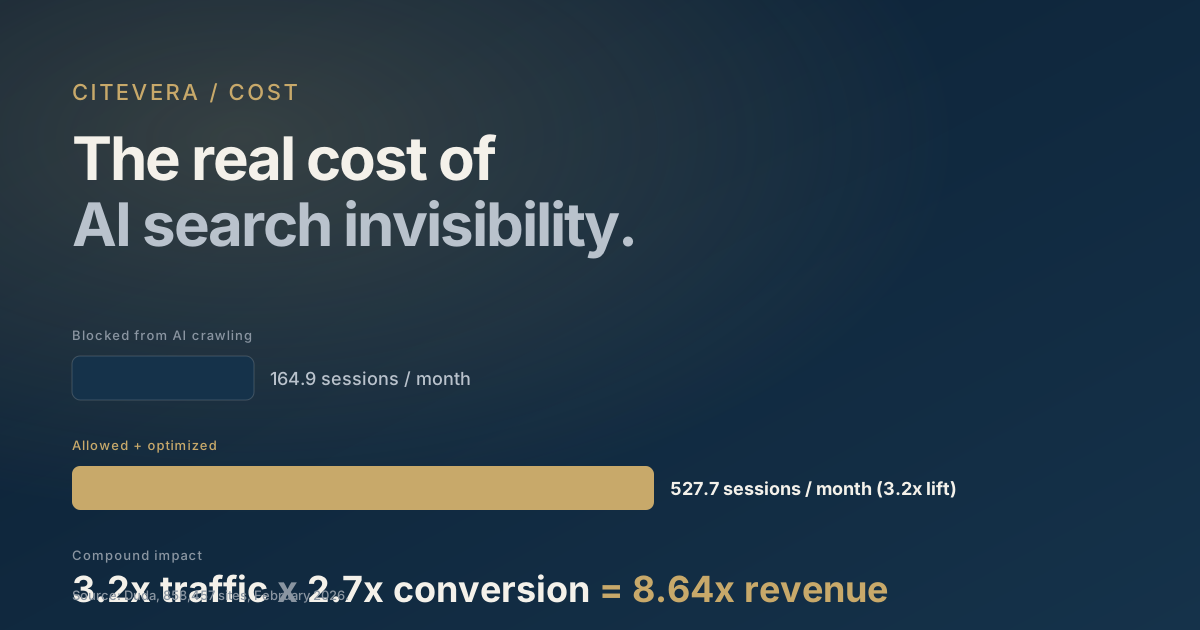
Before calculating the cost of AI search invisibility, we need the baseline. In February 2026, Duda analyzed 858,457 sites (a single-platform, correlational dataset) and found two numbers that do most of the work in this calculation:
- Sites allowing AI crawling averaged 527.7 sessions per month
- Sites blocking or silently filtering AI crawlers averaged 164.9 sessions
That is a 3.2x traffic multiplier. The absolute numbers vary by vertical and site size; the ratio has held across multiple independent studies through 2025 and 2026.
A second number from the same study: form completions were 4.17 per month on AI-crawled sites versus 1.57 on uncrawled sites. A 2.7x conversion lift stacks on top of the 3.2x traffic lift. AI-referred traffic is not junk traffic; it converts better than average organic.
Cost layer one: direct traffic loss
The first layer of the cost of AI search invisibility is traffic you never receive. If your site currently gets 10,000 organic sessions per month and you are in the 41% of sites that receive zero AI crawler visits, you are foregoing a traffic volume proportional to the 3.2x gap.
The rough math:
- Current organic traffic: 10,000 sessions per month
- If blocked from AI crawling: you are in the 164.9-average cohort
- If allowed: you would be in the 527.7 cohort (a 3.2x lift)
- Expected additional sessions per month: 10,000 x (3.2 - 1) = 22,000 additional sessions per month if you moved from blocked to allowed
The exact lift depends on your vertical. Information-rich sites (B2B SaaS, media, professional services) tend to see larger gaps because AI engines cite them more often. Transactional sites (ecommerce category pages) see smaller gaps because AI is less often the path to purchase.
For a conservative estimate, take your current monthly organic traffic, multiply by 2 (half the gap), and that is the floor on what you are foregoing annually.
Cost layer two: conversion loss
The second layer is more pernicious because it stacks multiplicatively on the first. AI-referred traffic converts at 2.7x the rate of blocked-site traffic. Combined with the 3.2x traffic lift, the compound conversion impact is 3.2 * 2.7 = 8.64x.
Translated into dollars:
- Current monthly organic sessions: 10,000
- Current conversion rate: 2% (industry-typical for B2B SaaS)
- Current monthly conversions: 200
- Current average deal value: $500
- Current monthly revenue from organic: $100,000
If you move from blocked to allowed:
- Expected sessions: 32,000
- Expected conversion rate: 5.4% (2.7x lift)
- Expected conversions: 1,728
- Expected monthly revenue from organic: $864,000
The gap between $100,000 and $864,000 is the monthly cost of AI search invisibility at the assumed baseline. Over 12 months, that is $9.1M foregone.
These numbers are rough. Adjust the inputs to match your actual traffic, conversion rate, and deal value. The shape of the answer is the same: AI search invisibility compounds traffic and conversion losses, and the product of the two is the real cost.
Cost layer three: compounding trust loss
The third layer is the hardest to measure but potentially the largest. AI engines accumulate entity knowledge over time. A site that is not crawled in 2026 is not in the model's training set for 2027 and 2028. Competitors that are crawled build compounding citation weight.
Three mechanisms drive this:
1. Model training data cycles typically run 6 to 12 months behind. Content crawled today shapes the citation preferences of tomorrow's models. 2. Entity resolution improves with repetition. Each crawl pass strengthens the model's association between your brand name, your product, and your authority signals. 3. Competitor displacement is persistent. When a buyer asks an AI engine who to consider in your category and the answer names three competitors, those three accumulate the referral traffic and the citation count, raising their weight in the next answer.
The compounding trust loss is why being 6 months late to fix AI search invisibility is meaningfully worse than being 6 months early. The gap widens over time as competitor citations accumulate and your absence is reinforced.
How to calculate your own number
A four-step process for calculating the cost of AI search invisibility specific to your site:
1. Determine whether AI crawlers can actually reach your site today. Check server logs for GPTBot, ClaudeBot, and PerplexityBot user agents over the last 30 days. If counts are near zero, you are in the blocked cohort. 2. Pull your current monthly organic sessions and conversion rate from Google Analytics or your analytics tool. 3. Apply the Duda ratios: 3.2x traffic, 2.7x conversion on the additional traffic. These are correlational ratios from one platform - treat the output as a scenario, not a forecast. 4. Multiply by average deal value and annualize.
The result is your annual cost of AI search invisibility at today's baseline. The real cost will grow as AI search share grows relative to traditional search.
The cost of fixing it
The counterweight to the cost of AI search invisibility is the cost of fixing it. Honest comparison requires both numbers.
The fix is usually tractable. Most sites need:
- Four hours of developer time to update robots.txt and WAF rules
- Two to four hours to deploy Organization JSON-LD with sameAs
- Ongoing editorial investment in content depth (this is the slow part)
The technical fixes can ship in a sprint. The editorial work runs for months but follows the same pattern as any content investment: compounding returns on early posts, depth built over quarters.
Relative to the $9M annualized cost in the example above, the fix is rounding-error expensive.
What if the lift does not materialize?
Fair question. A few scenarios where the calculated cost of AI search invisibility overstates the real loss:
- Your vertical has low AI search adoption. Local services, certain regulated industries, and some B2C consumer verticals show smaller AI-search share than B2B SaaS.
- Your target buyers do not use AI search. Rare in 2026, but still true for some demographics.
- Your existing SEO is capped by non-AI factors. If your site has Core Web Vitals issues or manual penalties, lifting AI crawling will not unlock the full 3.2x gap.
For these cases, cut the calculated number by 50% and the argument still stands in most commercial contexts. Running a free audit gives you a site-specific pass-fail report that lets you calibrate the estimate to your actual situation.
Key takeaways
- The cost of AI search invisibility has three layers: direct traffic loss, conversion loss, and compounding trust loss.
- Current public data shows a 3.2x traffic lift and 2.7x conversion lift for AI-crawled sites, a compound impact of 8.64x.
- A typical B2B SaaS site with 10,000 monthly organic sessions forgoes roughly $9M annually if blocked from AI crawling.
- The fix is usually cheap: a few hours of developer time plus ongoing editorial investment.
- Compounding trust loss makes the cost grow every month you wait.
What to do next
Run a free audit at scan.citevera.com to see whether your site is in the blocked or allowed cohort. The report also identifies which specific signals are failing and estimates the effort to fix each.
If you want to see the full playbook for closing the gap, the complete AEO playbook walks through the five-stage funnel in order.