

How to Measure AI Search Visibility: Metrics That Matter
AI search visibility measurement has no Search Console. Here are the four metrics that actually matter and how to track each without custom tooling.
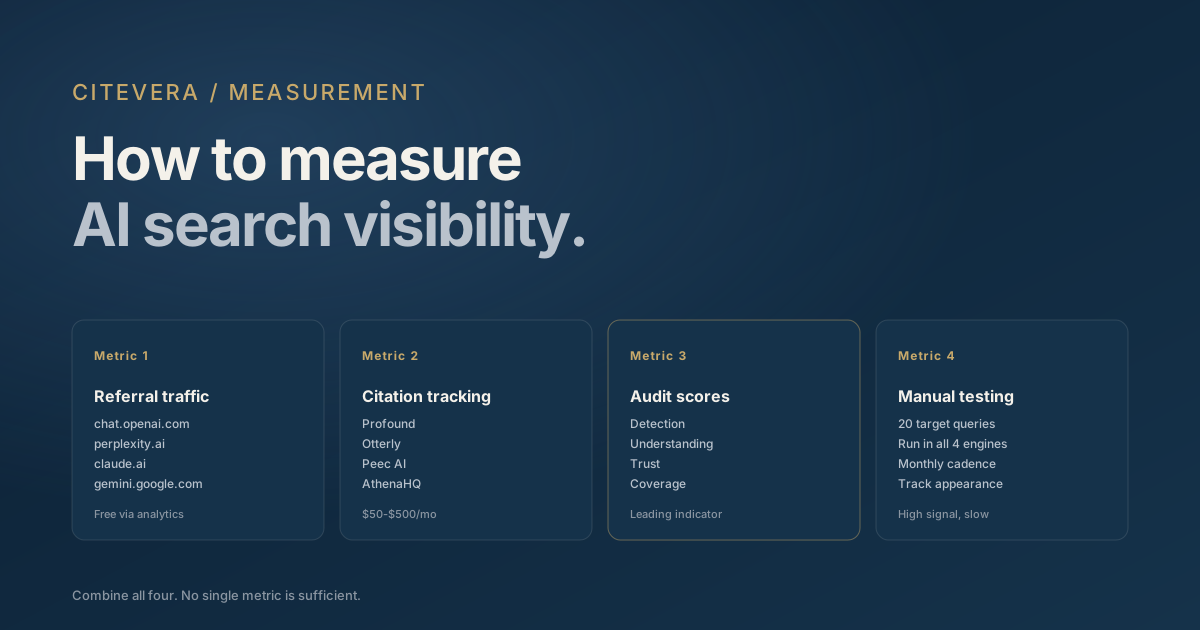
AI search visibility measurement is harder than SEO measurement because there is no Search Console for AI answer engines. No rank report. No impressions-vs-clicks chart. Most teams tracking AI search visibility are combining two or three imperfect signals and triangulating.
This post covers the four metrics that actually matter for AI search visibility measurement, how to track each one, and how to combine them into a single view of your performance. None of this requires custom tooling or paid dashboards; all four metrics can be tracked with free tools.
Why AI search visibility measurement is hard
The core challenge: AI answer engines do not expose a structured query-by-query visibility report. You cannot query "what percentage of AI answers about my category mention my brand?" and get a number. You have to construct the answer from partial signals.
Three partial signals exist and are worth combining:
- Direct referral traffic from AI engines (quantitative, small N)
- Citation tracking from paid tools like Profound, Otterly, and Peec AI (quantitative, broader N, costs money)
- Manual query testing across your category queries (qualitative, rigorous, time-consuming)
No single signal is sufficient. All three together give a reasonable picture.
Metric 1: AI engine referral traffic
The first and easiest AI search visibility measurement is referral traffic from AI engines themselves. Filter your analytics tool for referrer patterns:
chat.openai.comchatgpt.comperplexity.aigemini.google.comclaude.aicopilot.microsoft.com
Most AI engines now pass referer headers when users click citations. The volume is small (AI referral traffic is usually 1 to 5% of total organic today), but the trend direction is the signal that matters.
What to track monthly:
- Total sessions from AI referrer domains
- Sessions broken down by AI engine
- Landing page distribution (which of your pages get cited most?)
- Conversion rate from AI-referred traffic (usually higher than cold search)
The growth rate over quarters tells you whether your AI search visibility is rising or declining even when absolute numbers are small.
Metric 2: Citation tracking
Citation tracking tools run AI engine queries on a schedule and record which sources get cited. Major tools: Profound, Otterly, Peec AI, AthenaHQ. They cost $50 to $500 per month depending on query volume and engine coverage.
What citation tracking tells you:
- Citation frequency for your brand across a defined query set
- Competitor citation frequency in the same queries
- Trend over time as you ship AEO fixes
- Which specific queries cite you versus competitors
What citation tracking does not tell you:
- How much traffic the citations actually drive
- Which citation surfaces matter most for purchase decisions
- Why a specific query cites a specific source (the model's internal reasoning is opaque)
For AI search visibility measurement, citation tracking is the most direct signal of "am I in the answer?" but it is retrospective. It tells you whether yesterday's content made today's citations; it does not tell you what to ship next.
Our monitor AI brand mentions for free post covers the free-tier workflow for brands with small query sets.
Metric 3: Audit-layer signals
Citation tracking reports outcomes. Audit-layer signals report inputs. Running an audit of whether your site is set up to be cited tells you whether the outcomes you are not yet measuring are likely to arrive.
Audit metrics to track:
- Overall audit score (pass/fail aggregate across 35 signals)
- Detection score: can AI crawlers reach your pages?
- Understanding score: can they parse your content?
- Trust score: do you have entity signals?
- Coverage score: how deep is your topical content?
Citevera's audit produces these scores for any URL in 1-3 minutes for most sites. Tracking them over time shows whether your underlying AI search readiness is improving even when citation tracking is noisy.
A practical pattern: run the audit monthly, compare against last month's score, correlate score movement with citation tracking or referral traffic shifts. This combines the leading indicator (audit signals) with the lagging indicator (citations and traffic).
Metric 4: Manual query testing
The most rigorous AI search visibility measurement signal is also the slowest: run representative queries in AI engines manually and record the results. Pick 20 queries your buyers would type. Run each one in ChatGPT, Claude, Perplexity, and Gemini. Record:
- Did the AI answer mention your category at all?
- Was your brand named in the answer?
- Was your site cited as a source?
- Which competitors were cited?
Repeat monthly. The slow cadence forces rigor. You get a high-confidence, low-noise view of where you stand in AI answers for queries that matter to your business.
The shortcut: use ChatGPT Pro or Claude's API to run the queries programmatically, then have a small script extract brand mentions. This reduces the per-query labor from minutes to seconds.
Combining the four metrics
Each metric has limitations. Combining them gives a fuller picture for AI search visibility measurement.
A practical monthly dashboard:
1. Referral traffic (absolute numbers and growth rate) 2. Citation frequency (from your citation tracker or manual sampling) 3. Audit score (overall and per-axis) 4. Manual query test results (appearance rate and citation rate)
When all four trend up, your AI search visibility is improving. When audit scores improve but referrals do not, the compounding trust effect has not caught up yet; expect a lag of 2 to 3 months before citations follow audit fixes. When citations improve but referrals do not, your cited pages have attribution issues or conversion friction.
The correlations between the four metrics are imperfect but directionally informative.
How to report AI search visibility to leadership
Most executive teams do not want to see four separate metrics. Consolidate into a single "AI search health" score that averages:
- Audit score (baseline readiness, 0-100)
- Citation tracker percentile (your rank versus competitors in tracked queries)
- Referral traffic growth rate (quarter over quarter)
- Manual test appearance rate (percentage of target queries where you appear)
Normalize each to 0-100 and average. Track monthly. The single number smooths noise and lets leadership see whether the AI search investment is working without needing to understand the four underlying signals.
Key takeaways
- AI search visibility measurement requires combining four imperfect signals: referral traffic, citation tracking, audit scores, and manual query testing.
- No single metric is sufficient; triangulation is the point.
- Audit scores lead citation changes by 2 to 3 months. Expect lag.
- Referral traffic is small in absolute terms but the growth rate is the signal.
- Consolidating into a single AI search health score simplifies executive reporting without losing signal.
What to do next
Start with a free audit at scan.citevera.com to establish your baseline. Run it monthly to track the leading indicator. Combine with your existing analytics to track AI referral traffic and manual query testing on your top 20 queries.
If you run a marketing agency, Citevera for agencies includes scheduled monthly rescans and portfolio-level reporting across all client sites.