

ChatGPT vs Perplexity vs Claude vs Gemini: Which AI Search Cites You Most?
ChatGPT vs Perplexity vs Claude vs Gemini differ in citation behavior, crawler share, and source preferences. Here is the field guide for marketers choosing where to focus.
Not all AI search engines cite sources the same way. ChatGPT vs Perplexity vs Claude vs Gemini is a comparison every marketer investing in AEO eventually has to make, because the four engines optimize for different things and reward different content choices.
This post is a field guide to the four major AI answer engines as they exist in 2026: their crawler share, citation behavior, source preferences, and what each one rewards at the content level. The goal is to help you decide where your marginal AEO hour should go.
The crawler share baseline
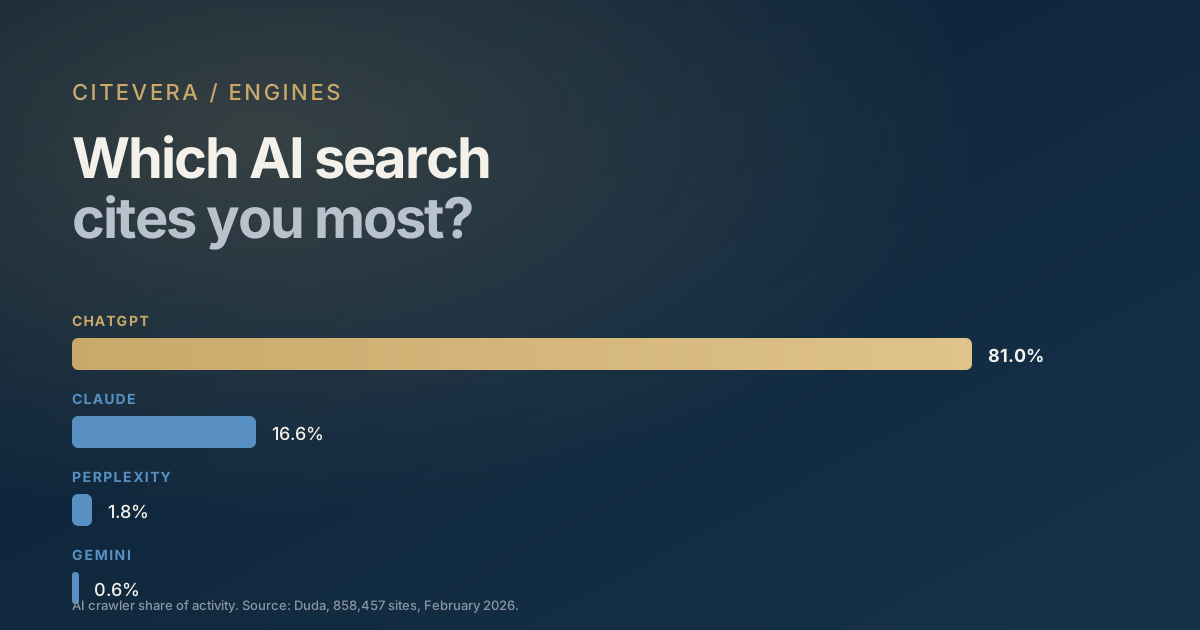
Before comparing citation behavior, the crawler-share baseline tells you how much traffic each engine brings to the open web. Per Duda's February 2026 analysis of 858,457 sites (a single-platform, correlational dataset):
- GPTBot (ChatGPT): 81.0% of AI crawler activity, 55.8M visits
- ClaudeBot (Claude): 16.6%, 11.5M visits
- PerplexityBot (Perplexity): 1.8%, 1.3M visits
- Gemini-associated crawlers: 0.6%, 380K visits
ChatGPT dominates the crawler pool by a large margin. But crawler share is not citation share. Perplexity cites more sources per answer than ChatGPT. Claude's citation behavior is more academic. Gemini draws heavily from the Google index, which means classic SEO signals still matter. The per-engine tuning work starts from the same audit foundation but then diverges.
ChatGPT and OpenAI Search
The biggest pool by volume and the engine most B2B buyers use for category research. ChatGPT's citation behavior in 2026 leans on three signals:
- Entity presence. Organization JSON-LD with complete sameAs linking to LinkedIn, Crunchbase, Wikidata, and Google Business Profile. ChatGPT resolves sites to entities and cites entities more readily than anonymous URLs.
- Topical depth. Sites with 50+ posts in a topic cluster get cited disproportionately against sites with one or two excellent posts. The 33x content-depth finding in the Duda data shows up here.
- Recency. ChatGPT surfaces datePublished and dateModified heavily when grounding a response in real-time retrieval via OAI-SearchBot.
ChatGPT cites fewer sources per answer than Perplexity (typically 2 to 4 per answer versus Perplexity's 5 to 8), so the competition for citation slots is more intense. Winning the ChatGPT citation usually means winning the top entity in a topic.
Our GPTBot optimization guide covers the five concrete changes that move ChatGPT visibility.
Claude and ClaudeBot
Smaller crawler share, but disproportionate influence in technical and enterprise contexts where Claude is the preferred model for deeper reasoning tasks. Claude's citation behavior looks closer to academic attribution:
- Thoughtful sourcing. Claude preferentially cites pages that themselves cite sources. A paragraph with an inline citation to a study is more likely to be cited than an equivalent paragraph without attribution.
- Structural clarity. Short paragraphs, clear headings, and explicit Q-and-A formatting produce higher citation rates. Claude prefers extractable structure over dense prose.
- Long-form context. Claude's larger context windows let it read longer pages in full. Sites with thorough explainers and walkthroughs get cited more often than sites with short marketing copy.
Claude cites sources in-line with a more deliberate cadence than ChatGPT. When Claude cites you, the citation is usually contextual: it names the source as part of an argument rather than as a footnote. That means the cited passage has to be strong on its own.
Perplexity
PerplexityBot is 1.8% of crawler traffic but accounts for a disproportionate share of B2B research queries because Perplexity's UI leads with citations. Every answer shows a source list up front.
Perplexity's preferences:
- Recency. Perplexity weights dateModified heavily. A 2025 article loses to a 2026 article of equivalent quality almost every time.
- Inline source links. Perplexity preferentially cites pages that show their own work. If your article links out to the studies and references it builds on, Perplexity reads that as rigor and is more likely to cite you.
- Numeric precision. Perplexity citations skew toward pages with specific, attributed statistics. "92.8% crawl rate (Duda, 2026)" is more citable than "the majority of sites."
Our Perplexity citation patterns post covers the specific formatting choices that move Perplexity visibility. This is the engine where the stat citations and source links discipline pays off the most.
Gemini and Google AI Overviews
Gemini's direct crawler share is 0.6%, but that understates its importance. Google AI Overviews appear on a growing share of Google Search queries and draw from the indexed Google corpus. The practical implication: classic SEO signals still matter for Gemini visibility because Gemini inherits Google's ranking system.
What Gemini rewards:
- E-E-A-T signals. Experience, expertise, authoritativeness, trust. Author profiles, Organization schema, external citations.
- Core Web Vitals. Gemini leans on the standard Google ranking signals more than the other engines do.
- Structured data. Google AI Overviews pull heavily from schema-marked content; sites with comprehensive JSON-LD get cited in Overviews more often.
- Google Business Profile. Local queries trigger GBP-linked citations. The 92.8% crawl-rate gap between GBP-synced and non-synced sites (Duda) shows up hardest in Gemini.
Gemini is the engine where classic SEO and AEO converge most. If your SEO is strong, your Gemini AEO is already strong. If your SEO is weak, fixing SEO pays Gemini dividends.
The cross-engine common stack
Most marketers cannot separately optimize for four engines. The good news: roughly 80% of what works for one works for all four. The common stack:
1. All major crawlers allowed in robots.txt and WAF 2. Organization JSON-LD with complete sameAs 3. Clean heading hierarchy and short paragraphs across content pages 4. FAQ schema on pages that answer questions 5. datePublished and dateModified set on all articles 6. Topical depth built out over quarters
With the common stack in place, per-engine tuning is the last 20%. For most sites, that last 20% is not worth the engineering attention until the common stack is solid.
When per-engine tuning is worth it
Three situations justify per-engine optimization effort.
- You already dominate the common stack. If your audit score is above 85 and your content depth is at the 50+ bucket, per-engine tuning is the next marginal improvement.
- You have a specific engine concentration. If your analytics show 80% of AI referrals come from one engine, tune for that one. The reverse is also true: if a specific engine is a customer acquisition channel (for example, Perplexity for research-heavy B2B categories), prioritize it.
- A competitor is winning on an engine you are losing. If a manual query check shows a specific competitor consistently beating you on ChatGPT but not Perplexity, the engine-specific factors matter.
Otherwise, stay on the common stack and reinvest the time in editorial depth.
A per-engine measurement approach
To know where you stand in ChatGPT vs Perplexity vs Claude vs Gemini, track four separate citation rates. Run 20 representative queries in each engine monthly. Record your appearance rate and citation rate per engine. Our AI search visibility measurement guide covers the combined dashboard approach.
The ratio between engines tells you where your investment is paying off:
- High ChatGPT + low Claude: your entity signals work but your structural clarity does not.
- High Perplexity + low ChatGPT: your recency and sourcing are strong but your topical depth is thin.
- High Gemini + low everyone else: your classic SEO is strong; your AEO-specific signals need work.
Key takeaways
- ChatGPT dominates AI crawler share at 81%, but crawler share is not citation share.
- ChatGPT rewards entity presence and topical depth. Claude rewards attributed, structured content. Perplexity rewards recency and inline sourcing. Gemini inherits Google ranking signals.
- 80% of what works for one engine works for all four; per-engine tuning is the last 20%.
- Per-engine optimization is worth it only after the common stack is solid and usually only for sites with specific engine concentration.
- Measure citation rate per engine monthly to decide where marginal effort should go.
What to do next
Run a free audit at scan.citevera.com to see how your site scores against the common AEO stack. The report flags which signals are failing and ranks fixes by impact, which applies across all four major engines.
For per-engine deep dives, see GPTBot optimization and Perplexity citation patterns.