

Perplexity citation patterns: what predicts a quote
Perplexity cites sources more visibly than any other major answer engine. What we see across hundreds of Citevera audits: the signals that predict a Perplexity quote, the patterns that never work, and how Perplexity differs from ChatGPT and AI Overviews.
Why Perplexity is worth studying specifically
Most answer engines hide their sources. ChatGPT shows a "sources" list only sometimes. Google AI Overviews shows a compact list that is easy to miss. Perplexity puts citations front and center, numbered and clickable, as a structural part of every answer. For a brand trying to optimize AEO, Perplexity is the loudest measurement signal in the ecosystem - every answer you see tells you exactly which sources got picked.
That visibility makes Perplexity a useful lab. The patterns that earn a cite on Perplexity tend to generalize to other engines; the patterns that fail here fail elsewhere too. Here is what we see consistently across a few hundred Citevera audits where the customer cared about Perplexity specifically.
The Perplexity extraction model
Perplexity runs a query by fanning out to several search backends - Bing, Google, and its own index - retrieving the top results, then reading them with a language model to compose the answer. Each quoted claim is attributed to one of the fetched sources via the numbered citation system.
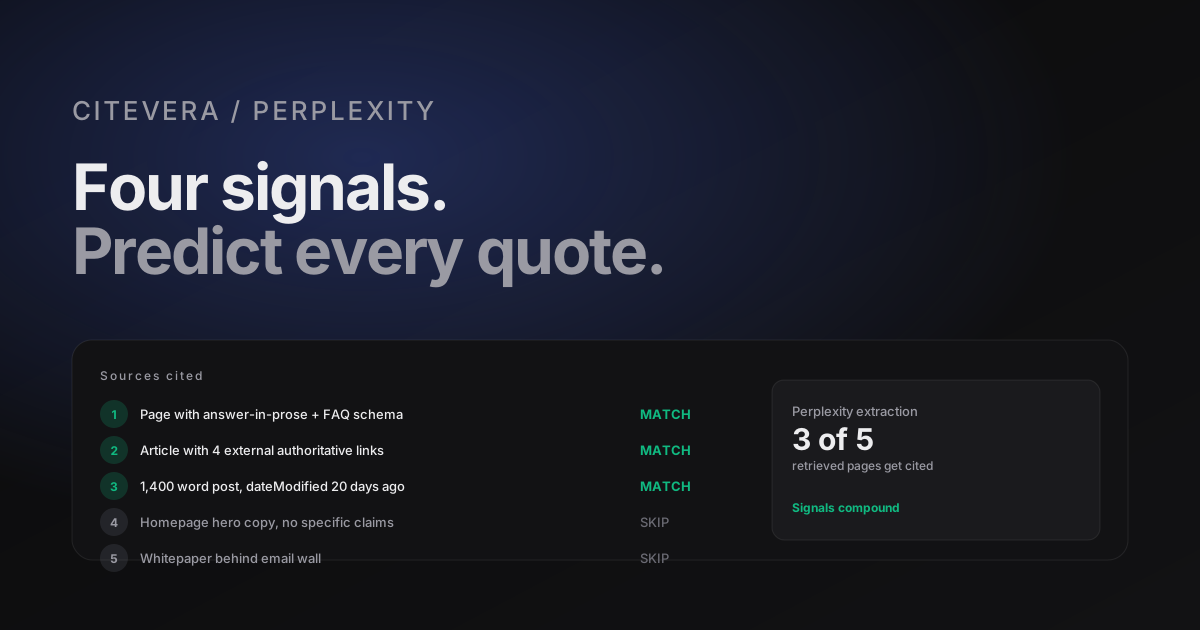
The key variable from an AEO perspective is: of the 5 to 15 sources the engine retrieves for a query, which 3 to 7 actually get cited in the answer? That is the gate. Being retrieved is necessary but not sufficient; being cited is the prize.
The four signals that predict a Perplexity cite
1. Proximity of answer to the query phrasing
Perplexity quotes sentences that read like direct answers to the query. A query of the form "how does X work" produces citations that contain "X works by" or "X is a Y that does Z". Pages with this exact kind of answer-in-prose win. Pages where the answer has to be inferred from surrounding context lose.
The easiest way to engineer this: pick the 10 queries you want to rank for, write each as a question, and make sure one of your pages contains a sentence that is a clean declarative answer to that question. Not a paragraph. A single sentence. Perplexity quotes sentences, not paragraphs.
2. Schema.org structured data
Pages with FAQPage, HowTo, or BlogPosting schema are cited at roughly 1.5 to 2x the rate of equivalent pages without. The effect is consistent across topics. We suspect Perplexity uses schema as a prior during extraction - pages that declare their structure are easier to parse confidently, and the engine prefers confident extractions.
The inverse pattern: pages with broken or contradictory schema get down-weighted. A FAQPage that lists questions that are not on the page is detected and penalized.
3. External link presence
Pages that themselves link out to primary sources are cited more often. This is counterintuitive - you might expect that linking outside your own site would divert attention - but the effect is the opposite. Perplexity appears to treat out-linked sources as evidence, and the engine prefers to cite a source that aggregates evidence over a source that makes a naked claim.
The ideal structure: when you make a specific claim, link to the primary source for that claim. "Baymard's 2024 cart-abandonment study found..." with a link is better than the same sentence without. Perplexity ends up citing both your page and Baymard's, which is still net-positive for you.
4. Page size and structure
Perplexity tends to cite pages in the 800 to 2,500 word range. Very short pages do not provide enough surface area. Very long pages dilute the signal - the engine has to pick between more candidate sentences, and it often picks the shorter page next to it.
Within that range, structure matters more than length. Pages with clear H2 / H3 boundaries, a direct-answer lede, and an FAQ tail are cited more often than equivalent-length pages without the structure. We covered those patterns in the anatomy-of-a-cited-blog-post piece.
Three patterns that never earn a Perplexity cite
1. Pure marketing pages
Homepage heroes and landing pages with promotional copy are almost never cited. Perplexity is oriented toward factual answers; "Our platform empowers teams to achieve more" does not contain a quotable fact. Even when a landing page ranks organically, Perplexity will reach past it to a blog post or docs page that has the specific claim.
The implication: do not try to make your homepage AEO-competitive. Use the homepage for humans and conversion; optimize your blog and documentation for citation.
2. Long whitepapers behind form walls
Perplexity does not submit forms. A 40-page whitepaper with 200 of the best-written paragraphs on your topic is invisible to the engine if it lives behind an email gate. If you want AEO value, publish the content unlocked - at minimum, publish the key findings as a blog post that links to the full PDF. The blog post gets cited; the whitepaper stays a lead magnet.
3. JavaScript-rendered content
Any content that only appears after client-side JavaScript execution is partial-probability territory. Perplexity's crawler renders some JS but not all. Counting on it is a coin flip. Server-render the important content - especially tables, FAQs, and any content inside accordions - and you remove the gamble.
How Perplexity differs from ChatGPT and AI Overviews
The patterns above generalize, but three differences are worth calling out.
Perplexity cites shorter spans
Where ChatGPT often synthesizes a multi-sentence answer by paraphrasing several sources, Perplexity tends to cite shorter, more direct spans - often a single sentence or a few phrases. That means Perplexity rewards sentence-level craftsmanship more than paragraph-level craftsmanship. A single clean sentence can be the difference between being cited and not.
Perplexity weighs recency harder
Perplexity visibly prefers recent sources, especially for queries about rapidly-changing topics. A page with dateModified in the last 90 days beats an equivalent page from 18 months ago on the same query, even when the older page has more backlinks. ChatGPT cares about recency but not as sharply.
AI Overviews trusts Google's ranking more heavily
Google AI Overviews starts with the top organic results and filters down from there. Perplexity starts with a wider retrieval net and picks from it. Consequently a page that ranks 7th organically has a much better chance of being cited by Perplexity than by AI Overviews, controlling for content quality. If you are ranked in the top 20 but not top 3, Perplexity is your faster path to citation.
A Perplexity-specific tuning exercise
If you want to optimize specifically for Perplexity, here is a 4-hour exercise that usually moves the needle on at least a handful of queries in 30 to 60 days.
1. List 10 queries your brand should be cited for. 2. For each, run the query on Perplexity. Note which sources get cited. 3. For each cited competitor source, read it. What specific sentence did Perplexity quote? Usually visible because it shows up in the answer text. 4. For each query where you were not cited, write a clean declarative sentence on one of your pages that answers the query. One sentence, in the first 200 words of the page. 5. Update schema on those pages to include BlogPosting with dateModified set to today. Regenerate. 6. Wait 4 to 6 weeks. Re-run the queries.
The re-runs will not all show you cited, but a meaningful fraction will. The hit rate we see with this exercise is roughly 40 to 60 percent on first iteration. Repeat on the queries where it did not work; usually a second pass with a sharper sentence closes the gap.
Run a free audit to see which pages on your site Perplexity is likely to cite
How Citevera scores Perplexity-adjacent signals
The audit does not have a "Perplexity score" - no engine publishes ranking factors and pretending to score a specific engine would be dishonest. What the audit does score is the underlying signals: answer directness, schema coverage, external source density, and freshness. Those correlate well with Perplexity outcomes specifically, and with AI Overviews and ChatGPT outcomes more generally.
A site that scores above 80 on the AEO axis has the ingredients that typically produce Perplexity citation within 2 to 6 weeks of shipping. A site below 60 rarely gets cited regardless of Perplexity-specific tuning; the floor-level signals need to be fixed first.
Frequently asked questions about Perplexity citation
Does Perplexity honor robots.txt?
Yes, and PerplexityBot is one of the more compliant major crawlers. Allow it explicitly in your robots.txt and confirm there are no WAF rules blocking it.
Does Perplexity Pro (paid) cite differently than free Perplexity?
Slightly. Pro uses different underlying models (GPT-4 class, Claude Sonnet, Sonar) and the models have different extraction preferences. In our testing the sources that work well on free Perplexity also work well on Pro, with small differences in the specific sentence quoted. Optimize for the signal patterns; do not optimize for a specific model underneath.
Should I reach out to Perplexity to request indexing?
No. Their crawl is automatic and reaching out does not meaningfully help. Put the work into being cite-worthy and the indexing will follow.
What is Sonar and does it matter for AEO?
Sonar is Perplexity's in-house model for some queries. For AEO purposes it behaves like the other models - it picks cite-worthy sources, runs extraction, composes an answer. You optimize for the signals, not the model.