

Stat citations and source links: why unsourced claims die in AI search
Answer engines arbitrate between sources that make the same claim. The arbitration rule is simple: sourced wins. Here is how to add evidence to an existing blog post, which sources count, and how to avoid the footnote-theater trap.
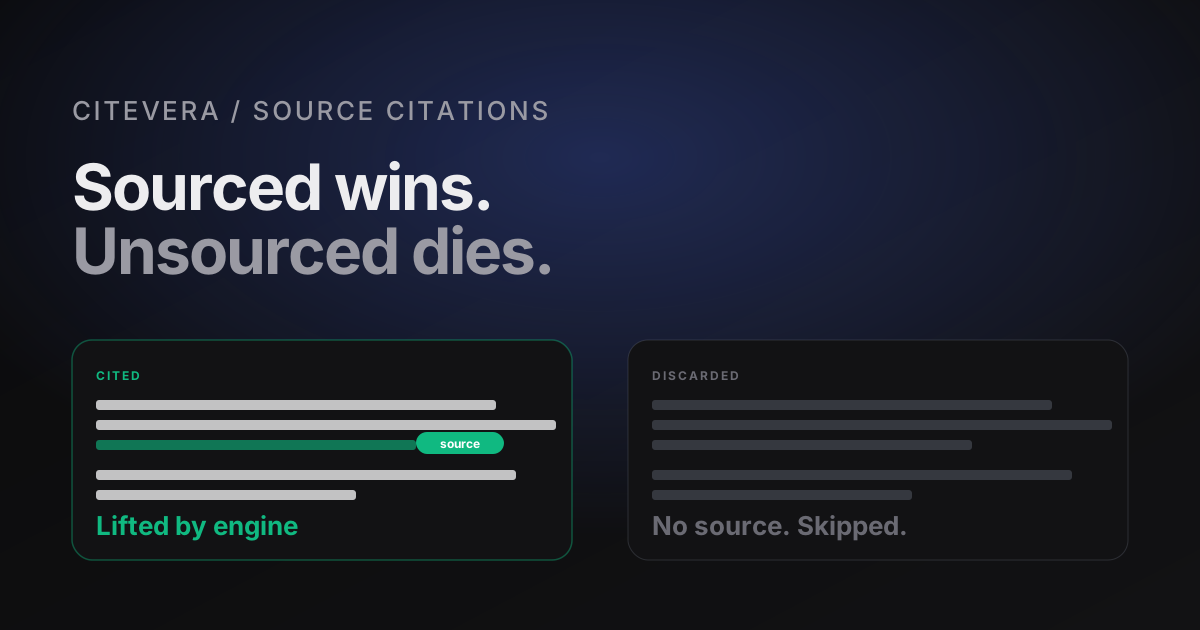
The arbitration rule
When an answer engine has two candidate sources for a fact - your blog and a competitor's blog, for example - and the fact is the same claim, the engine picks the sourced version. This is the most reliable content-quality rule we measure across 2025 and 2026. Unsourced authority does not beat sourced authority, even when the unsourced voice is louder, older, or more linked-to.
The implication for every team doing AEO work: every factual claim in your writing should have a source next to it. Not every sentence. Every fact. The difference between "FAQ schema helps with citation" and "FAQ schema roughly doubles citation rate in our 340-page audit sample" is the difference between a claim that gets discarded and a claim that gets lifted.
This post is the how-to: what counts as a source, how to add them without breaking voice, and which traps to avoid.
What counts as a credible source
Four categories matter, in rough order of weight.
1. Primary research and benchmarks
Your own data (if you run a product that generates it), published academic papers, industry benchmarks with visible methodology, and first-party studies by recognized institutions. These are the gold standard. A sentence linked to a Citevera benchmark ("average audit completes in 52 seconds") or to a Stanford HAI paper carries maximum weight.
2. Authoritative industry publications
The New York Times, The Financial Times, Wired, The Verge, and top-tier trade publications in your vertical. Engines trust these sources because they trust them; the editorial process lends credibility that the engine cannot independently verify.
3. Documentation from major vendors
Google's developer docs, OpenAI's announcement blog, Schema.org itself, RFC documents. When you make a claim about how a specific technology works, the primary docs for that technology are the canonical source.
4. Well-known industry blogs with track record
Blogs that have been publishing original analysis in a space for years, with a visible author byline and consistent quality. Weaker than the above but still meaningfully better than no source.
What does not count
Three kinds of links that look like sources but are not.
Links to your own past posts
Internal linking is good for structure and navigation. It is not a source citation. An engine does not treat a link from your blog to your own other blog as evidence for a claim - it reads as circular. Use internal links for context, but do not rely on them to make your assertions more credible.
Links to social media posts
Twitter, LinkedIn, and Reddit links can be useful for showing what people are saying, but they are not treated as sources for factual claims. The platforms are ephemeral, the attribution is weak, and the content is not reviewed.
Vague "studies show" with no link
The phrase "studies show" without an accompanying link is the classic footnote-theater pattern. It performs the shape of evidence without providing any. Engines detect the pattern and give it no weight.
How to add sources to an existing post
Most posts written before AEO mattered are underlinked. The retrofit is mechanical:
1. Read through the post. On a second pass, underline every sentence that contains a number, a claim about a specific behavior, or an assertion about what works. 2. For each underlined sentence, ask: what source could substantiate this? If you have a number, where did the number come from? If you cited a behavior, what document or study describes it? 3. Link the sentence to the source. Use inline markdown links: FAQ schema lifts citations by roughly 2x (Citevera audit data, 2026). 4. If you cannot find a source for a claim, decide: is this claim strong enough to stand on its own (your own opinion, clearly labeled), or should it be softened or cut? Unsourced hard claims are the pattern engines discount.
A typical 2,000-word blog post should carry 3 to 8 inline source links, concentrated in the first half of the body where the main arguments live. Fewer than 3 and the post reads as opinion; more than 8 starts to interrupt reading flow.
The footnote-theater trap
Some teams, after hearing about source-density, over-correct by adding links that look like sources but are not. Linking "we've seen this across many audits" to your own homepage is theater. Linking "studies show X" to a tweet that mentions X is theater. Linking every common noun to Wikipedia is noise.
The test: if a skeptical reader clicked the link, would they find substantiation for the claim you just made? If yes, the link is real. If they would find a tangentially-related page or a marketing landing page, the link is theater. Engines are getting better at detecting the difference, and theater is a net negative compared to no link at all.
Self-citation done right
You can cite your own data, and you should - if you have real data. The distinction between self-citation that works and self-citation that does not:
Works:
- Linking to a published benchmark page with methodology and sample size.
- Linking to a customer case study with named customers and verifiable outcomes.
- Linking to your documentation when making a claim about your product's behavior.
Does not work:
- Linking to your homepage because "that is the source".
- Linking to a landing page that repeats the claim without evidence.
- Generic "we've found" assertions with no link.
A self-cited claim is only as good as the page it links to. If the linked page does not actually document the evidence, the link does nothing for you.
Style: inline vs end-of-post footnotes
Two mainstream conventions:
Inline links (recommended)
Link the relevant phrase in the sentence. FAQ schema lifts citations by roughly 2x (Citevera audit data, 2026). Readers see the link inline; engines extract it as a contextual source.
Numbered footnotes
Classic academic style. Harder to produce in most CMSes, harder to read on mobile, and harder for engines to correlate with the specific claim. Inline is the 2026 default.
If you have a strong brand-style reason to use numbered footnotes, do so - just make sure the footnote anchor points directly from the claim to the source, not via an aggregate "references" section at the bottom.
The freshness variable
Sourced claims also decay. A 2021 benchmark linked in a 2026 post will be trusted less than a 2024 benchmark on the same topic. When you have a choice, prefer the more recent source. When you are citing your own data, date it clearly: "in our 2026 audit sample of 500 sites" beats "in our audit sample" because the engine can date-weight the source.
Update old posts' citations on your content-freshness passes. A post with a fresh dateModified and fresh source links carries more weight than a post with either alone.
Run a free audit to see which of your pages are making claims without sources
How Citevera scores source density
The audit counts external links in the first half of the body of every blog-category page, weighted by whether the linked domain is in a known authoritative set (publications, docs, academic). Pages with 3 or more credible external links in the first half earn full credit for source density. Pages with zero lose points proportional to how many specific factual claims are present.
On average, adding three well-placed source links to a previously-unsourced post lifts its individual AEO score by 4 to 7 points. Across a blog with 20 posts, a source-link pass can move the overall score by 8 to 12 points.
Frequently asked questions about source citations
Do I have to link to the exact source of every number?
You should. If a number is in your post without a source, the question for you as the writer is: could I actually defend this number if challenged? If yes, link the thing that lets you defend it. If no, cut the number.
Is linking to a paywalled source okay?
Yes. Engines evaluate source credibility, not reader access. A link to a paywalled WSJ article is credible even though most readers cannot follow it. Mix paywalled and free sources when you can, but do not avoid a great source because it is locked.
How do I handle sources that might go 404 over time?
Link-rot is real. The partial fix: for your most important sources, archive them on the Wayback Machine and link both the original URL and the archive. Less important sources can be re-audited during your content-freshness passes and replaced when they rot.
What about AI-generated sources?
Never cite an AI answer as a source. Engines do not trust AI-generated content as evidence for claims; citing it lowers your own credibility. If AI helped you find a source, cite the underlying primary source the AI pointed to, not the AI's summary of it.