

Schema Markup for AI Search: What to Deploy First
Schema markup for AI search sequences by impact: Organization, Article, FAQPage, Product, Review. Here is what to deploy first and what to skip.
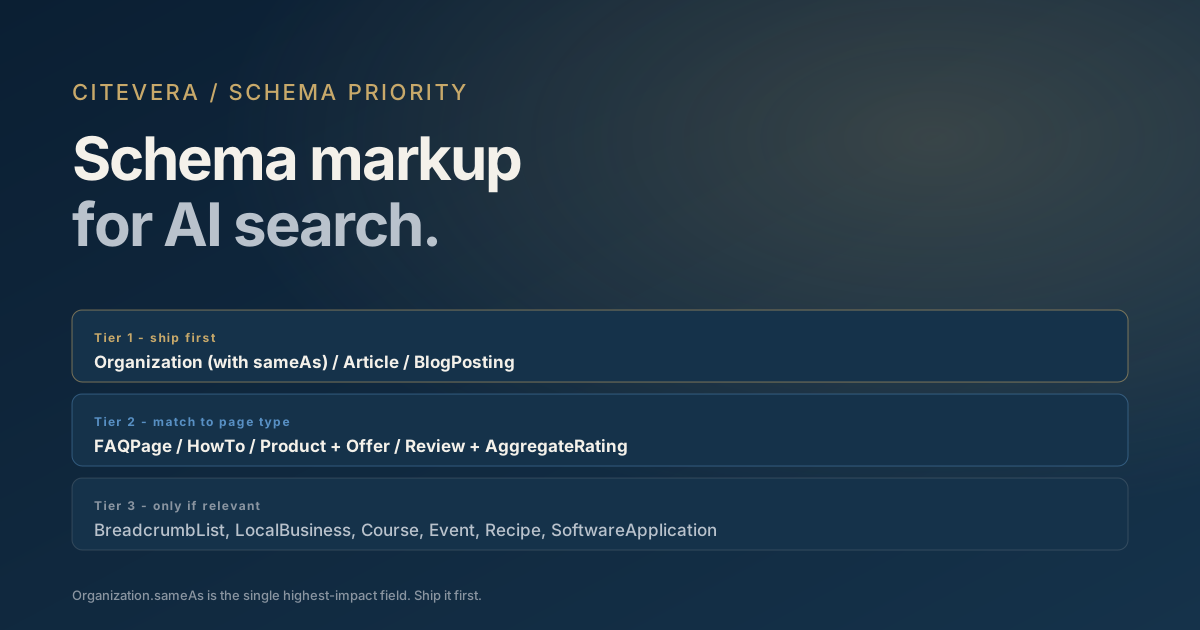
Schema.org has hundreds of types. Most sites do not need most of them. Schema markup for AI search works best when you deploy a small number of high-impact types correctly, then expand only if specific gaps remain. This post sequences the schema types by impact so you can ship the highest-leverage markup first and leave the long tail for later.
The ordering is based on Citevera's audits of several hundred sites and cross-referenced with public AI engine citation patterns. If you are starting from zero schema, ship in this order.
Tier one: deploy before anything else
Two schema types do most of the work in schema markup for AI search. If you can only ship two, ship these.
Organization
Organization JSON-LD on your homepage is the entity graph anchor for your entire site. Without it, AI engines cannot resolve your site to a named entity in their graph. With it, every other schema deployment compounds.
The minimum field set:
{
  "@context": "https://schema.org",
  "@type": "Organization",
  "name": "Your Company Name",
  "url": "https://yourcompany.com",
  "logo": "https://yourcompany.com/logo.png",
  "sameAs": [
    "https://www.linkedin.com/company/yourcompany",
    "https://www.crunchbase.com/organization/yourcompany",
    "https://www.wikidata.org/wiki/Q12345",
    "https://www.g2.com/products/yourcompany"
  ]
}
The sameAs array is the highest-impact single field. It links your site to its known identity across the open web. Sites with complete sameAs get cited at meaningfully higher rates than sites without.
Article
Article (or BlogPosting) JSON-LD on every content page. This gives AI engines structured metadata for citation attribution: author, publish date, headline, image.
{
  "@context": "https://schema.org",
  "@type": "Article",
  "headline": "Your article title",
  "datePublished": "2026-05-03",
  "dateModified": "2026-05-03",
  "author": {
    "@type": "Person",
    "name": "Author Name",
    "url": "https://yourcompany.com/authors/name"
  },
  "publisher": {
    "@type": "Organization",
    "name": "Your Company",
    "logo": {
      "@type": "ImageObject",
      "url": "https://yourcompany.com/logo.png"
    }
  }
}
Every blog post, article, or editorial page should have this. Most modern CMSes generate it automatically; check that yours actually emits it by viewing page source.
Our schema.org for AI engines post covers the field-level details for each Tier 1 type.
Tier two: high-leverage for specific content types
Four types earn their place on pages that match their semantic shape.
FAQPage
For pages that answer explicit questions. Pricing pages with buyer FAQs, documentation with "how do I" sections, category pages with common concerns. FAQPage JSON-LD exposes the Q-and-A structure to AI engines and lets them extract Q-A pairs directly.
Caveat: only use FAQPage when the page genuinely contains the matching question-answer pattern. Forcing FAQ schema on a page that does not actually have FAQs violates Google's spec and risks a rich-results penalty.
HowTo
For step-by-step instructional content. Tutorials, setup guides, troubleshooting articles. HowTo schema gives AI engines a structured view of the sequence.
Our HowTo schema 2026 guide covers the exact field structure and the common mistakes.
Product
For ecommerce or SaaS product pages. Offer, AggregateRating, and sku fields give AI engines the structured data they need to cite your product in comparison queries.
Review and AggregateRating
For pages displaying reviews or ratings. Either embedded reviews on product pages or summary AggregateRating at the category or brand level. Do not invent ratings; AI engines cross-reference third-party platforms and will ignore or penalize unsupported claims.
Tier three: deploy only if relevant
These types are high-leverage when they fit but not required:
BreadcrumbList: on sites with deep navigation hierarchies. See our five-minute BreadcrumbList guide.Course: educational sites with structured curriculaEvent: sites that host recurring eventsJobPosting: career pages (primarily for Google Jobs, with AI citation side effects)LocalBusiness: sites with physical locationsRecipe: food or cooking sitesSoftwareApplication: for detailed SaaS product pages where Product is too generic
If your site does not fit any of these, skip tier three entirely.
What to skip (or defer)
Some schema types get promoted in SEO tutorials but produce marginal or zero lift for AI search. Defer these unless you have a specific reason to ship them.
VideoObject: helpful for video-heavy sites but rarely a top-tier priorityService: generic and often redundant with OrganizationPersonschema on non-author pages: rarely cited unless the person has independent authorityWebSitewith SiteNavigationElement: the AI engine can already parse your navThingat the generic level: more specific types are always better
Shipping tier three or below before tier one and tier two is a common mistake. If Organization and Article are missing or incomplete, adding BreadcrumbList will not help.
A common tier one mistake
One anti-pattern shows up frequently in schema markup for AI search: teams deploy Organization schema but leave the sameAs array empty or half-populated. The Organization block validates, looks structurally correct, and produces near-zero AI citation lift because the entity linkage is the whole point.
If your Organization schema has name, url, and logo but an empty sameAs, you have deployed the outline without the load-bearing content. Think of sameAs as the way the AI engine confirms "this site is actually the organization it claims to be." Without the external links to LinkedIn, Crunchbase, Wikidata, G2, or your Google Business Profile, the engine has no way to verify the claim. Treat sameAs as the first field to populate, not the last.
A second anti-pattern: deploying Article schema on every page indiscriminately, including pages that are not articles (pricing pages, product pages, landing pages). Article schema on a non-article page misrepresents the content type. Use WebPage, Product, or the relevant specific type for non-article content; save Article and BlogPosting for actual editorial content.
How to validate schema markup for AI search
Three checks per page:
1. Run Google's Rich Results Test at search.google.com/test/rich-results against each template on your site. It validates the JSON-LD structure. 2. View page source and confirm the <script type="application/ld+json"> block is present and populated with real values, not template placeholders. 3. Verify fields cross-reference correctly. Organization.sameAs should point to real profiles; Article.author.url should resolve to an author page that itself has Person schema if used.
Validation catches structural errors but does not catch semantic errors (FAQPage on a page without FAQs, Product schema on a page without product). Those require human review.
Rollout sequence
A four-week sequence for schema markup for AI search deployment, assuming you start from zero:
- Week 1: Ship Organization schema on the homepage with complete sameAs. Ship Article schema on every blog post. Validate with Rich Results Test.
- Week 2: Audit pages that should have FAQPage or HowTo schema. Ship the ones that genuinely match. Validate.
- Week 3: Ship Product, Offer, and AggregateRating schema on product and pricing pages. Cross-reference review platform data to avoid unsupported claims.
- Week 4: Evaluate tier three additions. Ship only the ones that match your site's structure.
After week 4, schema maintenance is quarterly: review new content for schema coverage, update stale fields, and retire deprecated types.
Key takeaways
- Schema markup for AI search works best when sequenced: Organization and Article first, then FAQPage, HowTo, Product, Review as a second tier.
- Organization.sameAs is the single highest-impact field. Ship it with complete external profile links before anything else.
- FAQPage and HowTo schema must match the page's actual semantic structure; forcing them on mismatched pages risks penalties.
- Defer BreadcrumbList, VideoObject, Service, and generic types until tier one and two are solid.
- Validate with Google's Rich Results Test, but also do human review for semantic fit.
What to do next
Run a free audit at scan.citevera.com to see which schema types your site is missing, ranked by impact. The report also validates existing schema for structural errors.
If you are on WordPress, the Citevera plugin deploys Organization, Article, and FAQPage schema from inside WP Admin with configurable field mappings.