

HowTo schema in 2026: still alive, still cited
Google deprecated HowTo rich results in 2023 but the schema still matters for AI citation. What HowTo markup does in 2026, when to use it over FAQPage, and the five-element template for procedural content.
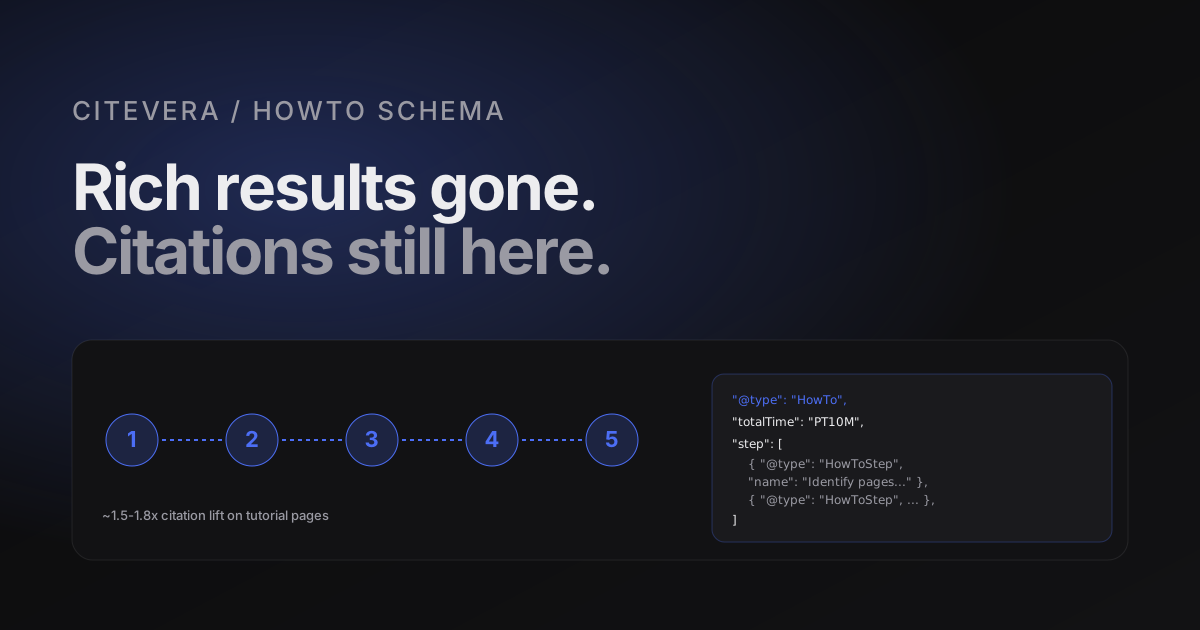
The deprecation myth
In late 2023 Google stopped showing rich results for HowTo schema in organic search. Most commentary at the time concluded the schema was dead. It is not, and the distinction matters: rich results are a rendering feature; structured data is a content feature. HowTo markup kept working as a content-description signal and it is currently one of the highest-leverage schema types for AI citation on procedural content.
In our audit sample, pages with HowTo schema are cited by answer engines at roughly 1.5 to 1.8x the rate of equivalent step-by-step pages without the schema. The lift is larger than FAQPage on tutorial content, because the step-by-step structure matches the query shape "how do I X" more precisely than a Q-A list does.
If you have tutorials, guides, or any content that walks the reader through a sequence, HowTo schema is worth the 20 minutes it takes to add.
When to use HowTo vs FAQPage
This is the most common question. The distinction:
- HowTo describes a sequence. Step 1 depends on Step 0. The ordering is intrinsic to the content.
- FAQPage describes independent questions. The questions stand alone and could be reordered without loss.
A tutorial for "how to install our plugin" is HowTo. A list of questions about our plugin is FAQPage. A page that has both a tutorial and an FAQ can carry both schemas - they coexist without conflict.
The failure mode is using FAQPage for sequential content. An engine extracting from "What is step 1?" / "What is step 2?" / "What is step 3?" structured as FAQ gets less reliable behavior than from HowTo with numbered step entries. The engine has to reconstruct the sequence from the question order; with HowTo the sequence is declared.
The five elements of a HowTo block
A minimally-good HowTo schema block has five elements:
{
  "@context": "https://schema.org",
  "@type": "HowTo",
  "name": "How to add FAQPage schema to a WordPress site",
  "totalTime": "PT10M",
  "supply": [
    { "@type": "HowToSupply", "name": "Admin access to your WordPress site" }
  ],
  "tool": [
    { "@type": "HowToTool", "name": "A structured-data plugin (optional)" }
  ],
  "step": [
    {
      "@type": "HowToStep",
      "name": "Identify pages with a visible FAQ block",
      "text": "List your posts and pages that have a Q and A section visible to readers. Only add FAQPage schema to pages that actually show an FAQ."
    },
    {
      "@type": "HowToStep",
      "name": "Generate or write the FAQPage JSON",
      "text": "Use a schema-markup plugin or write the JSON-LD by hand, listing each visible question and answer."
    },
    {
      "@type": "HowToStep",
      "name": "Validate the schema",
      "text": "Paste the JSON into the Schema.org validator. Fix any errors before shipping."
    },
    {
      "@type": "HowToStep",
      "name": "Publish and verify",
      "text": "Publish the page. Fetch it in Google's Rich Results test or a plain browser-view to confirm the JSON-LD is present in the rendered HTML."
    }
  ]
}
The five elements that matter:
1. name
Mirror the page title. "How to do X" is the standard form; the schema name should match or closely paraphrase the title. Do not put marketing prose here.
2. totalTime
Use ISO 8601 duration format (PT10M for 10 minutes, PT1H for 1 hour). Engines cite this when users ask "how long does X take". Omit only if the time is genuinely variable.
3. supply and tool
These are the lists of prerequisites. supply is things consumed (API key, coffee beans); tool is things used without consumption (a plugin, a browser). Both are optional but both add extractable content the engine can cite when users ask "what do I need for X".
4. step
The sequence. Each step has a name (short) and text (one to three sentences). Numbering is intrinsic to the array order; do not add "Step 1:" to the name because the position conveys that. Include 3 to 10 steps; more than 10 is a sign the tutorial should be split or broken into sub-guides.
5. The visible page structure must match
This is the lift rule from FAQPage all over again. If your HowTo block declares 5 steps, the page must show 5 visible steps with matching names. Engines cross-check, and mismatches penalize the page.
The common mistakes
Three patterns consistently turn HowTo schema from a citation boost into a drag.
1. "Tutorial" content that is not a tutorial
Some teams add HowTo schema to pages that are explanations, not procedures. An article titled "How memory allocation works in JavaScript" is informational, not procedural; adding HowTo schema to it is a mismatch the engine detects. Use HowTo only for "do this, then this, then this" content.
2. Sub-steps inside steps
HowTo supports nested sub-steps (itemListElement inside a step), but in practice deeply-nested markup is poorly-supported across engines. Keep the schema flat: 3 to 10 top-level steps, each one atomic. If a step has three sub-parts, either promote them to top-level steps or fold them into a single paragraph.
3. Generated time estimates that are wrong
If totalTime says "PT5M" but the tutorial takes 45 minutes, readers notice and so does the engine at arbitration time. Estimate honestly. If in doubt, leave the field out rather than invent a number.
Combining HowTo with BlogPosting
A tutorial blog post should typically carry both BlogPosting and HowTo schema. They live in the same <script type="application/ld+json"> block (or two parallel blocks - either is valid) and describe the same page from different angles. BlogPosting provides author, date, and article metadata; HowTo provides the procedural content structure.
Emit them like this:
[
  {
    "@context": "https://schema.org",
    "@type": "BlogPosting",
    "headline": "How to add FAQPage schema to a WordPress site",
    "author": { "@type": "Person", "name": "Jamie Lin" },
    "datePublished": "2026-04-15",
    "dateModified": "2026-04-15"
  },
  {
    "@context": "https://schema.org",
    "@type": "HowTo",
    "name": "How to add FAQPage schema to a WordPress site",
    "step": [ ... ]
  }
]
Both blocks feed the citation decision. A cited BlogPosting gets the article-level credit; a cited HowTo gets the procedural-level credit. Sites that emit only one of the two leave lift on the table.
Run a free audit to see which tutorial pages on your site are missing HowTo schema
How Citevera scores HowTo coverage
The audit detects tutorial-shaped content (numbered step lists, H2/H3 patterns matching "Step 1" / "Step 2") and flags any such page that lacks HowTo schema. Adding HowTo on flagged pages typically lifts the schema sub-score by 6 to 10 points. On sites with a documentation or tutorial section, this is usually the highest-leverage schema change we recommend.
The audit also flags the reverse case - HowTo schema on pages without visible step structure - and weights it as a penalty. Both directions matter.
Frequently asked questions about HowTo schema
Does Google still reward HowTo schema in organic search?
Not with rich results in most cases. It still contributes to content understanding and AI Overviews citation. The rich-result deprecation was cosmetic; the underlying signal remains.
Can I use HowTo for a multi-page tutorial series?
Split the series into parts where each page has its own HowTo block describing one complete procedure. Linking between parts via BreadcrumbList or a partOf reference lets the engine understand the series structure.
Should I include images in HowTo steps?
Yes, if you have them. Each step can include image pointing at a step-illustration. Engines that cite tutorial content sometimes quote or link the images. If you do not have images yet, ship without them rather than blocking on image creation.
What about video tutorials?
VideoObject schema handles those. HowTo and VideoObject can coexist on a video page, with the HowTo describing the steps and the VideoObject describing the video itself. Engines treat them as complementary.