

Entity Alignment: Why AI Cites Some Brands and Not Others
Entity alignment ai citations work because AI engines cite entities, not URLs. Here is how entity alignment works and how to audit yours.
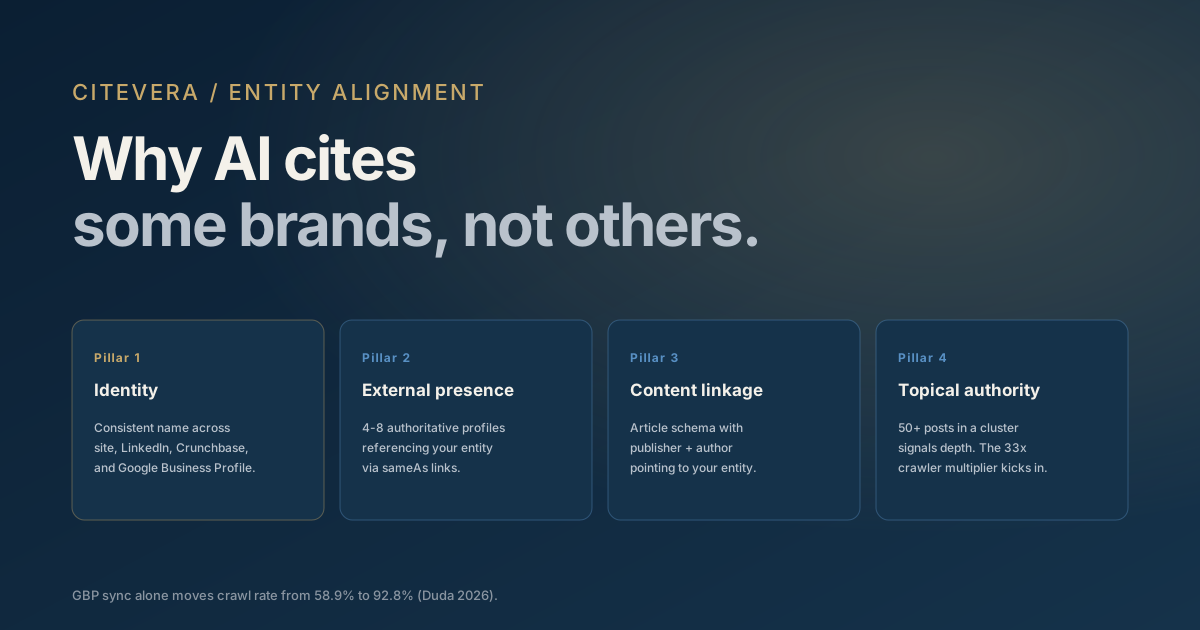
Two sites with similar content quality, similar traffic, and similar schema deployment can see very different AI citation rates. The difference is usually entity alignment ai citations: how cleanly the AI engine resolves your site to a named entity in its knowledge graph.
This post covers what entity alignment actually is, why it is the most undermeasured factor in AI citation performance, and how to audit your own entity alignment quality in 30 minutes.
The citation-by-entity mechanic
When ChatGPT, Claude, Perplexity, or Gemini produce an answer that cites a source, the underlying selection works at the entity level first and the URL level second. The engine asks: "what are the relevant entities for this topic?" Then: "what content from those entities best answers the question?"
Entity alignment is how confidently the engine can answer the first question for you. A site with strong entity alignment is "Citevera, the AI search readiness audit tool, based in [location], founded in [year], has customers including [X], [Y], [Z]." A site with weak entity alignment is "some URL that mentions AI search." The first gets cited. The second gets skipped.
Per Duda's February 2026 study (a single-platform, correlational dataset), sites with Google Business Profile sync saw a 92.8% AI crawler rate versus 58.9% without. GBP sync is one of several entity alignment signals; the gap captures part of the broader entity alignment effect.
The four pillars of entity alignment
Entity alignment is not a single signal. It is a set of four related signals that compound.
Pillar 1: entity identity
The engine needs to know, unambiguously, what your entity is called. This is set by your Organization JSON-LD's name field, repeated consistently across your site header, about page, and external profiles.
Common breaks:
- Your company name on LinkedIn is "Citevera" but your Organization schema says "Citevera, Inc."
- Your Twitter handle says "@citevera_ai" but your Organization schema links to a different sameAs URL
- Your Google Business Profile name includes a city suffix ("Citevera LLC - San Francisco") not matching any other surface
Each inconsistency makes the engine less confident that all the signals refer to the same entity. The citation rate suffers accordingly.
Pillar 2: entity external presence
Your entity exists in the engine's world if other authoritative sources reference it. Authoritative sources include:
- LinkedIn company page
- Crunchbase profile
- Wikidata entry
- G2, Capterra, Trustpilot, Clutch profiles (if applicable)
- Google Business Profile
- Industry trade publications
- Your founder/executive LinkedIn profiles with matching worksFor
The more authoritative external profiles reference your entity, the stronger the alignment. Sites with one or two external links lose to sites with five to ten on the same content quality.
Pillar 3: entity-content linkage
Your content needs to be attributable to your entity. This means:
- Article JSON-LD with publisher field pointing to your Organization
- Author schema with worksFor linking to your Organization
- Consistent author bylines across posts
- Site-level footer or header that clearly identifies the entity
Content that floats disconnected from any entity gets indexed but rarely cited. Content clearly attributed to a strong entity compounds the citation value of that entity.
Pillar 4: entity topical authority
The engine assigns topical authority to entities, not URLs. Citevera has topical authority on AI search readiness because most of its content is about AI search readiness. A generalist site with one post on AI search has weak topical authority regardless of how good that single post is.
Building topical authority requires depth: 50+ posts on a topic cluster is the threshold where the 33x crawler-visit multiplier kicks in (Duda 2026). Our content depth in AI search post covers the depth mechanics.
Why entity alignment ai citations are undermeasured
Most AEO audits focus on technical signals: crawler access, schema validity, heading structure. These are all important. But they are measured in isolation, and the entity-level picture that connects them is usually missed.
A site can pass every technical check and fail entity alignment if:
- Organization schema exists but sameAs is empty
- External profiles exist but are not linked via sameAs
- Content is attributed to anonymous "admin" or "team" bylines instead of named people
- Topical content is scattered across unrelated themes without depth in any
These failures do not show up in standard schema validators because the schema is structurally valid. They show up in citation rates.
A 30-minute entity alignment audit
A practical check you can run on your own site in 30 minutes.
Step 1: Check your Organization schema. View source on your homepage. Find the Organization JSON-LD block. Confirm:
namematches exactly across LinkedIn, Twitter, and Google Business ProfilesameAsincludes 4 to 8 external profiles- Each sameAs URL resolves to a real profile that back-references your entity
Step 2: Check your Person schema coverage. Pick 3 recent blog posts. View source on each. Confirm each has:
- An author field that resolves to a Person schema (not just a text name)
- The Person has worksFor linking to your Organization
- The Person has sameAs linking to their LinkedIn, Twitter, or similar
Step 3: Run a manual entity resolution query. Ask ChatGPT or Perplexity: "What is [your company name]?" A site with strong entity alignment gets a clean, factually-accurate answer with 2 to 4 cited sources. A site with weak entity alignment gets an uncertain answer or an answer that conflates your entity with another.
Step 4: Test the competitor gap. Run the same query for your top 3 competitors. If their answer is noticeably richer than yours (more facts, more cited sources, more confident), your entity alignment is the gap.
How to strengthen entity alignment
If the audit surfaces gaps, four interventions close them in order of leverage.
1. Deploy complete sameAs. If your Organization schema has empty or partial sameAs, populate it immediately. This is the single highest-leverage fix in entity alignment ai citations work.
2. Create missing external profiles. If you lack a Crunchbase profile, Wikidata entry, G2 listing, or similar, create them. Each adds an entity signal. Wikidata specifically is high-leverage because it is machine-readable and feeds several AI engine knowledge graphs directly.
3. Name your authors. Replace "admin" or "team" bylines with named people. Deploy Person schema on author pages with complete worksFor and sameAs.
4. Build topical depth. If your content is scattered, pick 2 or 3 core topics and commit to 50+ posts in each over the next four to six quarters. Topical depth compounds entity alignment over time.
Measuring entity alignment over time
Entity alignment is slow-moving. You cannot ship it in a week and see citation changes immediately. The compounding effect runs over months.
A reasonable measurement cadence:
- Monthly: run the manual entity resolution query against the four major AI engines. Record confidence and citation count.
- Quarterly: update your sameAs array if new authoritative profiles exist. Refresh Wikidata if structure has changed. Verify LinkedIn, Crunchbase, and G2 profiles are current.
- Annually: review the entity-alignment audit end-to-end. Close gaps that appeared during the year.
Citevera's audit includes entity-alignment scoring as one of the five stages of the AEO funnel. It covers Organization completeness, Person coverage, and topical depth in a single pass.
Key takeaways
- AI engines cite entities, not URLs. Entity alignment is how cleanly your site resolves to an entity in the engine's graph.
- Four pillars: entity identity, external presence, entity-content linkage, topical authority.
- Most AEO audits miss entity alignment because individual technical signals can pass while the entity-level picture fails.
- A 30-minute audit covers Organization schema completeness, Person coverage, and a manual entity resolution query.
- Strengthening entity alignment is slow-moving work; expect 2 to 3 months of lag between investment and citation changes.
What to do next
Run a free audit at scan.citevera.com to see your entity alignment score across all four pillars. The report flags missing sameAs entries, Person schema gaps, and topical depth shortfalls.
For the schema structure that supports entity alignment, see schema.org for AI search: the entity graph blueprint.