

Wikipedia, Wikidata, and AI Visibility: What Actually Helps
Wikipedia and Wikidata carry outsized weight in how AI engines describe entities - but most SMBs do not qualify and self-editing backfires. The legitimate paths.
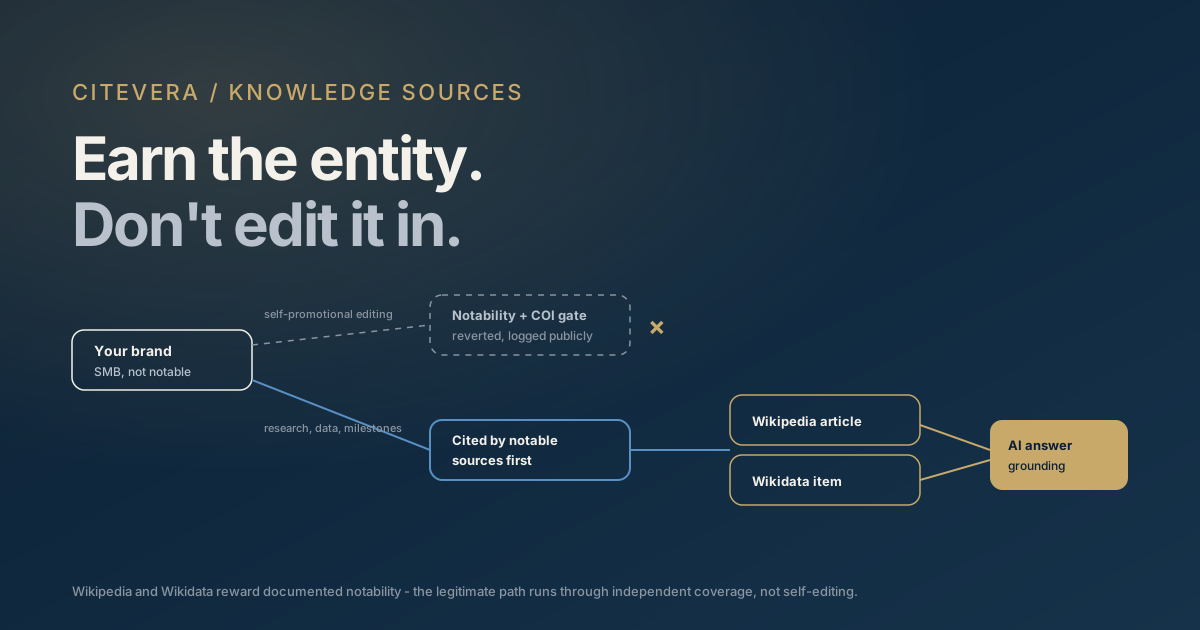
Wikipedia and Wikidata punch far above their weight in how AI systems describe the world - and for most small and mid-sized businesses, the honest answer about getting into them is: you do not qualify yet, and trying to force it will hurt you. Wikipedia's notability guidelines exclude the large majority of companies, self-promotional editing violates its conflict-of-interest policy, and the cleanup community is very good at detecting and reverting it - often leaving a public record of the attempt attached to your brand's name.
That does not make this topic irrelevant to you. It means the useful question is not "how do I get a Wikipedia page" but "what do these sources actually do inside AI systems, which parts can I legitimately influence, and what is the real path for a company that is not notable today?" This post answers that, ethics first, because in this particular arena the ethical path and the effective path are the same one.
Why these two sources carry outsized weight
Two separate mechanisms are at work, and they operate at different stages of an AI system's life.
Training. Wikipedia is among the most consistently included corpora in large language model training - it is high-quality, encyclopedic, entity-dense, and openly licensed, and it appears both directly and through web-scale crawls like Common Crawl. A model that trained on your Wikipedia article has your identity woven into its weights: it can describe you with no retrieval at all. A model that never saw you in training knows only what retrieval hands it at query time.
Retrieval and grounding. When ChatGPT, Perplexity, or Gemini answer an entity question live, Wikipedia articles rank well in the underlying search indexes and are treated as safe, neutral summaries to ground on. Wikidata plays a quieter role: it is a structured, machine-readable graph of entities and facts that feeds knowledge-graph systems - Google has long drawn on it among other sources for its Knowledge Graph - and its identifiers help systems resolve which "Mercury" or which "Apex Software" a document is about. That resolution job is the same one your own sameAs markup does from the other end, as we covered in the entity confusion post.
So the prize is real. That is exactly why the gate matters.
The notability reality check
Read Wikipedia's notability guidelines before you spend a single hour here. The core requirement is significant coverage in reliable, independent, secondary sources. Significant means the source is substantially about you, not a passing mention or a funding-round listicle. Independent means not your website, your press releases, your paid placements, or interviews where you supply the content. Reliable means publications with editorial oversight.
Most SMBs - including successful, profitable, beloved ones - do not clear this bar. That is not an insult; it is the design. Wikipedia is an encyclopedia of things the world has already documented, not a directory of things that exist. If the independent coverage does not exist yet, no editing strategy manufactures notability, and an article created without it gets deleted through processes that are public and searchable.
Wikidata's bar is lower but not zero: its notability policy requires, roughly, that an item refer to a clearly identifiable entity and be describable using serious, publicly available references, or fulfill a structural need in the graph. A real company with verifiable existence - registration records, coverage, an established web presence - can often sustain a modest Wikidata item when an equivalent Wikipedia article would not survive.
Why self-promotional editing backfires
Writing about yourself on Wikipedia is not just risky - paid or interested editing without disclosure violates Wikipedia's conflict-of-interest policy, and undisclosed paid editing violates the Wikimedia Foundation's terms of use. Say it plainly: do not write your own article, do not have your agency write it, do not hire a fixer who promises placement.
The failure mode is worse than "the article gets deleted". Deletion discussions are public and permanently archived, and they surface in search. Accounts get flagged and blocked; sock-puppet investigations get named after the companies involved. Your brand's most durable Wikipedia footprint can end up being a deletion log that says "promotional, non-notable, undisclosed paid editing" - which is now itself a document that retrieval systems can find when someone asks about you. In an ecosystem where AI engines weigh sentiment and context of mentions, manufacturing the wrong mention is strictly worse than having none.
If you have a genuine, verifiable factual error on an existing article about you, there is a sanctioned route: declare your conflict of interest on the article's talk page, propose the correction with an independent source, and let uninvolved editors make the change. It is slower than editing directly. It also works, and it leaves a paper trail that helps you rather than harms you.
What you can legitimately do
Path 1 - earn the coverage first. Notability follows documentation, so the real project is becoming documented: original research and data that journalists cite, expert commentary, genuinely newsworthy product milestones, founders who publish. This is slow and indistinguishable from good marketing, because it is good marketing. Publishing original research is the single most reliable engine here - a dataset that ten trade publications cite does more for eventual notability than any outreach campaign, and every one of those citations is independently valuable for AI visibility long before any encyclopedia notices.
Path 2 - a modest, well-referenced Wikidata item. Where the notability bar is met, a Wikidata item for your company or product - legal name, official website, industry, founding date, identifiers, each backed by a serious public reference - is legitimate infrastructure. Follow the same COI discipline: edit under a declared account, add only verifiable referenced facts, and never puff. An item that reads like a registry entry survives; one that reads like a brochure gets stripped or deleted.
Path 3 - link your entity graph to theirs. Whatever exists about you in these systems, connect it. Your Organization schema's sameAs array should point at your Wikidata item if you have one, and your Wikidata item should point at your official website. This closes the resolution loop from both ends and is entirely under your control - it is the same entity home discipline applied outward, and part of the broader entity alignment work of making every description of you agree.
Path 4 - strengthen the sources AI engines already use. Wikipedia is one grounding source among many. Retrieval-backed engines also lean on documentation, comparison content, industry publications, and community discussion. For a non-notable SMB, effort spent making your own site the best available document about your category beats effort spent gaming an encyclopedia - and unlike Wikipedia, that channel has no gatekeeper.
Frequently asked questions
Does my business need a Wikipedia page to show up in AI answers?
No. A Wikipedia article helps when a model or engine describes you, but engines answer commercial and category queries from ordinary web sources every day - documentation, comparison pages, reviews, industry press. Plenty of companies with zero Wikipedia presence get cited constantly because their own pages are the best available answers. Wikipedia is an amplifier for entity-level questions, not a prerequisite for citation.
Can I just create my own Wikidata entry?
Sometimes, carefully. Wikidata's notability bar is lower than Wikipedia's, and factual, well-referenced items about clearly identifiable companies and products are within policy. Use a declared account, cite serious public references for every claim, and keep it to registry-style facts. If your item's references are all your own website, expect it to be challenged.
Someone else wrote a wrong or outdated article about us. Can we fix it?
Yes, through the sanctioned route: post on the article's talk page, disclose your affiliation, cite an independent source for the correction, and request the edit. Direct editing of your own article - even to fix genuine errors - invites reverts and COI scrutiny that costs more than the error did. For urgent defamation-level problems, Wikipedia has formal channels; use them rather than edit-warring.
If we hire an agency that guarantees a Wikipedia page, what happens?
Best case, you waste the fee. Typical case, the article is deleted, the accounts are blocked, and your brand is named in a public deletion or sock-puppet record that persists indefinitely and is itself retrievable by AI engines. Guaranteed-placement offers are, almost by definition, undisclosed paid editing - the exact practice the terms of use prohibit. Decline.
Measure what the engines actually say
The Wikipedia question is really a proxy for a better one: what do AI engines currently say about your brand, and which sources are they grounding on? That is measurable today - no encyclopedia required. Citevera's paid plans bundle citation monitoring across ChatGPT, Claude, and Gemini, so you can see whether you are described accurately, cited at all, and gaining or losing ground; the audit scores the entity signals on your own site - the ones no gatekeeper can take away. Fix those first. If the independent coverage comes later, the encyclopedias will follow it, in that order.