

Citation Sentiment: Negative vs. Positive AI Mentions and What to Do About Them
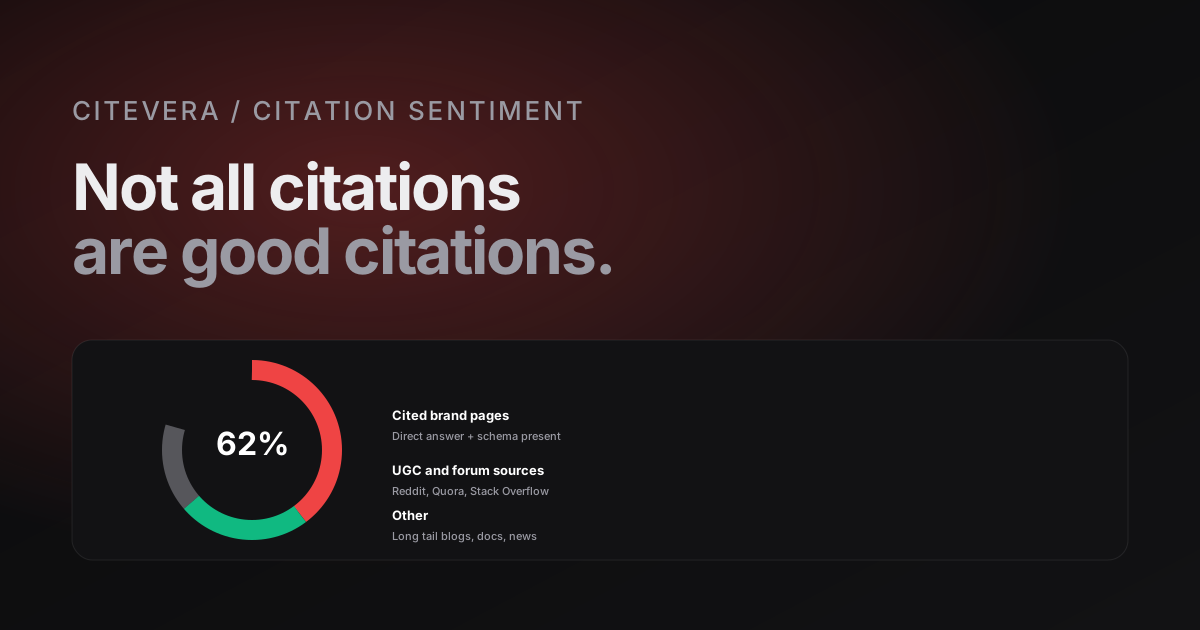
Not all citations are good citations. AI engines sometimes cite your brand to recommend against you. Here is how to detect, diagnose, and respond to negative-sentiment mentions.
The hidden category in citation tracking
Most teams tracking AI citations measure citation count and citation rate. Both are useful but neither captures sentiment. A brand cited 50 times in a month is doing well if those citations are positive; the same brand is doing badly if the citations are "X has poor support, consider alternatives."
We see this gap in nearly every monitoring program we set up. Teams assume citations are uniformly positive because most are. The minority that are negative tend to cluster on specific queries, specific competitors, or specific reputational issues - and that clustering is exactly the diagnostic signal that makes sentiment tracking valuable.
How AI engines arrive at sentiment
AI engines do not "feel" anything about your brand. They produce sentiment-laden mentions when their training data contains sentiment-laden source material. If reviewers, customers, or commentators have written negative things about your brand on the web, those framings show up in AI answers.
The mechanism is unsurprising. The engine retrieves sources, extracts claims, and reproduces the framing of the source material. A page that says "X is unreliable, choose Y instead" gets summarized as "X is considered unreliable; alternatives include Y."
This is why poor reviews on G2, Capterra, Trustpilot, and Reddit translate to negative AI citations months later. The reviews enter the engine's effective knowledge base; the engine produces summaries that reflect that knowledge.
The three categories of negative mention
Across our monitoring data, negative AI mentions cluster in three categories.
Customer service complaints. The most common. "X has slow customer support." "X took 3 weeks to respond to my refund request." These echoes from review sites get picked up readily and surface in answers about reliability or support quality.
Pricing or value complaints. "X is overpriced for what you get." "X charges hidden fees." These trace back to specific reviews or comparison articles. Often disproportionate to the actual customer experience because complainers post more often than satisfied customers.
Specific feature-failure complaints. "X is missing Y feature that competitors have." "X integration with Z is broken." These are usually accurate but partial - they reflect the reviewer's specific moment in time, not current product state.
Each category has a different remediation path.
Remediation pathway
For customer service complaints, the path is operational and slow. Improve actual support, then build a steady stream of new reviews from satisfied customers to dilute and eventually overwrite the older negative reviews. AI engines weight recency, so recent reviews dominate older ones over a 6-12 month window.
For pricing complaints, the path is partly editorial. Publish content that explains pricing rationale, total cost of ownership comparisons, and customer-quoted ROI examples. Engines pick up new authoritative content on pricing and balance the older complaint material.
For feature-failure complaints, the path is product plus content. Ship the missing feature or fix the broken integration, then publish documentation, changelog entries, and customer success stories that demonstrate the issue is resolved. Stale negative content lingers; new authoritative content displaces it over time.
In all three categories, direct response from the brand on the source platform (responding to reviews, commenting on threads, publishing official statements) accelerates remediation. AI engines pick up brand response signals as part of their context.
What not to do
Three responses to negative AI mentions tend to backfire.
Astroturfing reviews. Buying or coercing positive reviews to dilute negative ones. Detected by review platforms and by engines, with reputational consequences worse than the original problem.
Removing negative reviews. Unless the review is factually false (and you have legal recourse), removing reviews looks defensive and often violates platform terms. The remediation goal is to outweigh, not erase.
Demanding engines stop citing. No mechanism exists. Engines cite based on their training and retrieval. The only path is to change what they retrieve.
The honest read: if your brand has accumulated negative AI sentiment, you have a real customer-experience or product issue underneath it. Fixing the underlying issue is the only durable solution. Sentiment lifting follows operational improvement.
Tracking sentiment over time
Citation sentiment moves quarter-to-quarter. Tracking it requires:
Per-engine, per-prompt sentiment classification. Each AI response is classified as positive, neutral, or negative for your brand mention. Citevera Monitoring uses Haiku 4.5 for this classification with a custom rubric.
Source URL tracking. When a negative mention appears, capture the source URL the engine cited. This identifies which review or article is driving the negative sentiment, which guides remediation.
Trend analysis. Sentiment shifts faster than citation rate during major incidents (a viral negative review, a product outage). Slower changes (3-6 month windows) indicate gradual reputation movement.
Competitor sentiment baseline. Your brand's sentiment is more meaningful relative to competitor sentiment. If three competitors are all 60% positive and you are 40% positive, you have ground to make up. If everyone in the category is 40% positive, your gap may be category-wide rather than brand-specific.
How Citevera scores this
The Citevera Monitoring product classifies every tracked-prompt response on three sentiment levels (positive, neutral, negative) and surfaces the trend over time. The dashboard breaks sentiment by engine and by prompt, so you can see whether negative mentions cluster on specific question types or specific engines.
The audit complements monitoring by identifying source-content patterns associated with negative sentiment: review platform presence, support documentation gaps, comparison-page weak spots. The recommendation set guides remediation toward content investments most likely to shift sentiment.
Track citation sentiment across engines with Citevera Monitoring
Frequently asked questions
How often does sentiment classification disagree with reality?
The classifier (Haiku 4.5 with a tuned prompt) agrees with human raters on roughly 92% of cases in our calibration set. Edge cases include neutral mentions misclassified as positive, sarcasm misclassified as positive, and contextual qualifications. Treat sentiment as a strong signal but verify outliers manually.
Should I track sentiment on every prompt or just key ones?
Every prompt has citation potential. Sentiment changes across prompt sets reveal whether the issue is brand-wide or topic-specific. Track all prompts in your monitoring set; the marginal cost is small.
What if a single negative review is dominating my AI sentiment?
Identify the review, respond on the platform, then build new positive content around the same topic to displace it in retrieval. Engines weight recency; sustained new content outperforms a single old viral negative review over 3-6 months.
Can I push positive content into engines directly?
Indirectly. Publish content on your own site, on guest blogs, on review platforms (encourage customer reviews). Engines retrieve from the open web; you cannot inject into their indices but you can shape what they retrieve.
Does sentiment matter as much as citation rate?
For some questions, more. A brand cited 100 times negatively is worse than one cited 30 times positively. Track both; act on the composite.
How quickly does sentiment recover after a major customer-service improvement?
Six to twelve months typically. The lag has two components: time for new positive reviews to accumulate (3-6 months) and time for engines to reweight on the new signal (additional 3-6 months). Steady operational improvement plus active review-velocity programs accelerate the curve. One-shot fixes that decay back to old patterns produce no durable sentiment lift.
Can I have positive sentiment overall but negative sentiment on specific queries?
Yes, very commonly. Brands often have positive overall sentiment driven by core-product satisfaction but negative sentiment on specific topics like pricing, support, or particular features. Per-prompt sentiment tracking surfaces these clusters. Remediation should target the specific topic clusters, not broad brand reputation.