

Entity Disambiguation in AI Search: Why AI Engines Confuse Brands and How to Fix It
When two companies share a name, when products have generic terms, or when locations clash with brands, AI engines confuse entities. Here is the disambiguation playbook.
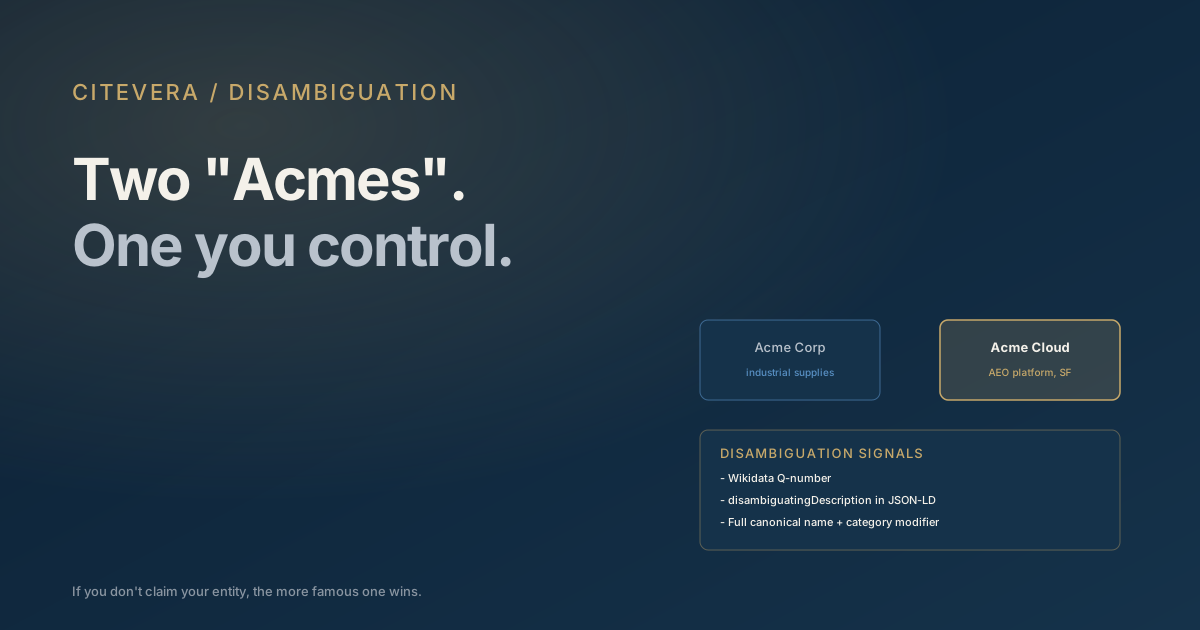
If your company name shares spelling or sound with another business, a place, a generic term, or a celebrity, AI engines have a problem. They cannot reliably tell which "Acme" the user means, so they hedge, mix sources from multiple entities, or pick the more famous one. This is entity confusion, and it is one of the most invisible AEO problems because it does not show up as low rankings - it shows up as inconsistent or wrong citations.
This post covers the entity confusion patterns AI engines fall into, the signals that drive disambiguation, and the playbook for sites whose name is not unique.
When entity confusion happens
Five common scenarios:
Same-name competitors
> "Acme" exists as a Looney Tunes-style fictional company, dozens of real businesses, a Wisconsin city, and a movie. AI engines have to pick which one fits the query.
If your brand shares its name with even one well-known other entity, the model is doing disambiguation on every query that mentions you.
Generic product terms
> "Citevera" is invented and unique. "Cloud Office" is generic. A company called "Cloud Office" competes against the descriptive phrase across millions of unrelated documents.
Generic naming costs you in AEO until your brand entity becomes strong enough to dominate the descriptive phrase.
Location clashes
> "Boston Consulting" the company vs "Boston consulting" the descriptive phrase. AI engines often confuse the two without explicit disambiguation.
Person vs company
> "Banana Republic" the clothing chain vs "Banana Republic" the historical political concept. The fashion brand resolved this through entity strength built up over decades.
Subsidiary vs parent
When a parent and subsidiary share branding, AI engines often confuse which entity is being referenced.
How AI engines actually disambiguate
The mechanisms are observable across engines:
Wikipedia and Wikidata as primary anchor
When two entities share a name, the engine often consults Wikipedia disambiguation pages or Wikidata. The entity with stronger Wikipedia presence wins citations on ambiguous queries unless the user explicitly disambiguates.
sameAs cross-references
A complete sameAs array (covered in the Organization schema deep-dive) gives engines multiple corroborating sources. The entity with more well-aligned sameAs anchors wins.
Location and category signals
If the user's query includes a location or category modifier ("Acme in San Francisco" or "Acme cloud platform"), the engine uses these to disambiguate. Sites that surface their location and category prominently get correctly resolved more often.
Recency and activity
Engines prefer entities that are currently active. A defunct company that shares your name will fade if you have ongoing fresh content; if you do not, the defunct entity might still surface for some queries.
Source corroboration
When multiple sources consistently use a name in one sense, the engine learns that meaning. A pattern of news coverage, GitHub mentions, and industry references all using "Acme" to mean your company beats sporadic mentions of competing entities.
The disambiguation playbook
Six tactics to claim your entity space:
Tactic 1: Wikipedia or Wikidata entry
The single highest-impact disambiguation move. If your company qualifies for Wikipedia notability, get an entry. If not, create a Wikidata entry, which has lower bar.
A Wikidata entry with:
- Your full company name and any alternative spellings.
- Your industry classification.
- Your headquarters city.
- Your founding date.
sameAsto your website, LinkedIn, Crunchbase, etc.
becomes the canonical entity reference engines use to break ties.
Tactic 2: Strong Organization schema with disambiguating context
Your Organization schema should include disambiguatingDescription:
{
  "@type": "Organization",
  "name": "Acme Cloud",
  "disambiguatingDescription": "Acme Cloud is the AEO platform company headquartered in San Francisco; not to be confused with Acme Corp, the industrial supplies brand.",
  "url": "https://acme.example",
  "industry": "Computer Software"
}
disambiguatingDescription is a schema.org property explicitly designed for this. Most teams skip it.
Tactic 3: Use your full canonical name consistently
If your name is ambiguous when shortened, use the full version everywhere. "Acme Cloud" not "Acme". Train your team to use the canonical form in all communications, press releases, social posts, and documentation.
Tactic 4: Address your category in metadata
Title tags, meta descriptions, og:description, and the H1 on your homepage should include your category in plain language: "Acme Cloud - AEO platform for B2B SaaS marketers". This is small but compounding signal across millions of crawls.
Tactic 5: Build third-party brand mentions in disambiguating contexts
When industry analysts, news outlets, and review sites mention your company, they typically include category and location context. The corpus of disambiguating mentions becomes the engine's training signal.
Tactic 6: Strong founder/executive entities
Named executives with their own LinkedIn presence and external citations create person-entity anchors that further disambiguate the company. "Sarah Chen, CEO of Acme Cloud" is a triangulation point.
What disambiguation problems look like in practice
Two diagnostic patterns:
Hedged AI responses
When you query "what is [your brand]" in an AI engine and the response begins with "It depends on which Acme you mean. There is..." you have an obvious entity confusion problem.
Wrong-entity citations
When the engine confidently answers but cites information from a different entity (a competitor, a location, a person with the same name), you have a less obvious but more damaging problem because users see the wrong information attributed to your brand.
Manual query testing across the four major engines monthly catches both patterns. Test 5 to 10 queries that should resolve to your brand and review the responses.
When entity disambiguation is impossible to fully resolve
Some name choices are uphill battles. Three honest cases:
- Names that are common English words. "Apple", "Sun", "Oracle". These were resolved through massive entity strength over decades and no AEO program can replicate that quickly.
- Names that share with celebrities or fictional characters. Cultural references can dominate.
- Names that are also locations. Strong local SEO signal can confuse business resolution.
When you are starting from a name like this, set realistic expectations: full disambiguation is a multi-year project. Focus on category and location modifiers in queries; users searching for "[your brand] [category]" will resolve correctly even when "[your brand]" alone does not.
Renaming as a last resort
If entity confusion is severe and persistent, renaming is sometimes the right call. Three considerations:
- Build the new name's entity strength before retiring the old. Run both for 6 to 12 months with explicit "formerly known as" framing.
- Migrate the entity graph. Update Organization schema,
sameAsarrays, Wikipedia/Wikidata, social handles, and DNS. Each change is a signal to engines. - Press releases announcing the rename carry the rename through wire syndication and reinforce the new entity.
Most companies do not need to rename. Better disambiguation tactics suffice for 90% of cases.
Tracking disambiguation health
Three metrics worth following:
- Manual query test pass rate. Of 10 monthly queries, what percentage resolve correctly to your brand?
- Wrong-entity citations. When AI engines cite your brand for content that isn't yours, log it.
- Brand-mention sentiment. When your brand is correctly identified, is the surrounding context favorable, neutral, or unfavorable?
The first metric is the simplest. A disambiguation health score of 8 of 10 or better means the engine reliably resolves your entity. Below 6 of 10 means active disambiguation work is overdue.
Key takeaways
- Entity confusion is invisible until you test for it. Manual query testing catches it.
- Wikipedia or Wikidata entry is the single highest-impact disambiguation move.
- Organization schema's
disambiguatingDescriptionproperty is purpose-built for this and underused. - Use your full canonical name consistently across all communications.
- Some name choices require multi-year disambiguation programs; renaming is occasionally the right call.
What to do next
Run a free audit at scan.citevera.com to see whether your brand has the entity infrastructure (Organization schema, sameAs array, disambiguatingDescription) needed to win against same-name confusion.
For the foundational entity work, Organization schema deep-dive covers the underlying structure that disambiguation builds on.