

Organization Schema for AEO: A Deep-Dive Implementation Guide
Organization schema is the single most under-implemented AEO signal. Here is the full property list, the sameAs strategy, and the pitfalls that quietly disqualify your entity.
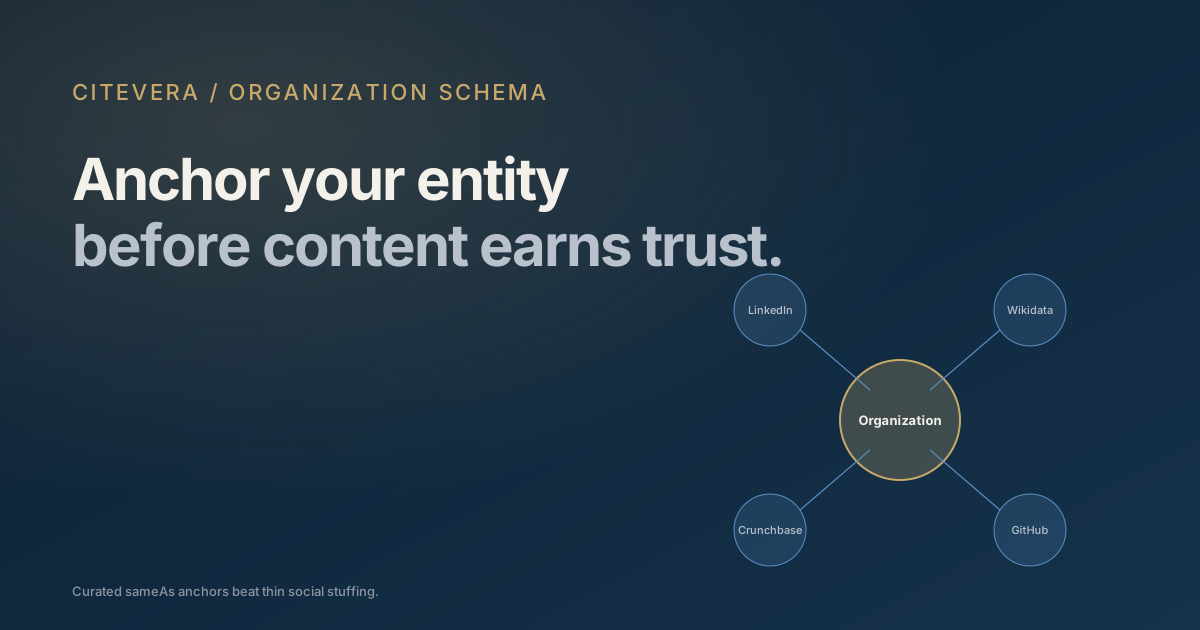
Organization schema is the JSON-LD block that tells AI engines who you are as a business entity. Without it, every other AEO signal you ship lands on a page the model cannot confidently associate with a known company. With it, the same content stacks toward an entity the model can resolve, cite, and disambiguate from competitors.
This post is the deep-dive: every property worth populating, the sameAs strategy that actually works, the validation pitfalls, and how Organization schema interacts with the rest of your AEO stack.
Why Organization schema sits at the top of the AEO stack
AI engines retrieve fragments and resolve them to entities. A passage that says "our platform reduced churn by 31%" is unattributed text. A passage on a page that publishes Organization JSON-LD with a populated sameAs array is a claim from a resolvable company.
The model is doing entity resolution under the hood. That resolution gets easier when you publish:
- A canonical company name (
name) - A canonical URL (
url) - A logo (
logo) - External identity anchors (
sameAs) - Optional but valuable: founders, founding date, NAICS code, contact channels
When the model is asked "what is the leading platform for X?" and several competitors all have content claiming to be the leader, the engine breaks the tie partly through entity strength. Organization schema is the cheapest way to materially strengthen that signal.
The minimum-viable Organization JSON-LD
Most teams ship something like this in the site footer or root layout:
{
  "@context": "https://schema.org",
  "@type": "Organization",
  "name": "Acme Cloud",
  "url": "https://acme.example",
  "logo": "https://acme.example/logo.png"
}
This is necessary but not sufficient. It validates, it appears in Google rich results checks, and it does almost nothing for AEO. The engine has no external anchors to verify the entity, no founding metadata to disambiguate from same-named competitors, and no contact channels to reinforce identity.
The full Organization schema property list worth populating
A production-grade Organization block, in priority order:
1. name - canonical company name, identical to how you sign contracts. 2. legalName - if different from name. "Acme Cloud" vs "Acme Cloud, Inc." 3. url - the canonical homepage URL with trailing slash matching your canonical tag. 4. logo - absolute URL to a high-resolution PNG or SVG, ideally 600x600 or larger. 5. description - a 1 to 2 sentence company description matching your About page H1. 6. sameAs - array of authoritative external profile URLs (covered below). 7. foundingDate - ISO 8601 date. 8. founders - array of Person objects with name and sameAs to LinkedIn. 9. address - PostalAddress with at minimum addressLocality and addressCountry. 10. contactPoint - ContactPoint array with telephone, email, and contactType. 11. numberOfEmployees - QuantitativeValue if disclosed publicly. 12. naics - North American Industry Classification System code if applicable. 13. slogan - your tagline if you have a stable one. 14. parentOrganization / subOrganization - if you are part of a corporate family.
The ten properties above the line are the ones that move the needle. The bottom four are nice-to-haves that strengthen disambiguation in ambiguous cases.
The sameAs strategy that actually works
sameAs is the property AI engines use to traverse from your page to other corroborating sources. A weak sameAs array contains your three social profiles. A strong one is curated and ordered.
The order I recommend:
1. Wikipedia or Wikidata page if you have one. This is the strongest single anchor. If you do not have one yet, see "the Wikidata gap" below. 2. LinkedIn company page - second-strongest because it carries verified employee data. 3. Crunchbase profile - especially valuable for B2B SaaS where Crunchbase is treated as a financial data source. 4. GitHub organization if you publish open source. Useful for technical companies. 5. Twitter/X profile - lower weight than it once was but still corroborating. 6. Industry-specific profile - G2, Capterra, ProductHunt, AngelList, an industry association directory. 7. YouTube channel if active. 8. Facebook company page if active and verified.
Avoid stuffing sameAs with thin profiles. Five strong anchors beat fifteen weak ones because the model traverses these and weighs the consistency of the data it finds.
The Wikidata gap most companies miss
Wikidata is the structured-data backbone behind Wikipedia and a primary entity reference for several large language models during pretraining. Most AEO programs ignore it.
If you do not have a Wikipedia page, you can usually still create a Wikidata entry as long as your company has been independently covered by reliable sources. The bar is lower than Wikipedia notability. A Wikidata Q-number gives you an entity ID you can include in sameAs as https://www.wikidata.org/wiki/Q1234567.
For entity alignment in AEO, Wikidata is one of the highest-leverage one-time investments you can make.
Where to place the JSON-LD on your site
Three options, in order of strength:
1. Site-wide in the root layout <head>. Every page is a chance to reinforce the entity. This is what most strong AEO sites do. 2. Homepage only. Acceptable but weaker because deep pages do not reinforce the entity. 3. About page only. The least valuable because it requires the engine to reach a specific page to resolve the entity.
If your site has a CDN edge worker, ship the JSON-LD from the edge so it appears in the initial HTML response, not after client-side JS. AI crawlers vary in their JS execution and not all of them run scripts before deciding what to extract.
Common Organization schema mistakes that disqualify the entity
Five recurring mistakes I see during audits:
- Inconsistent
nameacross pages. "Acme Cloud" in some places, "Acme" in others, "Acme, Inc." elsewhere. Pick one canonical name and use it everywhere. urldoes not match the canonical homepage. The Organizationurlshould match what your canonical tag declares the homepage to be, including trailing slash and protocol.logoreturns a 404 or redirects. Easy to miss after a CDN migration. Test the logo URL withcurl -Iquarterly.- Stale
sameAsprofiles. A LinkedIn URL pointing to an old company page after a rebrand undermines disambiguation. - Missing
@context. Validators sometimes pass the block but engines that strictly parse JSON-LD reject it. Always include"@context": "https://schema.org".
A 5-minute audit covers all five. The Citevera audit checks each of these against the canonical homepage on every scan.
How Organization schema stacks with other schema types
Organization is the root of your entity graph. Other schema types reference it.
- Article schema uses
publisherto reference back to your Organization. Use@idURI references rather than re-declaring the full Organization block on every article. - FAQPage schema does not require Organization but benefits when the publishing entity is resolvable.
- HowTo schema can reference your Organization as the
provider. - Product schema uses
brandandmanufacturerto reference your Organization.
The Citevera schema markup priorities post covers the order in detail. Organization sits at priority 1 for AEO programs.
Validation and monitoring
Three tools to keep your Organization schema healthy:
- Schema.org validator (validator.schema.org) - syntactic correctness.
- Google Rich Results Test - confirms the markup is parseable and shows what Google extracts.
- Manual JSON-LD diff - dump your production JSON-LD weekly and diff against the previous snapshot. Unintentional changes from a CMS update are common.
Set a quarterly review on your Organization block to keep founders, employee counts, and sameAs profiles current. A stale Organization block is worse than no Organization block because the engine can detect contradictions between your JSON-LD and external sources.
Key takeaways
- Organization schema is the entity anchor that makes every other AEO signal resolvable to your business.
- A minimum-viable block validates but does little; the real lift comes from a populated
sameAsarray, contact channels, and founder data. - Wikidata is the highest-leverage one-time investment most teams skip.
- Place the JSON-LD site-wide in the root layout, not just the About page.
- Keep the block consistent, current, and audited quarterly.
What to do next
Run a free audit at scan.citevera.com to see what Organization properties your site currently exposes and where the gaps are. The report flags missing sameAs anchors, name inconsistencies, and stale logo URLs.
For teams ready to expand beyond Organization, schema markup priorities for AI search sequences the rest of the schema stack.