

Brand Mention Tracking Across ChatGPT, Claude, and Gemini: A Practical Comparison
Each AI engine has its own personality when it comes to citing brands. Here is what we have observed across 1,200+ tracked prompts: where each engine pulls from, how often it cites brands, and what to do about the differences.
What we measured
Citevera Monitoring tracks customer-defined prompts across the four major AI engines and records whether each customer's brand was mentioned in the generated response, along with which competitor brands appeared and which URLs were cited. Across roughly 1,200 prompts tracked over a six-month window, we have a clean dataset of how each engine cites differently.
This article summarizes the patterns. The numbers below are aggregates across our tracked-prompt corpus, weighted toward B2B SaaS and ecommerce niches because that is what most customers track. Your numbers will vary by industry.
Citation rate by engine
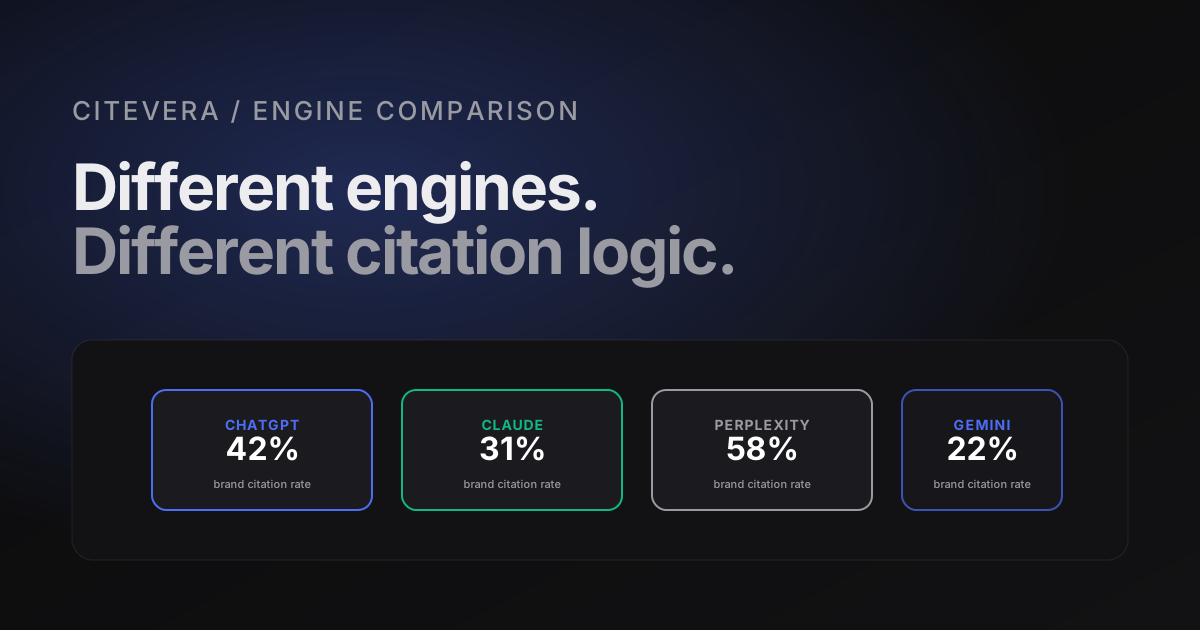
Across all tracked prompts, the four engines cite brands at meaningfully different rates.
Perplexity cites brand-name web sources roughly 58% of the time. It is the most consistently citation-heavy engine, partly because its answer format includes inline citations as a default UX element. Almost every Perplexity answer includes 3-5 source links.
ChatGPT cites brand-name web sources roughly 42% of the time. The rate has climbed steadily since ChatGPT added live web browsing - early 2025 numbers were closer to 25%. With browsing enabled, ChatGPT citation behavior is now more similar to Perplexity than to Claude.
Claude cites brand-name web sources roughly 31% of the time. Claude is conservative about citations and often gives a synthesized answer without linking to specific sources unless the user explicitly asks for sources. When it does cite, it cites cleanly.
Gemini cites brand-name web sources roughly 22% of the time in chat mode. AI Overviews on Google Search cite at much higher rates (60-80% depending on query type). The 22% number is for the Gemini chat product specifically.
These rates matter for monitoring strategy. If you only track ChatGPT, you miss the high-citation engine (Perplexity). If you only track Perplexity, you miss the dominant chat product (ChatGPT). A complete monitoring program covers at least three engines.
What each engine prefers as a source
Beyond raw citation rate, the engines have distinct preferences for source types.
Perplexity favors news and recent blog content. It updates its index aggressively and weights recency highly. A blog post published yesterday is much more likely to be cited by Perplexity than the same content published two years ago. Perplexity also frequently cites Reddit, Wikipedia, and Stack Overflow for community-knowledge queries.
ChatGPT with browsing enabled favors authoritative-looking sources: news outlets, industry publications, well-known company sites, government and educational sites. It is more conservative about UGC. When it does cite blogs, the blogs tend to have strong domain authority signals.
Claude favors structured factual content. Documentation sites, technical references, and articles with clear schema markup are over-represented in Claude citations. Claude is the most rewarding engine for sites that have done the AEO basics well.
Gemini chat overlaps heavily with Google Search results. The same pages that rank well organically tend to be cited by Gemini chat. AI Overviews follow a different logic that rewards passage-level extractability and FAQ schema.
How to translate this into action
A brand that wants to be cited consistently across all four engines needs to satisfy four different preferences simultaneously. Three patterns work.
Publish frequently with dated content. This satisfies Perplexity and AI Overviews preference for freshness. Each major piece should have a clear datePublished and dateModified, and the modified date should actually move when you update.
Invest in schema and structured markup. This satisfies Claude and Gemini chat preferences for structured factual content. FAQPage, HowTo, BlogPosting, and Article schema with full Author and Organization markup should be standard on every published piece.
Build domain authority signals. This satisfies ChatGPT preference for authoritative sources. PR placements on industry publications, links from .edu and .gov sites where appropriate, and consistent NAP (name, address, phone) data across the web.
Layer in original research. This works across all engines because every engine wants citable statistics. Original research published with proper attribution, dates, and methodology earns citations on questions where competitors do not have data.
How Citevera scores this
The Citevera Monitoring dashboard tracks per-engine citation rate over time. The dashboard breaks each tracked prompt by engine, so you can see whether Perplexity cites you weekly while Claude does not, or whether ChatGPT cites you on B2B questions but not on consumer ones. This level of granularity is the difference between "we are cited" and "we know which engines cite us, on which questions, and how that has changed."
The audit complements monitoring by scoring the structural signals each engine prefers. A site that is strong on freshness signals tends to do better on Perplexity; a site strong on schema does better on Claude. The audit reveals which engines are likely to cite you well and which need structural work to unlock.
What to do if one engine consistently does not cite you
If three engines cite you regularly but one does not, the issue is usually engine-specific. Diagnose by engine.
No Perplexity citations: check your dateModified updates. Perplexity weights freshness; stale content does not surface.
No Claude citations: check your schema. Claude is the most schema-rewarding engine; missing FAQPage or Article schema often blocks citation.
No ChatGPT citations: check your domain authority signals. ChatGPT favors well-known sources. If you are a newer brand, this is a longer build.
No Gemini chat citations: check your traditional Google Search rankings. Gemini chat overlaps with Google ranking signals. If you do not rank, you are unlikely to be cited.
Track your brand mentions across all four engines with Citevera Monitoring
Frequently asked questions
Should I prioritize one engine over the others?
Prioritize the engine your customers use most. For B2B research, ChatGPT and Perplexity dominate. For consumer-facing questions, Google AI Overviews and Gemini matter more. Use search-share data and customer interviews to decide; do not assume.
How often do citation rates change?
Slowly week-to-week, meaningfully quarter-to-quarter. Engine model updates can shift citation behavior measurably - we have seen Claude citation rates jump 5-10 points after major model releases. Plan for quarterly trend reviews.
Can I influence which engine cites me by writing differently?
Indirectly. Each engine prefers slightly different content shapes. But writing one piece for ChatGPT and another for Claude is usually the wrong tradeoff. Write one well-structured, well-researched piece that satisfies multiple engine preferences simultaneously. The structural overlap between what Perplexity, ChatGPT, and Claude reward is large.
What about Microsoft Copilot, Meta AI, and other engines?
Copilot uses similar logic to ChatGPT (both Microsoft, both Bing-fed). Meta AI is not yet a major referrer for most brands. xAI Grok is too new for stable patterns. The four engines covered here account for the vast majority of citation traffic in our customer data.
How many prompts should I track per engine?
Minimum 30 per category for stable signal. Citevera Monitoring Lite covers 10 prompts per customer; Pro covers 50. The 30-prompt threshold is where weekly trend lines stabilize and you can detect 5-point SOV shifts confidently. Below that, single-prompt outcomes dominate the metric.
Does ChatGPT browsing-mode change how it cites?
Significantly. With browsing enabled, ChatGPT cites at roughly 42% (the number reported in this article). Without browsing, citation rate falls to under 10% on most queries because the model relies on training-data knowledge alone. Most ChatGPT users now have browsing enabled by default, but tracking should distinguish the modes when possible.