

Original Research as AEO Strategy: Why Owning Stats Beats Citing Them
Original research is the highest-leverage AEO investment per dollar because every citation links back to your domain. Here is how to design and ship it.
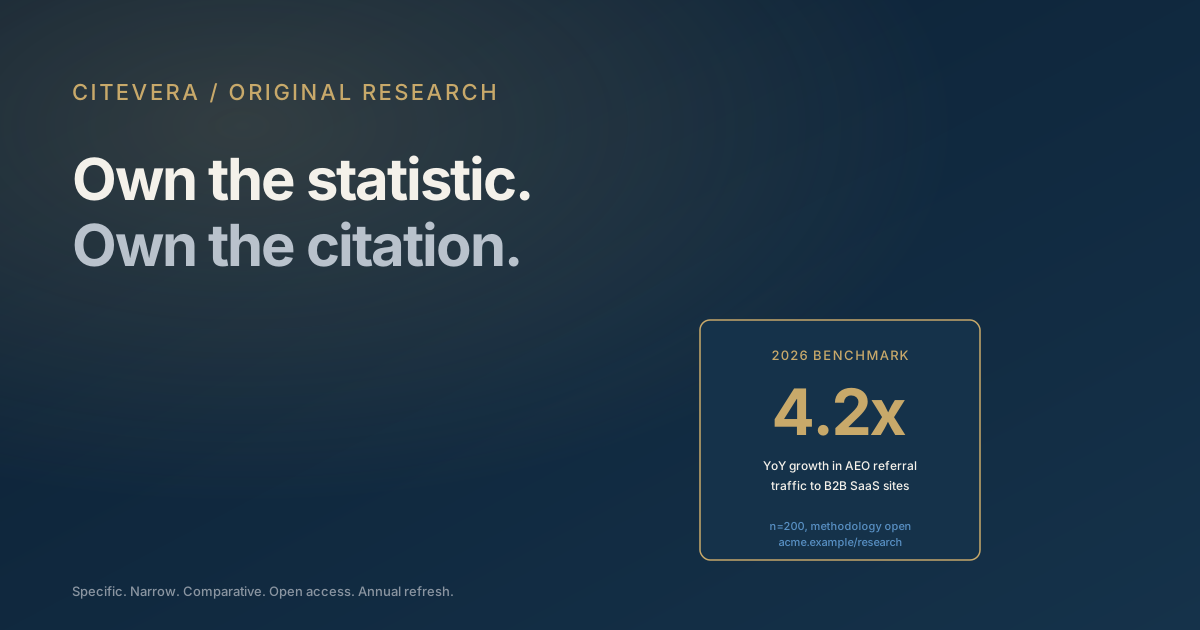
When an AI engine cites a statistic, it cites someone. If that someone is McKinsey, Gartner, or Forrester, the citation builds their entity. If that someone is you, every retrieval of that statistic compounds back to your domain. Original research is the most expensive AEO investment to ship and the highest-yield once it lands.
This post covers when original research is worth the investment, the design decisions that make a study cite-worthy, and the publication pattern that turns a research report into an AEO compounding asset.
Why original research outperforms most AEO content per dollar
Three reasons:
1. Citation flow is one-way. When models retrieve a statistic from your study, they cite your domain. There is no competing source for the same data point because you generated it. 2. Reuse is unlimited. A single strong statistic can be cited in hundreds of downstream blog posts, articles, and LinkedIn posts that all link back. The corpus of mentions builds entity strength. 3. The asset is durable. Most blog posts decay in citation value within 12 to 18 months. A well-executed annual research report stays canonical for 12 to 24 months and becomes part of industry vocabulary.
The catch: original research is expensive to do well. A real study with 200+ respondents and a credible methodology costs $15,000 to $80,000 depending on scope. The economics still work for most B2B companies because the citation flow over 18 months exceeds the cost.
When original research is worth the investment
Three trigger conditions:
Your industry has stale or weak existing data
If practitioners cite the same 2022 industry report repeatedly because nothing newer exists, there is a vacuum. Filling it with a 2026 study with rigorous methodology earns immediate citation flow.
You have unique data access
If you have proprietary data through your platform (anonymized usage patterns, aggregate buyer behavior, market segment trends), turning that into a published report is high-margin research. The data already exists; the cost is in framing and writing.
You serve a high-stakes vertical where decisions need data
Buyers in finance, healthcare, legal, and enterprise software citation-shop heavily during purchase. Original research that addresses their decision factors gets shared, cited, and bookmarked at high rates.
If none of these apply, focus AEO budget on content density and schema first. Original research is a multiplier, not a starter.
The four research designs that work for AEO
Not every research design earns citations equally. Four patterns have the strongest track record:
Industry survey
Survey a defined population (CMOs, developers, IT leaders) with 15 to 25 questions. Sample size 200+ for credibility. Publish anonymized aggregate results.
Strengths: clear methodology, easy to cite ("according to Acme's 2026 CMO Survey, 67% of marketing leaders report...").
Cost: $20,000 to $60,000 depending on panel quality.
Aggregate platform data study
Pull insights from your own product's anonymized data. "Across 12,000 sites we audited in Q1 2026, the median Organization schema completeness score was 34%."
Strengths: cheap (data exists), defensible methodology, often produces statistics no other source has.
Cost: $5,000 to $15,000 in analysis and writing.
Benchmarking study
Measure performance across a sample of companies on specific metrics. "We benchmarked 200 enterprise SaaS websites on AEO readiness; the median score was..."
Strengths: produces a leaderboard or distribution that media outlets love to cite.
Cost: $15,000 to $40,000 depending on measurement depth.
Trend forecast with empirical baseline
Combine current measurements with directional forecasts. "AI search referrals to B2B software sites grew 4.2x year-over-year from Q1 2025 to Q1 2026. We project 2.3x growth in 2026."
Strengths: gets cited in trend pieces and predictions.
Cost: $10,000 to $30,000 depending on data inputs.
What makes a research report citable
Six attributes:
Methodology section that survives scrutiny
A short, specific methodology section. Sample size, recruitment approach, response rate, time period, definitions of measured variables. AI engines cite studies that show their work; they downweight studies that hide methodology.
Specific, narrow statistics
> "67% of B2B marketing leaders increased AEO spend in 2026"
beats
> "Most marketing leaders are increasing investment in answer engine optimization"
The percent and the year are extractable; the "most" version is unciteable.
Comparative or trend framing
Statistics with a comparison anchor get cited more than absolute numbers.
> "AEO budgets grew 4.2x year-over-year"
beats
> "AEO budget reached $X billion"
The growth multiplier creates a citation hook.
Visual assets that work as standalone
Charts and graphs that include the headline statistic in the chart itself, with your domain in the footer. These get screenshot-shared on LinkedIn and X with attribution intact, multiplying citation surface.
A single 30 to 60 word headline finding
The "if a journalist quotes one number from this study, this is the number" finding. Featured in the press release, the executive summary, and the social cards. Concentrating citation flow around one signature statistic is more effective than diluting across 12 equally-weighted findings.
Open access, not gated
Gating the report behind an email form is a marketing-funnel decision. For AEO, gating reduces citation flow because crawlers cannot reach the content. The right pattern: ungated public report on your domain with rich findings, plus a downloadable PDF or detailed appendix behind the email form for lead gen.
The publication pattern that earns compounding citations
A single research report should produce a coordinated set of assets:
The flagship report page
A long-form HTML page with the full methodology, all findings, and visualizations. Self-canonical. Article schema with Dataset schema for the underlying data.
A 1,500 to 2,500 word executive summary blog post
Summarizes the key findings with links into the flagship report. Easier to consume; serves as the entry point for most readers.
A press release announcing the report
Wire syndication amplifies the headline finding. The release should include the headline statistic prominently and link to the flagship page.
5 to 10 derivative blog posts
Each derivative covers one finding in depth. "Why 67% of CMOs are increasing AEO budgets" is a post unto itself, citing your own study.
Social cards and quote graphics
LinkedIn and X-optimized images with the headline finding and your URL. Designed for screenshot-sharing.
A live "study findings" page that updates
For studies that repeat annually, maintain a single canonical URL that updates with each year's data. The URL accumulates citation history rather than splitting it across yearly archives.
Schema markup for research reports
Three schema types apply:
Article + Dataset
Use Article schema for the report page. Add Dataset schema referencing the underlying data:
{
  "@type": "Dataset",
  "name": "AEO Readiness Benchmark 2026",
  "description": "Anonymized AEO readiness scores across 200 enterprise SaaS websites.",
  "keywords": ["AEO", "answer engine optimization", "benchmark"],
  "creator": {"@id": "https://acme.example/#organization"},
  "datePublished": "2026-05-15"
}
ScholarlyArticle for academic-rigor reports
If your study has co-authors, citations, and academic methodology, ScholarlyArticle schema is appropriate.
NewsArticle for the press release
Standard NewsArticle schema for the wire release version.
Maintenance and refresh cadence
Two practices:
- Annual refresh for survey-based reports. The methodology is reusable; the data refreshes. Year-over-year reporting becomes its own citation hook.
- Quarterly data updates for platform-data reports. Easier to maintain and produces a steady drumbeat of fresh citations.
Stale research reports start losing citations to fresher competitor data within 18 to 24 months. Plan refresh cycles into the budget.
Common original research mistakes
Five recurring failures:
- Methodology hidden in a download. Models cite what they can read. Methodology should be on the report page in HTML.
- Sample size too small to defend. A "study" of 23 respondents will be cited but with appropriate skepticism. Aim for 200+ for survey work.
- Findings dressed up as conclusions. "Our study found that respondents reported X" is a finding. "X is increasing because Y" is a conclusion that requires more analysis. Be honest about which is which.
- Charts as images only. Provide both visual chart and underlying data table so engines can extract the numbers.
- Single-cycle reports. A study you publish once and never repeat is leaving the compounding value on the table.
Key takeaways
- Original research is the highest-yield AEO investment because every citation links back to your domain.
- Industry surveys, platform-data studies, benchmarking, and trend forecasts are the four designs that work.
- Specific narrow statistics with comparison anchors get cited more than absolute numbers.
- Open access (ungated) the flagship report; gate detailed appendices for lead gen.
- Plan annual refreshes to compound citation flow over multiple years.
What to do next
Run a free audit at scan.citevera.com to see whether your domain hosts citable original statistics or relies on borrowed data. The report flags absence of original research as an entity-strength gap.
For more on how statistics function as citation fuel, statistics and numbers as citable data points covers the per-statistic citation pattern.