

Citation Velocity: Why First-Mover Brands Dominate AI Answers
Brands that get cited early on a topic accumulate citation velocity that compounds. New entrants face a structural disadvantage that traditional SEO did not have. This is what to do about it.
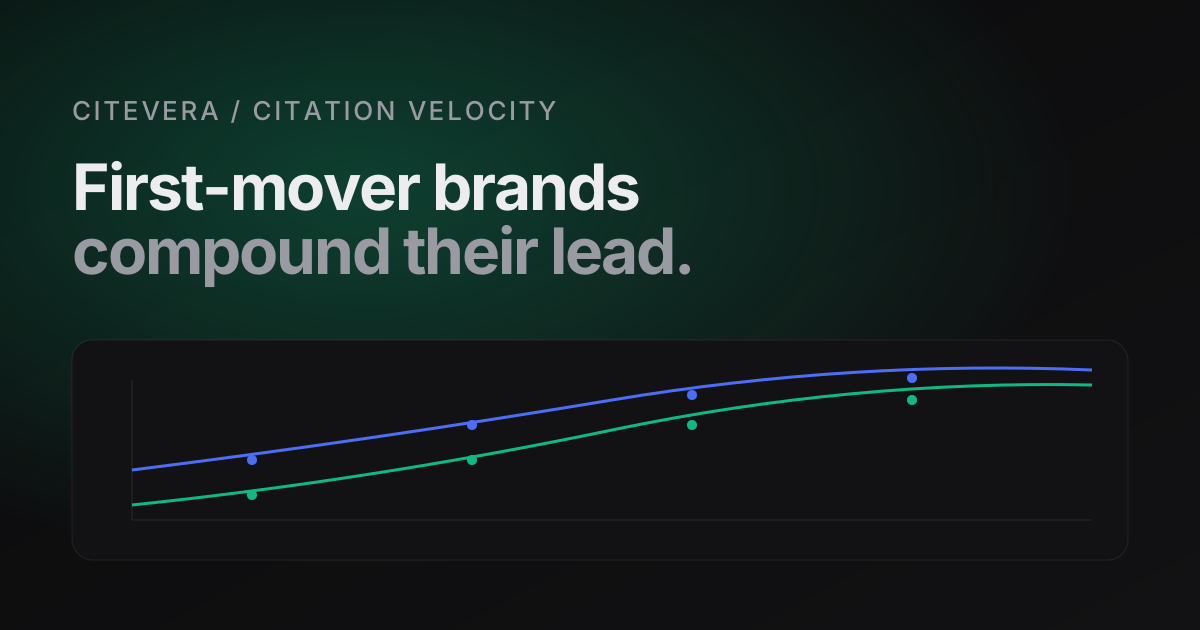
The compounding mechanic
Citation in an AI answer is not a one-time event. Each time your brand is cited in a generated response, two things happen. First, the engine reinforces its own model of your brand as a relevant authority on the topic. Second, the user who saw the citation may visit your site, share the answer, link to it, or write content that references your brand - which the engine sees on its next crawl.
These second-order effects compound. A brand cited 100 times in week one is more likely to be cited 110 times in week two, then 125 in week three. The cumulative effect over a year is large and very hard for late entrants to overcome.
Traditional SEO had similar dynamics but they were weaker. SEO ranking changes are gradual and the algorithm evaluates many signals afresh on every crawl. AI engines, by contrast, have learned representations that take longer to update. A brand established in the model's representation as authoritative on a topic stays authoritative across many model versions.
What "first mover" actually means here
Being a first mover for AEO is not the same as being a first mover for the product category. A brand can have existed for ten years and still be a "first mover" in AEO if it was the first to publish high-quality, structured, citation-ready content on a topic.
The window is also narrower than category-level first-mover advantage. AEO first-mover advantages established in 2024-2025 are nearly impossible to overturn through content alone. AEO first-mover advantages established in 2026 are still being captured. The brands that win AEO in 2027 will be the ones that establish their citation footprint in 2026.
This means: there is still a window. It is closing. The brands that take AEO seriously now will dominate in 18 months. The brands that wait for "the strategy to settle" will find themselves in the late-mover position permanently.
How to build citation velocity from a standing start
A brand that has not yet been cited needs to break into the citation cycle. There are three honest paths.
Path 1: Original research. Publish data, surveys, or experiments that nobody else has. AI engines hungry for citable statistics will pick up the data and credit your brand. A 200-respondent industry survey published with clean schema will outperform 100 me-too articles for citation velocity.
Path 2: Topical depth. Pick a narrow topic and become the most comprehensive resource on it. Twenty-five pages covering every facet of one topic outperform 100 pages spread across ten topics. Engines reward topical authority concentration.
Path 3: Structured-first publishing. Publish content with answer-first format, complete schema, author markup, and clean technical implementation from day one. Most competitors do not. The structural delta closes the gap with brands that have been around longer.
In practice, the brands that succeed combine all three. They publish original research as the velocity flywheel, build topical depth around it, and structure everything for citation extraction.
Why latecomers struggle
A brand that starts AEO 18 months after the leaders faces three structural problems.
The model already has a representation of "who is authoritative on this topic" and updating it takes sustained signal. One great article does not move the needle.
The leaders are publishing more content than the latecomer can match in volume, and they have an established baseline of citations that creates a flywheel.
The latecomer is competing for the same query space with the same content shapes (lists, comparisons, how-to guides). Differentiation requires either a genuinely fresh angle or original data nobody else has.
The honest read: latecomers can still win on niche topics, original research, or rapid technical publishing. Latecomers cannot easily win on broad topics where leaders are entrenched.
How Citevera scores this
The Citevera audit measures citation velocity directly when monitoring is enabled. The dashboard tracks citation count per engine per week, sliced by topic. A flat or declining trend signals that competitors are pulling away. An accelerating trend signals you are compounding.
The audit also measures the structural prerequisites for velocity: original-research signals (statistics, dated data), topical depth (cluster page count), and structured publishing (schema, author markup). Brands that score well on prerequisites tend to build velocity. Brands that score poorly do not, regardless of content volume.
This is why the audit weights structural signals heavily. They are leading indicators of citation velocity. Citation velocity is the leading indicator of long-term AEO position.
What to do this quarter
If you are an established brand with no AEO program: start now. The 18-month window is not waiting. Pick three topics where you have genuine domain expertise, audit your existing content for citation-readiness, and publish original research that anchors each topic.
If you are a new brand with no citations yet: pick one narrow topic. Outpublish leaders on that topic for six months. Use original research as the wedge. Once you have citation velocity in one area, expand.
If you are a brand that has been "doing AEO for a while" but seeing flat citation counts: the issue is usually not content volume. It is structural. Audit the technical signals - schema, direct-answer position, author markup. Fix the structural gaps before publishing more content.
Run a free Citevera audit to see your structural readiness for citation velocity
Frequently asked questions
How long does it take to build citation velocity from zero?
Six to twelve months for a well-executed program in a moderately competitive niche. Faster in narrow technical niches; slower in broad consumer categories. The first three months produce minimal citation lift; months four through twelve compound rapidly if the foundation is right.
Can paid distribution accelerate this?
Yes, but indirectly. Paid promotion that drives organic links and brand mentions on third-party sites strengthens the engine's representation. Paid promotion that just drives direct traffic to your site does not.
What if a competitor has a 3-year head start?
Compete on a sub-topic where they are weak. Brands with broad authority often have specific subtopics they have not deeply covered. Find the gap, dominate the gap, expand outward.
Does PR coverage help citation velocity?
A lot. PR coverage on authoritative third-party sites (industry publications, well-known blogs) creates the kind of cross-source signal that engines reward heavily. Three substantive PR placements often outperform 30 self-published articles for velocity.
Is this measurable in real time?
Mostly. Citevera Monitoring tracks citation rate per engine per week with daily granularity on the Pro tier. Weekly granularity is enough for trend detection; daily helps when you are running specific publishing experiments.
Does paid PR placement on top-tier publications give faster velocity?
Yes, materially. A placement on a major industry publication produces signal across multiple engines simultaneously and at higher weight than self-published content. Three to five top-tier placements in a year often outperform 50 self-published articles for citation velocity. The bottleneck is usually access and pitch quality, not budget.
Are there industries where late entrants can still win?
Yes, in genuinely emerging niches where no leader has established representational presence. AI-native subcategories (AI agents, AI evals, AI ops) are still wide open as of 2026. Mature categories with established leaders are much harder. Strategically, late-stage AEO investment should target emerging sub-niches, not head-on competition with entrenched leaders.