

Key Takeaways Boxes: Do Summary Blocks Win Citations?
Key takeaways boxes earn AI citations when every bullet is a self-contained, extractable claim. Here is the retrieval mechanism, the format rules, and the failure mode.
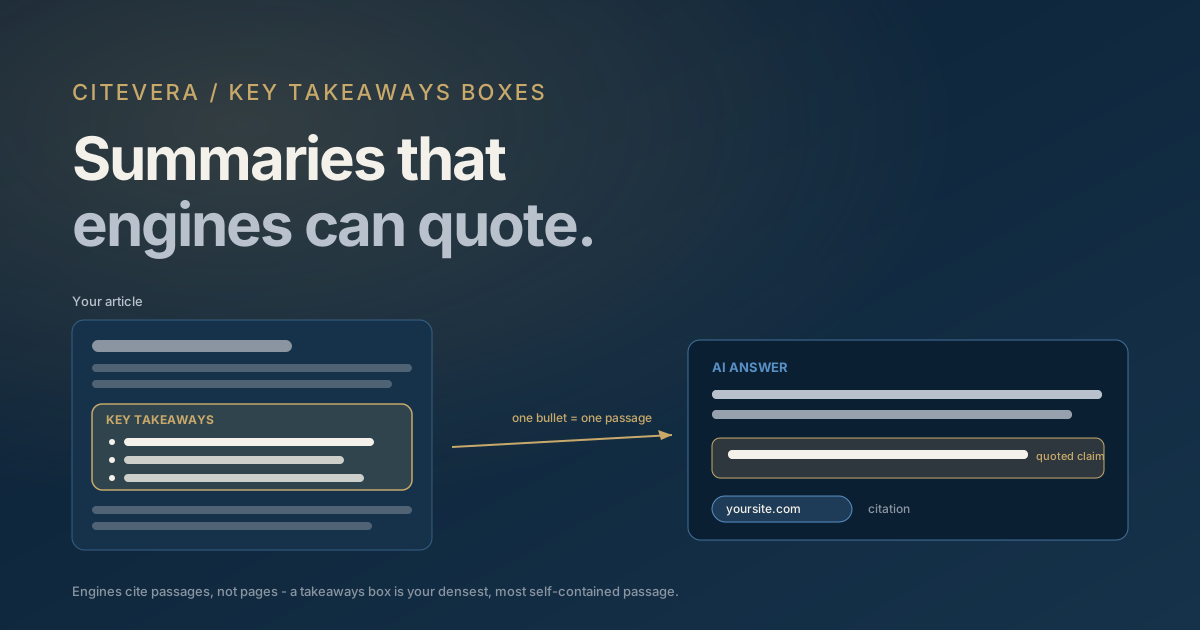
A key takeaways box - a short bulleted block of claims near the top of an article - is one of the highest-leverage formatting moves in AEO, but not for the reason most people assume. Answer engines don't reward "summaries" as a category. They retrieve and cite passages, not pages, and a well-built takeaways box is the densest, most self-contained passage on the page. Write it as a stack of standalone factual claims and you hand the retrieval pipeline exactly the unit it wants to quote. Write it as vague meta-commentary ("this guide covers everything you need to know") and it does nothing at all.
The difference between those two outcomes is entirely mechanical, which means it's entirely controllable. This post walks through why summary blocks get extracted, the specific writing rules that make each bullet quotable on its own, where the box belongs on the page, and the common failure mode - summaries that summarize nothing.
Why answer engines quote summary blocks
Every major answer engine - ChatGPT with browsing, Perplexity, Claude with web search, Google AI Overviews - works on roughly the same retrieval pattern. The engine fetches candidate pages, splits each page into passages of a few hundred tokens, scores those passages against the user's query, and feeds the top-scoring passages to a language model that composes the answer and attaches citations.
The scoring step is where takeaways boxes win. A passage scores well when it's dense with query-relevant terms, semantically complete, and doesn't depend on surrounding context to make sense. Most body prose fails at least one of those tests: it builds arguments across paragraphs, leans on pronouns and callbacks, and spreads one claim over two hundred words. A takeaways box is, by construction, the opposite. It compresses the article's strongest claims into a chunk-sized block where every sentence carries weight.
This is the same logic behind putting a direct answer in your opening paragraph, which we cover in direct answer density in the first 150 words. The takeaways box extends that principle: instead of one answer-first paragraph, you get four to six answer-first claims, each individually retrievable.
There's a second-order effect too. When the composing model receives your takeaways passage, it gets pre-digested claims it can restate with minimal rewriting. Passages that are easy to paraphrase accurately are safer for the model to use, and safer passages get cited. You're reducing the engine's work at both the retrieval step and the generation step.
The core requirement: every bullet must survive alone
Here's the test that separates citable takeaways from decorative ones: lift any single bullet out of the box, show it to someone who has never seen your article, and ask whether it's a complete, verifiable statement. If the answer is no, that bullet will never be quoted.
The most common way bullets fail this test is pronouns. "It reduces crawl waste by consolidating duplicate URLs" is useless in isolation - what is "it"? The retrieval pipeline doesn't resolve your antecedents. The extracted passage either names its subject or the claim evaporates. Compare: "Canonical tags reduce crawl waste by consolidating duplicate URLs into one indexable version." Same claim, but now it stands alone.
The second failure is claim-splitting: a bullet that only makes sense as a continuation of the previous bullet. Chained bullets read nicely to humans scanning the page, but chunkers don't guarantee the chain stays intact. Each bullet needs its own subject, its own verb, and its own complete assertion.
Format rules for extractable bullets
The rules below come straight from how passage extraction behaves, not from style preference.
- Name entities, never pronouns. Write "GPTBot", "FAQ schema", "your pricing page" - not "it", "this markup", "that page". Every bullet gets a named subject.
- One claim per bullet. If a bullet contains "and also" or a second independent assertion, split it. Compound bullets dilute passage relevance for any single query.
- Keep bullets between roughly 15 and 35 words. Shorter reads as a fragment; longer starts behaving like body prose and loses the density advantage.
- State claims, don't hedge them. "Structured headings help parsers segment content" beats "structured headings may potentially help in some cases". Engines quote confident, specific language because it composes cleanly into answers.
- Only include numbers you can source. A bullet like "AI summaries appeared in roughly 1 in 5 searches in Pew Research Center's 2025 panel" is a strong extractable claim precisely because it's attributed - see the AI search statistics roundup for figures you can safely cite. An invented number in a takeaways box is an invented number in someone's AI answer, and that's how trust dies.
- Label the box plainly. "Key takeaways" or "TL;DR" as a bolded lead-in or a heading. The label itself is a weak signal; the content does the work. Don't spend creativity here.
Notice what these rules produce: a block that reads like a series of definition-grade sentences. That's not a coincidence. The same properties that make definition paragraphs win citations - a named subject, a complete predicate, zero dependence on context - are what make takeaways bullets extractable.
Where the box belongs on the page
Placement matters less than construction, but it still matters.
Put the box high - after your opening answer-first paragraphs and before the first major section, or directly under your first h2. Two reasons. First, some retrieval systems truncate long pages or weight earlier content more heavily, so claims near the top are more reliably ingested. Second, human readers deciding whether to stay get the same benefit, and dwell behavior feeds the classic ranking signals that still determine which pages get retrieved at all.
Implementation should be boring: a plain HTML unordered list, in the main content flow, in the server-rendered HTML. Do not put takeaways in an accordion that requires a click, a tab panel, a carousel slide, or - worst of all - an image. Most AI crawlers execute little or no JavaScript, so content that needs interaction or hydration to appear simply doesn't exist for them. A styled div wrapper around a real ul is fine; the styling is invisible to parsers and the list structure is preserved.
One box per page. If you find yourself wanting a second takeaways block halfway down, that's usually a sign the page covers two topics and should be two pages.
The failure mode: summaries that summarize nothing
The takeaways box pattern got popular enough that most implementations are now noise. The dominant failure looks like this: "In this post, we explore why summary boxes matter for AI search." That bullet contains zero claims. It describes the article instead of compressing it. No query is answered by it, so no retrieval system will ever surface it, and no model will ever quote it.
Run this audit on any takeaways box: for each bullet, ask "what question does this bullet answer?" If the only honest answer is "what is this article about?", the bullet is filler. A real takeaways bullet answers a question a user would actually ask an engine - "do summary boxes help AI citations?", "how long should takeaways bullets be?", "where should a TL;DR go on the page?"
The subtler failure is the takeaways box that overpromises. If a bullet asserts something the body never substantiates, you've built a passage that invites citation and then fails verification when an engine or a human checks the surrounding content. Engines increasingly cross-check extracted claims against the rest of the page and against other sources. The box must be the article's strongest claims, not its marketing copy.
Writing workflow: extract, don't compose
The practical way to get this right is to write the box last. Finish the article, then go section by section and pull out the single strongest claim from each - the sentence you'd defend in an argument. Rewrite each one to stand alone: swap pronouns for entities, attach the source if there's a number, cut hedges. Four to six claims is the sweet spot; past seven you're diluting.
Then do the isolation test once more: read each bullet as if it appeared alone in a ChatGPT answer attributed to your domain. If you'd be comfortable with that exact sentence representing your site, ship it. If not, fix the sentence - because that exact scenario is the goal. This is the same discipline that runs through every anatomy of a cited blog post: the cited unit is the passage, so you engineer the passage.
Frequently asked questions
Do key takeaways boxes need special schema markup?
No. There is no schema.org type for summary blocks, and none is needed. A plain unordered list in the article body is what parsers consume. Your effort is better spent on the article-level basics - Article schema, a clear author, clean heading hierarchy - than on inventing markup for the box itself.
How many bullets should a takeaways box have?
Four to six. Fewer than three suggests the article doesn't have enough substance to summarize; more than seven turns the box back into a wall of text and dilutes the density that makes it retrievable. Each bullet should map to one section's strongest claim.
Should the takeaways box go at the top or the bottom of the post?
Top - after your opening paragraphs, before or just inside the first main section. Early placement protects the box from page truncation during ingestion and serves scanning readers. A closing summary at the bottom is fine for humans but duplicating the box adds little for extraction.
Does a takeaways box replace an answer-first opening paragraph?
No, they do different jobs. The opening paragraph answers the page's primary query in flowing prose that engines can quote as a direct answer. The takeaways box covers the article's four to six secondary claims, each targeting its own long-tail query. Strong pages have both, and they shouldn't repeat each other word for word.
Do takeaways boxes help with Google AI Overviews specifically?
The mechanism applies: AI Overviews compose answers from retrieved passages and favor self-contained, verifiable statements. No one outside Google can promise inclusion, but pages built from extractable claims are structurally better candidates than pages that bury claims in long prose, and the same construction serves ChatGPT, Perplexity, and Claude simultaneously.
Check whether your summaries actually extract
You can't eyeball extractability at scale. A Citevera audit scores your pages on answer-first structure, passage self-containment, and the crawlability basics that determine whether engines see your takeaways at all - and it generates the fixes, not just the findings. If you want the fast version, run your key pages through the free AI crawler access checker first to confirm the engines can even fetch the HTML your takeaways live in.