

How Claude Picks Citations: Patterns Specific to Anthropic's Search Behavior
Claude cites differently than ChatGPT or Perplexity. Here are the patterns Anthropic's models reward, the sources they prefer, and how to optimize for them specifically.
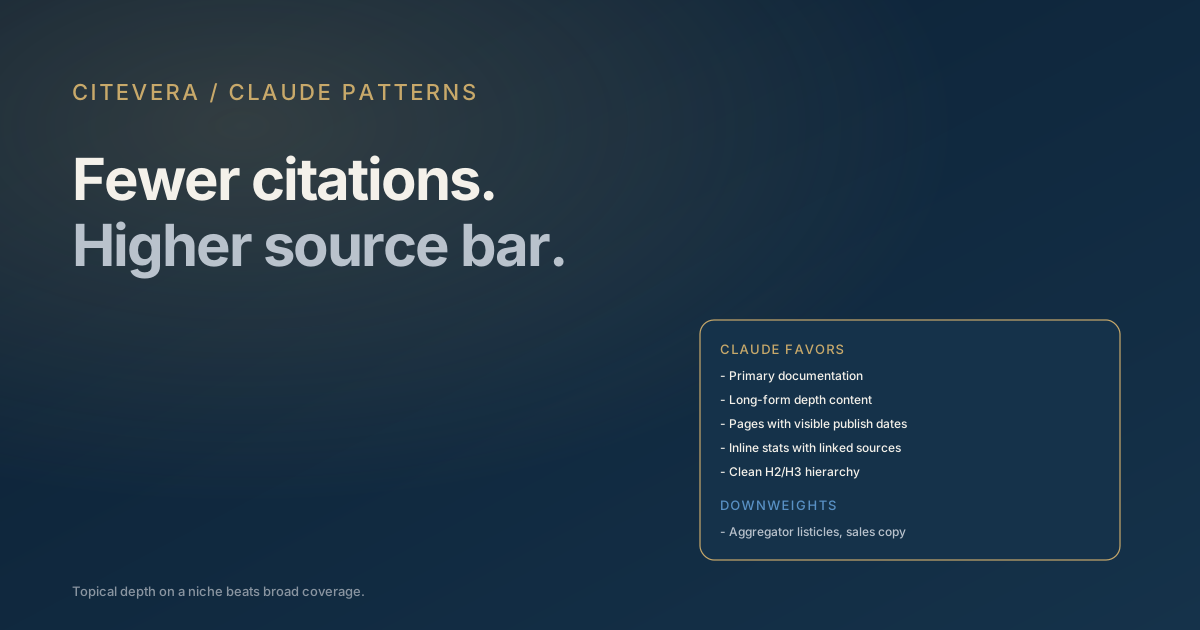
Claude's web search and citation behavior differs meaningfully from ChatGPT, Perplexity, and Gemini. Anthropic ships Claude with citation conventions that emphasize source quality, recency context, and structural cleanliness in distinctive ways. Optimizing for "AEO" generically gets you partway; optimizing for Claude specifically picks up the remaining tail of citations Claude uniquely awards.
This post covers the citation patterns Claude favors, the source types it prefers, and the page elements that materially affect Claude's citation decisions.
What Claude's web search does differently
Three observable behaviors as of 2026:
1. Claude uses fewer citations per answer than Perplexity and shows them more conservatively. A typical Claude answer with web search enabled cites 2 to 5 sources, often fewer than Perplexity's 6 to 12. 2. Claude prefers structurally clean documentation and primary sources more than ChatGPT, which more often cites secondary blog content. 3. Claude cites with stronger source-quality prioritization in domains like medicine, law, and finance, biasing toward institutional or expert sources even when blog content ranks higher in traditional search.
These behaviors compound: the bar to be cited by Claude is somewhat higher than ChatGPT, but the citations Claude does award are often more durable because Claude's selection logic biases toward content that ages well.
Source types Claude favors
Patterns observed across thousands of Claude citations:
Primary documentation and reference material
Claude cites official documentation more readily than other engines. If you have docs on docs.acme.example, those URLs frequently outrank your blog for technical queries in Claude's results.
Implication: ship documentation with the same AEO discipline as marketing content. Definition paragraphs at the top of doc pages, FAQ schema for common questions, clean H2 hierarchy.
Long-form, in-depth content
Claude has a notable preference for content that demonstrates depth on a topic. A 2,500 word post that covers a topic comprehensively often gets cited over a 700 word post on the same topic, even when the shorter post ranks better in Google.
Implication: pillar content matters more for Claude than for engines that surface shorter snippets. The content depth in AI search post covers the depth signal in detail.
Sources with explicit dates
Claude is sensitive to recency context. Pages with visible datePublished and dateModified (both in HTML and Article schema) signal that the content's currency can be evaluated. Claude downweights undated content for time-sensitive queries.
Implication: always show a publish date on content. Update date when materially edited.
Cited sources within content
Claude treats your inclusion of citations as a quality signal. A post that cites 5 to 10 external sources with linked references gets weighted more strongly than one that cites nothing, even if the unsourced post is otherwise well-structured.
Implication: continue to cite real sources in your content. Do not skip attribution.
Source types Claude tends to downweight
Three patterns:
Lightly-rewritten aggregator content
Pages that look like aggregations of other sources without original analysis get cited less by Claude. This includes generic listicles, content-mill blog posts, and SEO-optimized rewrites of existing content.
Domains with thin or contradictory information
Claude factors source consistency. A domain that publishes contradictory facts across pages (different statistics, different dates, different definitions) gets less trust than one with consistent claims.
Heavily branded or sales-coded content
Pages that read as sales copy rather than informative content get less play. Claude has a calibration toward neutral, descriptive prose over promotional language.
The Claude-specific structural signals
Five page elements that materially affect Claude's citation behavior:
Clean H2 to H3 hierarchy
Claude appears to retrieve passages by heading-and-paragraph pairs more than by raw text. A page with 8 to 12 well-named H2s and clean paragraph segmentation gets cited at higher rates than a page with the same content but weak structure.
Explicit "what is X" definitions
The 60-word definition paragraph pattern works especially well for Claude on definitional queries. Claude often pulls the definition paragraph verbatim rather than synthesizing from surrounding context.
FAQ schema with substantive answers
Claude reads FAQ schema. A page with 6 to 10 well-structured FAQs covering buyer or research questions gets pulled into Claude's responses on those exact questions. Generic FAQs ("Is this product easy to use?") get ignored; specific FAQs ("How does X compare to Y on enterprise SSO?") get cited.
Inline statistics with sources
Statistics in the body with linked sources are Claude's favorite citation fuel. The pattern:
> "B2B AI search traffic grew 4.2x year-over-year in early 2026 (Citevera 2026 Benchmark)."
Inline stat, parenthetical source, linked. Claude often pulls this exact pattern into its responses with the source attribution intact.
Table of contents linking to anchors
Long pillar pages benefit from a table of contents at the top with anchor links to each H2 section. This helps Claude locate specific sub-topics within long pages and increases citation rates on long-form content.
How Claude handles authoritative vs niche sources
Claude balances authority and specificity. Two patterns observed:
- For broad informational queries (definitions, overviews), Claude prefers authoritative sources with established history.
- For specific niche queries (rare technical questions, specific tools, narrow comparisons), Claude prefers specialized sources even from smaller domains.
The implication for AEO programs: building topical authority on a specific niche pays off more in Claude than building generic authority across a broad topic. A small site that owns "AEO measurement methodology" earns more Claude citations on that query than a large site that mentions AEO measurement as one of 50 topics.
Cross-referencing and corroboration
Claude leans into corroboration. When multiple sources agree on a fact, Claude is more likely to cite one of them confidently. When a source claims something not corroborated elsewhere, Claude either omits the claim or hedges.
The strategic implication: original claims need to either build their own corroboration (other sources eventually citing you) or be presented with strong methodology signals that justify the lack of corroboration. Original research that shows methodology can earn Claude citations even before secondary sources pick up the data.
How to test what Claude cites for your topics
Three approaches:
Manual query tests
Use Claude.ai with web search enabled. Run 10 to 20 queries relevant to your topic monthly. Note which sources Claude cites and where you appear (or do not).
Track citations to your domain
When Claude cites your content, the citation includes a URL. Server logs do not always show Claude as a referrer, but query-by-query manual tests give you a sample.
Test against engines side by side
Run the same query in Claude, ChatGPT (with web search), Perplexity, and Gemini. Note where each engine cites you and where each does not. The engine-specific gaps reveal where to focus optimization.
Where Claude's preferences diverge from other engines
Three notable divergences:
- vs ChatGPT: Claude prefers primary documentation more than ChatGPT, which often cites secondary explainer content.
- vs Perplexity: Claude cites fewer sources but at higher quality bars; Perplexity cites more breadth.
- vs Gemini: Claude is more conservative about recency-required topics; Gemini has tighter Google integration and surfaces fresher content faster.
The cross-engine comparison covers these in detail. Optimizing specifically for Claude means leaning into depth, structure, and source quality.
Key takeaways
- Claude cites fewer sources per answer than Perplexity but applies higher source-quality thresholds.
- Primary documentation, long-form content, and explicitly dated pages are favored.
- The 60-word definition paragraph pattern works especially well for Claude on definitional queries.
- Inline statistics with linked sources are Claude's favorite citation fuel.
- Topical depth on a specific niche outperforms broad coverage for Claude citation flow.
What to do next
Run a free audit at scan.citevera.com to see whether your top pages have the structural elements Claude favors: definition paragraphs, FAQ schema, inline cited statistics, clean H2 hierarchy.
For the broader engine landscape, ChatGPT vs Perplexity vs Claude vs Gemini compares the four engines' citation behaviors.