

How AI Answer Engines Choose Sources: Inside the Citation Selection Layer
AI answer engines do not pick sources at random. There is a multi-stage selection process: retrieval, reranking, citation eligibility, and final composition. Each stage prefers different signals.
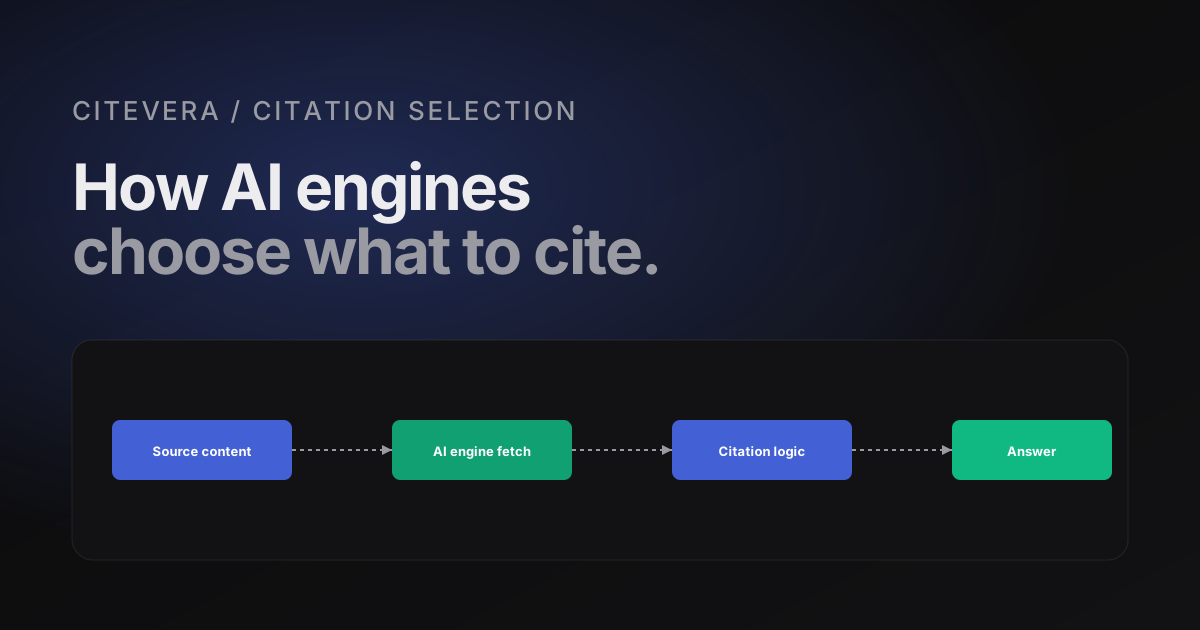
The four-stage pipeline
When an AI answer engine receives a question, it does not browse the open web in real time the way a human researcher would. It runs a pipeline. Understanding the pipeline is the difference between writing content that gets cited and writing content that does not.
Stage 1 is retrieval. The engine searches its index, plus any live retrieval APIs it has, for documents that contain language related to the query. This is keyword and embedding based. If your page does not surface in retrieval, nothing else matters - the next stages never see your content.
Stage 2 is reranking. From the retrieval set (often 50-200 candidate documents), the engine narrows to a smaller working set (typically 5-20). Reranking weighs structural signals: how directly does the document answer the question, how authoritative is the source, how recent is the content, how clean is the markup.
Stage 3 is citation eligibility. Not every document in the working set is eligible to be cited in the final answer. The engine applies filters: license compatibility, content type (some engines avoid forums for certain queries, others favor them), and presence of clear factual statements that can be attributed.
Stage 4 is answer composition. The engine drafts the answer using the citation-eligible documents. The final cited sources may be 0-5 of the working set, depending on answer length and confidence.
Where the leverage is
Most teams optimizing for AEO focus on stage 4 (the final answer) without realizing they have to win stages 1-3 first. A page that is not retrieved cannot be cited. A page that is retrieved but down-ranked in stage 2 is rarely cited. A page that passes stages 1 and 2 but is rejected at stage 3 because the engine cannot extract a clear factual statement is also not cited.
The leverage points are stages 1 and 2. Retrieval rewards content that uses the language of the question, has indexable structure (HTML, not JS-rendered), and is cleanly served. Reranking rewards direct answers, schema markup, freshness, and clear authority signals.
Stage 3 is mostly hygiene. If your content is structurally clean and your assertions are concrete, eligibility is rarely the blocker. The exception is licensing: some content explicitly disallows AI training or quoting via robots.txt or licensing terms, and engines respect that.
Stage 4 is the engine's call. You cannot directly influence which 0-5 sources end up in the final answer. You can only stack the deck by being a strong candidate at every prior stage.
Concrete signals that move retrieval
Retrieval prefers documents that are syntactically and semantically aligned with the query. Five signals consistently help.
Question-shaped headings. "What is X?" or "How do I Y?" headings match user queries directly. Engines retrieve these because the embedding similarity is high.
Term coverage. Pages that use the full vocabulary around a topic (not just synonyms) retrieve better. A page on "AEO" that also uses "answer engine optimization," "AI citations," and "generative engine optimization" matches more queries.
Stable URLs. Documents at stable URLs accumulate retrieval signals over time. URL changes reset that accumulation.
Server-side rendered HTML. JavaScript-rendered content may or may not be retrieved depending on the engine's crawler. Server-rendered content is always retrieved.
Sitemap inclusion. Engines crawl sitemap.xml first. Pages not in the sitemap are discovered later (or not at all).
Concrete signals that move reranking
Reranking is where most of the AEO advice lives. Five signals consistently move scores.
Direct answer in the first 150 words. Reranking models reward documents that answer the question early. Long preambles before the answer hurt rerank position.
FAQPage and HowTo schema. Structured Q&A is easier to extract. Reranking models trained on schema-rich data consistently elevate schema-bearing pages.
Author and Organization markup. Reranking weighs source authority. Person and Organization schema with credentials, sameAs links, and dates of last update help.
Freshness. Most engines reweight toward recent content. A 2-year-old article without a dateModified update gets down-ranked.
Internal linking depth. A page well-linked from other pages on a topical hub site reranks higher than an orphan page.
How Citevera scores this
The Citevera audit treats stages 1 and 2 as the highest-leverage axes. The retrieval axis measures crawl-ability, indexability, sitemap presence, and language alignment. The rerank axis measures direct answer presence, schema completeness, freshness, author markup, and topical depth.
Together these account for ~70% of the AEO score, because they account for ~70% of citation outcomes in our audit data. Stage 3 (eligibility) is folded into a "structural cleanliness" axis with smaller weight - most sites pass eligibility once retrieval and reranking are right.
The score is calibrated against citation frequency in the wild: pages that score well on retrieval and rerank tend to get cited; pages that score poorly do not. The mapping is not perfect (citation is probabilistic) but it is strong enough to drive prioritization.
What this means for prioritization
If you have one quarter to improve AEO, here is the order.
First, fix retrieval blockers. Server-side render the content. Add to sitemap. Make sure robots.txt allows AI crawlers. Verify your URLs are stable and return 200.
Second, improve reranking on your top-priority pages. Add a direct answer in the first 150 words. Add FAQPage and HowTo schema where appropriate. Add Author markup with credentials. Update dateModified when you actually update content.
Third, expand topical coverage. Build the cluster of pages around your priority topic so internal linking and term coverage strengthen.
Skip vanity stages. Optimizing the citation eligibility stage (small structural fixes, alt text, image schema) before fixing retrieval and rerank is reordering deck chairs.
Run a free Citevera audit to see where you stand on each stage of the pipeline
Frequently asked questions
Do all AI engines use the same pipeline?
The shape is similar across major engines (ChatGPT, Claude, Perplexity, Gemini, AI Overviews) but the weights differ. Perplexity weights freshness and source diversity heavily. ChatGPT weights schema and direct answer. Gemini weights Google's ranking signals. Knowing the shape helps; knowing the weights helps more.
Can I influence which engines pick my page?
Indirectly. Each engine has tuning knobs. Perplexity favors fresh content, so frequent updates help. Claude favors structured factual content, so schema and clean markup help. Gemini overlaps with Google search ranking, so traditional SEO carries over. ChatGPT gates retrieval through Bing, so Bing visibility matters.
How often does the pipeline change?
The pipeline structure is stable. The weights inside each stage shift constantly - we have observed measurable rerank changes within weeks of a model update. This is why repeated audits matter: a page that scored well six months ago may score worse today, even with no content change.
Does crawler-blocking via Cloudflare bot rules also block AI engines?
Often yes, even when administrators do not realize it. Cloudflare's default bot management can flag GPTBot, ClaudeBot, and PerplexityBot as suspicious traffic. The fix is explicit allow-rules for the major AI crawler user-agents alongside whatever else your bot management blocks. Test with a server-log review after changes - the engines should appear regularly in your logs if they are reaching you.
How long after a content update before engines re-crawl and re-rerank?
Discovery typically takes 1-7 days for active sites. Re-ranking against the new content takes another 2-6 weeks as the engines accumulate signal across queries. Plan for 60-90 days from a major content change before citation rate fully reflects the new content. Smaller updates show effects sooner; major restructurings take longer.