

Trust Pages: Winning 'Is It Safe' and 'Is It Legit' Queries in AI Answers
When buyers ask AI if your product is safe or legit, engines blend review sites, forums, and your own trust pages. Build a citable trust surface or others answer for you.
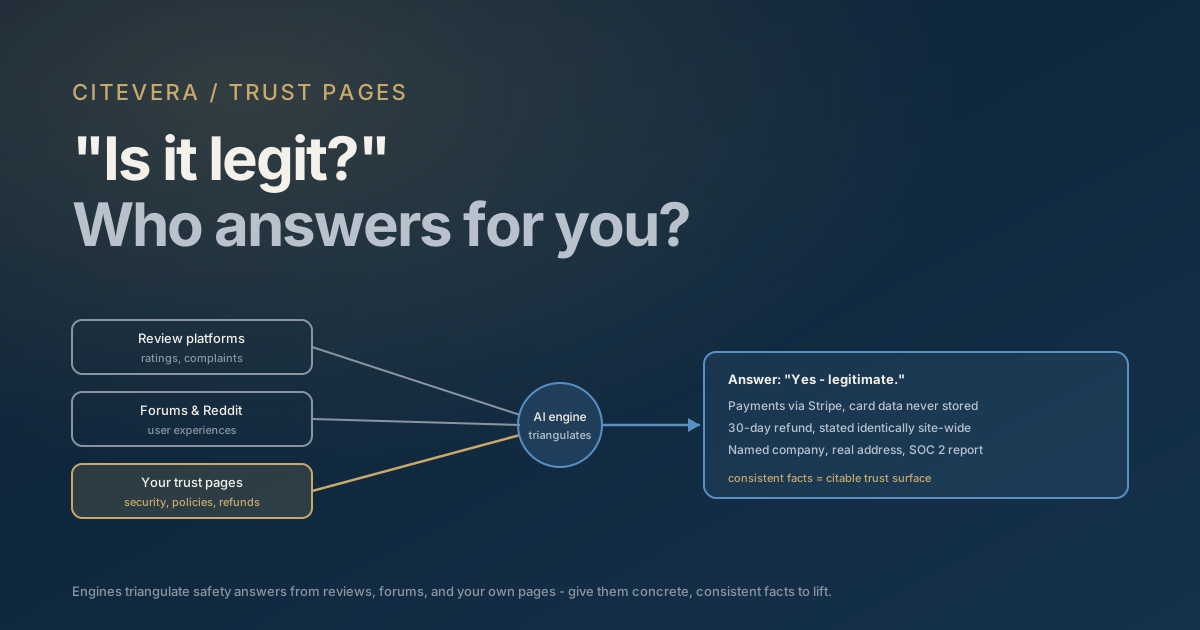
Before buying from a brand they do not recognize, people now ask an AI assistant the question they used to type into Google: "is [brand] legit," "is [product] safe," "is [site] a scam." The engine composes an answer from whatever it can retrieve - review platforms, Reddit threads, complaint boards, and your own site. If your site offers nothing extractable on safety, legitimacy, and policies, the answer gets written entirely from third-party sources, with whatever errors and old grievances they contain.
The fix is a deliberate, citable trust surface: a security page with concrete practices, transparent company information, real policies, and refund terms stated plainly - all consistent with each other and with what the rest of the web says about you. You cannot control the whole answer, but you can make sure the engine has your best material in the blend, clearly stated and easy to lift.
This post covers where engines pull trust answers from, what a citable trust surface looks like page by page, why consistency is itself a signal, and the tactics that backfire.
Where engines pull "is it safe" answers from
Watch a retrieval-grounded engine answer a legitimacy query and a pattern emerges: it triangulates. The typical source blend includes review platforms (Trustpilot, G2, app store listings), community discussion (Reddit and forums, which engines cite heavily for experience-flavored queries - see why engines lean on UGC sources), complaint and watchdog surfaces like the Better Business Bureau, scam-checker sites of wildly varying quality, and finally your own domain.
Two things follow from that blend. First, your own pages are one voice among several, so the engine is effectively cross-examining you: claims on your site that third-party sources contradict get hedged or dropped. Second, absence is expensive. If a Reddit thread from three years ago is the most extractable content about your refund behavior, it becomes the answer's backbone by default. The trust surface exists to give the engine a better backbone.
The stakes compound because assistants summarize sentiment, not just facts. An answer that opens with "reviews are mixed, and some users report difficulty getting refunds" shapes the purchase decision before your site is ever visited. Citation sentiment is worth monitoring for exactly this class of query.
The security page: concrete practices, not adjectives
"We take security seriously" is unextractable. An engine looking for material to answer "is [product] safe to connect to my data" needs statements of fact, and a good security page is a list of them.
- Name the mechanisms. Encryption in transit and at rest (say which), authentication options (SSO, 2FA), how credentials and API keys are stored, data retention and deletion behavior, and where data is hosted.
- Name the third parties. If payments run through Stripe and you never touch card numbers, say exactly that - "payments are processed by Stripe; card details never reach our servers" is a sentence engines lift verbatim into safety answers.
- State audits and certifications only if they are real and current. A SOC 2 report, a penetration test cadence, GDPR data-processing terms. Link the evidence where it exists.
- Give security researchers a path. A disclosure policy and a security contact (a security.txt file fits here) are both a real practice and a legibility signal.
Write each fact as a standalone declarative sentence. The page's job is to be quotable one line at a time, which is the same property that makes any page citable.
Transparency pages: who you are, plainly
Legitimacy queries are entity queries: the user is asking whether a real, accountable organization stands behind the site. Engines resolve that from your about page, contact page, and structured data - and from whether those agree with external records.
- About page with real specifics. Founded when, based where, by whom, doing what. Named founders or leadership with real bios beat an anonymous "our team is passionate" page. This is the same material that feeds E-E-A-T signals for AI search, and it does double duty here.
- A contact page with an actual address and a reachable channel. Scam-checker heuristics - human and automated - treat an unreachable company as a red flag, and engines reproduce those heuristics' outputs.
- Organization schema that matches. Your Organization node's name, url, logo, and sameAs links to real profiles give engines a machine-readable identity to anchor the entity. Keep it consistent with the about page's prose.
- Honest company scale. Claiming "trusted by thousands of teams" while every external source describes a small new product creates exactly the contradiction that makes engines hedge.
Policies and refund terms: state them where engines can read them
"Can I get my money back" is a subquestion inside most is-it-legit queries, and it is the one your own site should win outright, because you are the authoritative source for your own terms.
Publish the refund policy as plain prose on an indexable page - not solely inside a checkout flow, a PDF, or an account area. Lead with the operative sentence: the window, the conditions, the method. "Every paid plan includes a 30-day money-back guarantee; email support and we refund in full, no questions asked" is a complete, extractable answer. Bury the same policy in 2,000 words of legal boilerplate and the engine may instead quote a forum user's version of it.
Do the same for the privacy policy's key facts (what you collect, what you sell or do not sell, how deletion works), cancellation mechanics, and support response expectations. A short FAQ on the pricing or trust page - "Is there a refund policy?", "Can I cancel anytime?" - matches the question form users actually put to assistants, which is why FAQ-shaped trust content extracts so well.
Consistency across pages is itself the trust signal
Engines cross-check. The same fact stated identically on your pricing page, refund policy, terms, and FAQ reads as a stable, verifiable claim. The same fact stated three slightly different ways - 14 days here, 30 days there, "contact us for eligibility" in the terms - reads as unreliable, and an engine synthesizing across your own pages will either surface the contradiction or hedge the whole topic.
In our audits we commonly see exactly this drift: a pricing page updated last quarter, a terms page from two years ago, a support macro quoting a policy that no longer exists. Treat trust facts like code constants - defined once, referenced everywhere. When the refund window changes, sweep every page that states it, including old blog posts. Consistency should extend outward too: your G2 profile, app store listing, and directory entries all feed the same answer blend, so bring them in line with the site whenever you control them.
What not to do
Trust theater backfires with AI engines more sharply than with human visitors, because engines compare claims against records at scale.
- No fake or unearned badges. A SOC 2 logo without a report, a "McAfee Secure" seal from a defunct program, invented "award winner" crests. Where a claim is checkable and fails, expect it to be contradicted in the answer.
- No unverifiable superlatives. "Bank-level security" and "military-grade encryption" name no mechanism and invite skepticism; engines favor pages that say AES-256 and TLS 1.3 over pages that say military-grade.
- No fabricated reviews or testimonials. Review platforms police this, engines read review platforms, and a manipulation flag on your Trustpilot profile is far worse in an AI answer than a modest rating.
- No suppressing the negative while claiming perfection. If complaints exist, an answer will find them. A public, dated response - "we had shipping delays in 2024; here is what changed" - gives the engine a resolution narrative instead of an open accusation.
Frequently asked questions
What should I do if AI engines currently call my brand a scam or "mixed"?
Find the sources the answer is actually built from - ask the engine for its sources, or check the citations it displays. Then address them at the source: respond to review-platform complaints, resolve BBB cases, and publish direct, factual pages answering the specific accusations. Answers shift when the underlying retrieval set shifts, on the engines' recrawl and refresh timelines, so treat it as a weeks-to-months effort.
Do I need a dedicated "trust center" page?
A single hub helps but is not the mechanism. What matters is that the individual facts - security practices, company identity, refund terms - each live on an indexable page in extractable prose. A trust center that links the security page, policies, and certifications is a good pattern; a trust center that replaces plain pages with a JavaScript widget is a regression.
Does schema markup help for trust queries?
Yes, as reinforcement. An accurate Organization node with sameAs links gives engines a verifiable identity, and FAQPage markup on policy questions mirrors the query form. Schema cannot outweigh contradictory third-party evidence, but it removes ambiguity about who you are, which is half of a legitimacy answer.
Should I publicly respond to negative Reddit threads about my product?
Generally yes, if you can do it factually and calmly. Engines retrieve the whole thread, so a thread that ends with a named company representative resolving the issue produces a very different summary than one that ends with the complaint. Never astroturf; undisclosed company accounts get outed, and that thread becomes new scam evidence.
How do I monitor what AI engines say about my brand's safety?
Put your legitimacy queries - "is [brand] legit," "is [brand] safe," "[brand] refund" - into a fixed prompt set and run it on a schedule across the major assistants, tracking both the verdict and the cited sources. You can do this manually, or use free brand-mention monitoring approaches to systematize it.
Make your trust surface auditable
Trust pages fail quietly: the facts drift out of sync, the refund policy hides in a PDF, the security page says "seriously" instead of "AES-256." A Citevera audit scores whether your pages are extractable and consistent enough to be cited, and the citation monitoring bundled with every paid plan runs your brand and legitimacy queries across ChatGPT, Claude, and Gemini on a schedule - so when an engine's verdict about you changes, you find out from a dashboard, not from a customer.