

E-E-A-T signals AI engines actually read
Experience, expertise, authoritativeness, trustworthiness - the Google quality framework translates imperfectly to AI answer engines. Which E-E-A-T signals matter for AI citation, which do not, and how to express them in ways engines can extract.
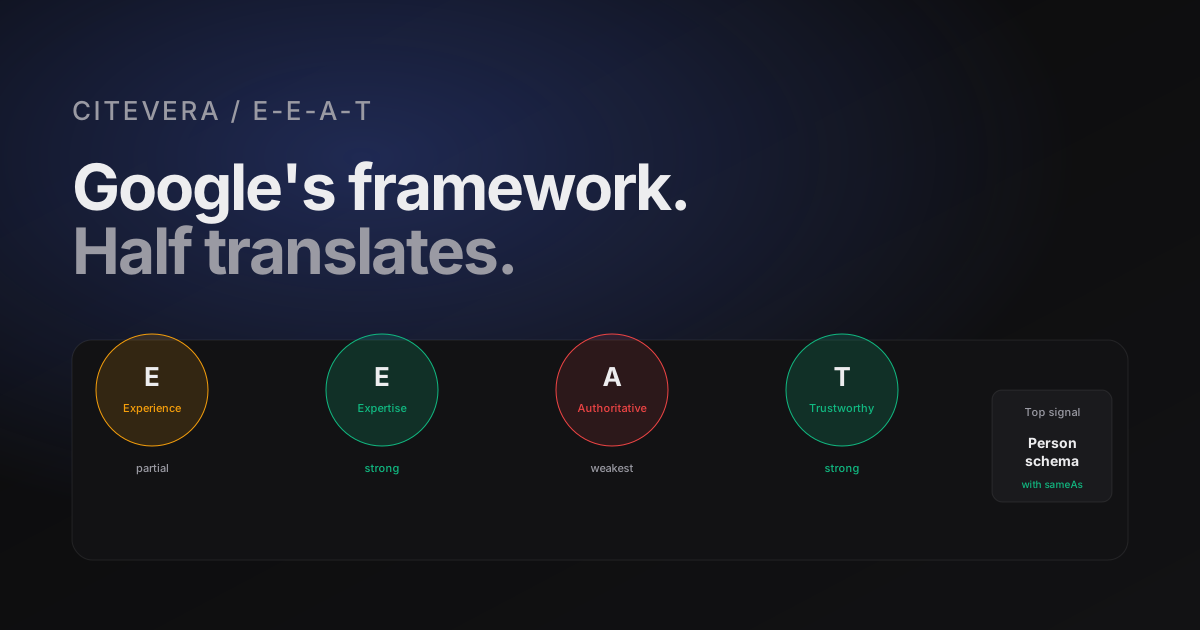
The half-translation
E-E-A-T - Experience, Expertise, Authoritativeness, Trustworthiness - is Google's quality framework for human evaluators. It has always been fuzzy; E-E-A-T is not a direct ranking factor but a set of signals that map indirectly onto many signals that are. When AI answer engines entered the field, the framework translated imperfectly. Some E-E-A-T signals matter more to AI citation than they ever did to organic ranking; others matter less.
Here is what we measure mattering across 500+ Citevera audits.
The translation, signal by signal
Experience: partial translation
E-E-A-T's "experience" means the author has personally done the thing they are writing about. Google evaluators look for first-person accounts, specific case details, and evidence of direct involvement.
AI engines read some of this but weakly. An engine cannot easily verify that a human wrote from experience. What it can verify: whether the content uses specific named examples, whether claims are backed by numbers with methodology, whether the post references original data. A post with "In our 340-page audit sample..." carries more weight than "In many cases..." because the specificity reads as first-hand, even without explicit verification.
Practical translation: replace vague authority ("we've seen repeatedly") with specific authority ("in our 2026 audit sample of 500 sites"). The specificity is what survives the engine's read.
Expertise: strong translation
E-E-A-T's "expertise" is whether the author knows the topic. AI engines surface this through two mechanical channels:
1. Author schema with Person linking. A BlogPosting with an author: { Person: { name, jobTitle, url, sameAs } } block gets the author credited as the expert voice. If the sameAs links to a LinkedIn profile, an academic affiliation, or a personal site with a clear bio, the engine cross-references and builds a model of authority. 2. Author consistency across the site. A site where 15 posts are attributed to "Jamie Lin" with consistent schema builds an entity model for Jamie Lin. That entity accumulates authority signals across posts. A site where every post is attributed to "Admin" or where the byline changes randomly has no author entity and cannot accumulate.
The practical fix: pick real authors, write accurate bios, emit Person schema correctly. This is a one-time template change plus a modest per-post cost.
Authoritativeness: weakest translation
E-E-A-T's "authoritativeness" is roughly "is the site itself a trusted source on the topic". For Google, backlinks and domain age are the major inputs. For AI engines, the correlation with backlinks and age is weaker - we see it matter but less than schema and content signals.
What does translate: whether the site is referenced by other authoritative sources. If Stanford HAI cites your post in their own writing, that citation gets picked up by engines and feeds their source-quality model. If nobody references you, your authoritativeness has to come from the content signals alone.
Practical translation: aim for a few high-quality inbound links from respected sources in your vertical. Trying to build 1000 mediocre links is wasted effort. Building 5 links from the 20 most-respected sites in your space pays off.
Trustworthiness: strong translation
E-E-A-T's "trustworthiness" is whether the site can be trusted not to mislead. For AI engines this translates well, through several mechanical channels:
- Accurate contact and organization information. A site with a real physical address, a reachable contact email, and clear ownership reads as trustworthy.
- HTTPS, proper DNS, no redirect chains. Basic technical hygiene signals seriousness.
- Source citations. Back to the footnote rule: sourced claims are more trustworthy than unsourced claims.
- Disclosure. Affiliate links disclosed, sponsored content labeled, conflicts of interest named. Engines detect undisclosed advocacy.
Practical translation: be the site that could pass a journalism-school review. Contact info visible. Sources linked. Clear attribution. Transparent about commercial relationships.
The signal that matters most and gets missed
Of all the E-E-A-T translations, the one that most consistently differentiates cited from uncited sites - controlling for other variables - is author identity expressed structurally. Sites with a real author byline, linked to a real Person entity with verifiable external identity (LinkedIn, Twitter/X with matching name, personal site or academic profile), consistently get cited more than sites without.
The mechanism is probably straightforward: the engine builds an entity for the author, checks whether the author has credible external references, and uses that as a prior when deciding whether to cite content attributed to them. A first-time writer with no external presence does not get the benefit. A long-time writer with an obvious footprint does.
For most sites this means setting up author pages with:
- A named author (not "Team X" or "Admin").
- A short biography with verifiable claims.
sameAslinks to the author's professional profiles.- A unique URL for the author page that Person schema can reference.
It is a 30-minute-per-author exercise. Do it for the 3 to 5 people who write most of your content.
The anti-pattern: fake bios
The reverse exists. Some sites invent author bios to simulate authority. Engines are increasingly good at detecting fabricated identities - the author has no LinkedIn presence, no external articles, no record of existence outside this one site. When detected, the whole site's authority signal gets discounted.
The rule: if you do not have real named humans writing, attribute content to the organization and skip the Person schema. "author": { "@type": "Organization", "name": "Citevera" } is a legitimate pattern. Fabricating a human is not.
E-E-A-T and medical, financial, or legal content
For "your money or your life" topics - medical, financial, legal - E-E-A-T weighs heavier. AI engines are cautious about citing unverified sources on consequential topics. A site writing about prescription medications without medical-professional authorship will struggle to be cited regardless of how well-structured the content is.
If you publish in YMYL areas, the author-credential requirement is close to absolute. Get a real credentialed author - MD, CFA, attorney, etc. - named and bylined, with Person schema linking to their credentials. The citation premium is large enough to justify the editorial overhead.
The things E-E-A-T does not capture for AI search
A few signals that matter for AI citation and are not in the E-E-A-T framework:
- Structured data. Nothing in E-E-A-T explicitly rewards schema markup, but it is the biggest AEO lever.
- Direct-answer density. E-E-A-T does not reward first-150-word answers specifically.
- llms.txt files. Completely outside E-E-A-T.
- Internal clustering. E-E-A-T is per-page; AEO is often per-cluster.
Conversely, some things E-E-A-T emphasizes matter less for AI citation than they do for organic ranking:
- Long, comprehensive content. AI engines often prefer focused depth over breadth.
- Recency beyond a point. A 3-month-old post and a 3-week-old post are both treated as fresh.
Run E-E-A-T review as one part of your AEO framework, not the whole. It complements structural AEO work but does not substitute for it.
Run a free audit to see how your site signals author authority
How Citevera scores E-E-A-T signals
The audit checks author attribution via schema (Person linking, sameAs presence), trust signals (contact page presence, about page, HTTPS hygiene), and source citation density. It does not attempt to score "experience" or "authoritativeness" directly because those are judgment calls that need human evaluation.
What the audit does well: flag pages that are missing Person schema, flag sites with no reachable contact information, flag content making claims without sources. Those are the E-E-A-T proxies that translate cleanly to AEO lift.
Frequently asked questions about E-E-A-T for AI search
Does Google's E-E-A-T guidance apply to AI Overviews?
Partially. AI Overviews runs on the same index as organic Google search, so signals that feed organic ranking also influence what sources are available to the Overview. But the Overview's own selection logic adds its own signals - schema, direct-answer density, freshness - that E-E-A-T does not explicitly cover.
Can small businesses compete on E-E-A-T?
Yes, within their niche. A small specialty site with one or two named experts, clearly credentialed, writing consistently, can out-E-E-A-T a much larger generic site on the niche's queries. Authority is topical, not universal.
Should I buy author bio placements on other sites?
No. Engines detect coordinated placements and discount them. Earn coverage through real work - conference talks, podcast appearances, bylines on respected publications - and let the signals accumulate naturally.
What about AI-generated content with human review?
Disclose it. Label AI-assisted content clearly. Engines are still forming views on mixed human-AI content, and the safest posture is transparency. Undisclosed AI content at scale is detectable and hurts trust signals site-wide when caught.