

Press Releases as AEO Amplifiers: Beyond Tier-1 Media Coverage
Press releases earn citations from AI engines through wire syndication and entity reinforcement, not just media pickup. Here is how to write one that compounds AEO value.
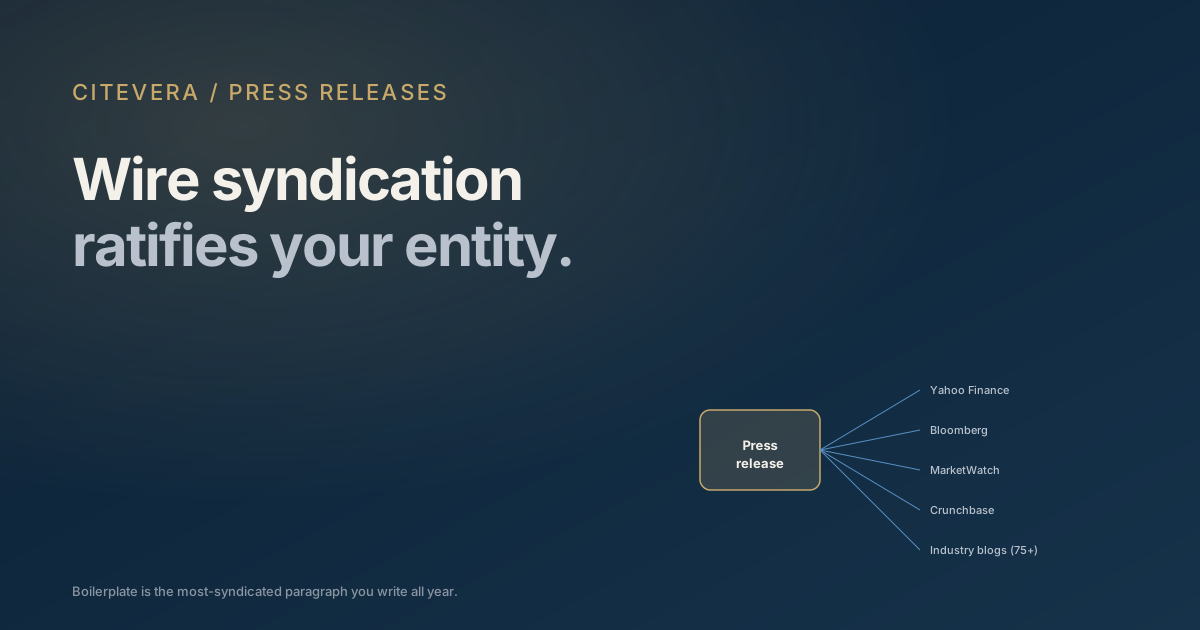
For most B2B companies, press releases sit awkwardly between PR and content marketing. The PR team optimizes for media pickup. The content team optimizes for SEO. Both teams ignore the third axis: AI search citation flow. A press release that lands on PR Newswire, Business Wire, or GlobeNewswire syndicates to hundreds of outlets and creates a wide layer of corroborating mentions that AI engines use for entity strength.
This post covers how AI engines use press releases, the writing pattern that earns citation lift beyond raw distribution, and the milestones worth releasing.
How AI engines actually use press releases
Two mechanisms:
Wire syndication creates a corroboration layer
When a press release goes out via a major wire service, it republishes on dozens to hundreds of finance, business, and industry sites within hours. Many are thin sites that auto-republish wire content. SEO professionals discount these because they offer little ranking value. AI engines treat them differently because the corroboration pattern (multiple sources reporting the same fact) is a signal of factual reliability.
A funding announcement that appears on 80 syndication sites with consistent details is a stronger entity signal than a single TechCrunch piece would be. Both matter; they reinforce each other.
Press releases anchor entity facts
Press releases are heavily structured. They include the company's full legal name, headquarters location, executive titles, founding year, and product description in a predictable place. AI engines extract these consistently. Over time, the corpus of press releases an entity has issued becomes part of its entity signature.
This is why a startup with no PR coverage often shows up as ambiguous in AI engines while a competitor with a 3-year history of regular press releases shows up clearly.
What kinds of news are worth releasing
Five high-yield categories:
1. Funding rounds. Highest-impact for entity strength. A funding press release ratifies the company in financial databases. 2. Major product launches. Use selectively; not every minor feature deserves a wire release. 3. Executive hires at VP level and above. Connects new Person entities to your Organization. 4. Industry awards and recognitions. Particularly when the awarding body is independent and reputable. 5. Acquisitions, partnerships, customer wins at meaningful scale.
Two categories to avoid:
- Routine product updates. If the news would not interest a journalist, the wire release is filler.
- Made-up "milestones". "First anniversary of our launch" releases are filler and dilute the entity signal across thin pieces.
A discipline of 4 to 8 substantive press releases per year produces stronger entity reinforcement than 30 thin releases per year.
The press release structure that earns AEO lift
Six elements in order:
Headline that names the company and the news
> "Acme Cloud raises $40M Series B to expand AEO platform across enterprise customers"
Not: "Cloud platform announces strong growth quarter".
Dateline with city, state, and date
> "SAN FRANCISCO - May 15, 2026 -"
Standard PR formatting. AI engines parse the dateline reliably.
Lead paragraph that answers what, who, when, where
The lead paragraph should be 50 to 80 words and contain the full company name, the news event, and the most important specifics. This is the citation-target paragraph.
A single quote from the CEO or relevant executive
One quote, attributed by full name and title. Multiple quotes from many people dilutes the citation-target paragraph and rarely helps.
A boilerplate "About [Company]" paragraph
This is the most under-leveraged part of a press release for AEO. The boilerplate should:
- Name your full legal company name and any common short forms.
- State your founding year and headquarters.
- Describe what you do in 1 to 2 sentences using the same vocabulary as your website copy.
- Include your URL.
Wire syndication republishes the boilerplate verbatim across hundreds of sites. A weak boilerplate (vague description, missing URL, no founding year) wastes the syndication.
Contact information and a media kit URL
Standard. A media kit URL pointing to your hosted assets reinforces the entity link.
Where press releases break and how to fix them
Five common failures:
The boilerplate is corporate filler
> "Acme Cloud is a leading provider of innovative cloud-based solutions designed to help businesses transform their operations."
This says nothing. AI engines extract it but it adds no entity signal. Replace with:
> "Acme Cloud, founded in 2022 and headquartered in San Francisco, builds answer engine optimization tools for B2B SaaS companies. The Acme platform measures and improves how often a company is cited by AI search engines like ChatGPT, Claude, and Perplexity."
The second version is citable and adds disambiguation.
No links back to your domain
A wire release with no URL leaves the syndication value disconnected from your site. Always include your domain in the boilerplate and in the lead paragraph when natural.
Missing on-site press release archive
If your press release goes out on the wire but never appears on your own site, you have no version to canonical and no internal-linking surface. Always publish a copy on your domain (e.g., acme.example/press/series-b-2026/) with the same content and the canonical pointing to your version.
Inconsistent company name across releases
"Acme Cloud" in one release, "Acme Cloud, Inc." in another, "Acme" in a third. Pick a canonical name and use it consistently. This applies to executive titles too.
Copy-paste old boilerplate without updates
A 2026 press release with a 2023 boilerplate that says "founded in 2022, with 12 employees" when you now have 60 employees. Update the boilerplate quarterly.
How to host the on-site copy
Three placement patterns:
Dedicated press release page
URL: acme.example/press/series-b-2026-05/. Each release gets its own URL. Self-canonical. Article schema with Organization as publisher.
Press release index page
URL: acme.example/press/. Lists all releases chronologically with brief excerpts. Internal links to each release page.
Newsroom hub
URL: acme.example/newsroom/. Combines press releases, media coverage, executive bios, and brand assets. Useful for enterprise companies with active media engagement.
The dedicated release page plus an index is the right minimum. The newsroom hub is the upgrade for companies where PR is a core function.
Schema markup for press releases
Article schema with the right articleType and Organization linking:
{
  "@context": "https://schema.org",
  "@type": "NewsArticle",
  "headline": "Acme Cloud raises $40M Series B...",
  "datePublished": "2026-05-15T08:00:00-07:00",
  "publisher": {
    "@id": "https://acme.example/#organization"
  },
  "author": {
    "@type": "Organization",
    "@id": "https://acme.example/#organization"
  },
  "articleSection": "Press Releases"
}
NewsArticle is the appropriate type for press releases. Reference your Organization by @id for entity graph cohesion.
How press releases stack with other AEO signals
Press releases work best as part of a broader AEO program, not as the centerpiece:
- Pillar content carries the deep authority signal.
- Glossary and FAQ carry the definitional citation flow.
- Press releases carry entity ratification and corroboration.
A site running all three produces compounding citation lift that none does alone.
Wire service selection
Three tiers:
- Tier 1: PR Newswire, Business Wire, GlobeNewswire, AP. Strongest syndication footprint. $400 to $1,500 per release depending on geography and length.
- Tier 2: EIN Presswire, Newswire.com, PR.com. Lower cost, narrower syndication. Adequate for routine releases.
- Tier 3: Free distribution services. Avoid; the syndication footprint is thin and the sites that republish are often spam-adjacent.
For 4 to 8 substantive releases per year, Tier 1 is the right choice. For higher cadence with lower stakes, mix Tier 1 (for funding/launches) with Tier 2 (for routine news).
Key takeaways
- Press releases earn AEO lift through wire syndication and entity reinforcement, not just media pickup.
- 4 to 8 substantive releases per year beats 30 filler releases.
- The boilerplate "About [Company]" paragraph is the most under-leveraged AEO surface in a press release.
- Always publish an on-site copy with self-canonical and NewsArticle schema.
- Tier 1 wire services are worth the cost for funding, launches, and significant news.
What to do next
Run a free audit at scan.citevera.com to see whether your domain has an on-site press release archive and whether your boilerplate is citable. The report flags missing newsroom architecture as an entity-strength gap.
For the entity-graph foundation that press releases reinforce, organization schema deep-dive covers the underlying entity infrastructure.