

Paywalled Content and AI Search: How Much to Expose
Fully walled content earns no AI citations; fully open gives away the product. The fix: open extractable layers, walled depth, and paywall markup engines parse.
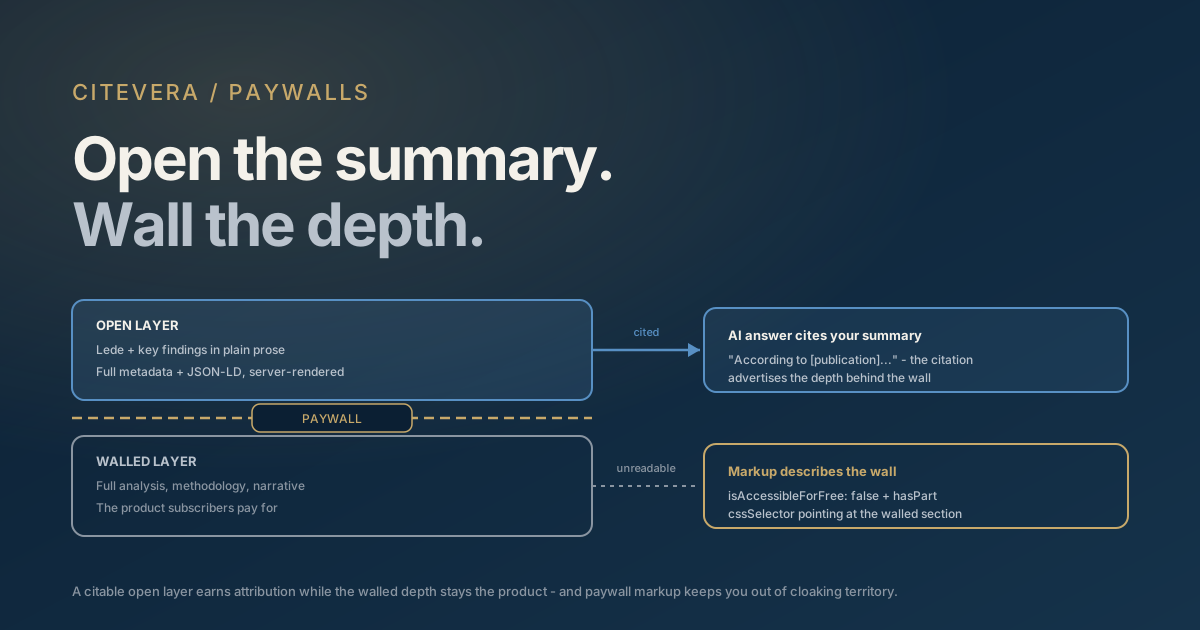
If your content sits entirely behind a paywall, AI engines cannot read it, so they cannot cite it, and your publication slowly disappears from the answer layer where a growing share of discovery now happens. If you drop the wall entirely, engines will happily summarize your work for free and the subscription case weakens. Neither extreme is a strategy. The workable position for most publishers is a deliberately layered page: an open, extractable surface built to be cited, a walled depth that stays the product, and structured data that tells engines exactly where the boundary sits.
This is a real dilemma with real trade-offs, not a checklist item. Pew Research Center's 2025 panel work found users who saw an AI summary clicked a traditional result on roughly 8% of visits versus about 15% without one, and clicks on links inside AI summaries ran around 1% of visits - so a citation is visibility and credibility more than it is traffic (full numbers in our AI search statistics roundup). The question each publisher has to answer is how much visibility is worth exposing, and to whom.
Here are the exposure patterns that work, the markup that describes the wall, and the robots decisions that sit underneath both.
The dilemma, stated honestly
A paywall and an answer engine want opposite things from the same page. The engine wants extractable text it can quote and attribute; the paywall exists to make the text scarce. Three facts frame every resolution of that tension.
Engines cite what they can fetch. A crawler that receives a login wall, a truncated teaser, or a JavaScript-gated shell has nothing to quote. Pages like that lose retrieval-based citations entirely, and over time the publication's absence from answers cedes its topics to open competitors.
Citation value flows to the brand, not the click. Given the Pew click numbers above, the realistic prize is being the named authority in the answer - "according to [publication]" - which supports the subscription brand even when the reader never visits.
Cloaking is a dead end. Showing crawlers full text while users hit a wall invites the engine to reproduce the very content you sell, trains users that the assistant is the free version of your product, and violates the honest-representation policies most engines and Google's paywall guidance are built around. The exposure decision should be one decision, applied consistently to bots and humans.
Whether to admit AI crawlers at all is its own strategic call - should you allow AI crawlers walks through that decision. This post assumes you want some AI visibility and asks how much to expose.
Pattern: generous previews with extractable summaries
The first workable pattern keeps articles walled but makes the open preview a complete, citable object rather than a truncated tease.
- Open a real summary, not a cliffhanger. Two or three paragraphs that state the piece's core finding or argument outright. An engine can quote and attribute this; a "The answer may surprise you..." teaser earns nothing.
- Expose the key facts you want attributed. If your investigation established a number, a date, or a finding you want the world to credit you for, put it above the wall in plain declarative prose. What sits below the wall is the methodology, the narrative, the full analysis - the reasons to subscribe.
- Keep metadata open. Headline, description, author, publish date, and the full JSON-LD should render for every fetcher regardless of the wall.
The strategic insight: a citation is an advertisement for the depth you did not expose. Choose the facts whose attribution builds your authority, and wall the work product around them.
Pattern: lead paragraphs open, analysis walled
For news and analysis publications, the natural cut is structural: the lede and nut graf open, the analysis walled. The open lede answers "what happened," which is what most answer-engine queries about news actually ask; the walled remainder answers "what does it mean," which is the subscription product. This maps cleanly onto how wire-style journalism is already written, so it usually requires a template change, not an editorial one.
Two implementation notes. Render the wall server-side so the open portion is real HTML at fetch time - a client-side wall that hides content after load behaves unpredictably across crawlers, and some see nothing at all. And keep the open portion consistent across engines and users; the temptation to give Googlebot more than GPTBot recreates the cloaking problem in a new shape.
Pattern: flexible sampling for the archive
Google's original flexible sampling concept - metering some free access rather than walling everything always - has an AEO analogue worth considering: vary exposure by content age and strategic value. Fresh flagship reporting stays tightly walled with a summary-only surface. The multi-year archive, which sells few subscriptions on its own, can open further and become your citation inventory - evergreen explainers, definitions, and reference pieces that engines cite repeatedly and that keep the publication's name in answers. Many publishers already discount archive access implicitly; making the crawl-facing version of that decision explicit turns dead weight into visibility.
The same logic runs the other way for premium data: if a report is the product, expose only the headline finding and treat every citation as lead generation for the full version.
Mark up the wall so engines understand it
Structured data is how you tell machines "this page has a paywall and here is exactly where it is" - which protects you from being treated as a cloaker and gives compliant engines a machine-readable map of open versus walled content. Google documents the pattern for paywalled content structured data, and it transfers directly.
The mechanics, on your Article or NewsArticle node: set isAccessibleForFree to false, wrap the walled section in an element with a CSS class, and declare that class in a hasPart block of type WebPageElement, with its own isAccessibleForFree: false and a cssSelector pointing at the class. A layered page has the open summary outside any marked section and one or more walled parts declared in hasPart. Three practical rules from audits of paywalled sites:
- The cssSelector must actually match the served DOM. Template refactors silently break this; validate after every redesign.
- Mark only genuinely walled parts. Declaring the whole page inaccessible while serving most of it free muddies the signal in both directions.
- Keep the markup server-rendered alongside the content, not injected by the paywall script.
Robots choices for paywalled archives
robots.txt is the coarse instrument underneath all of this: it decides which crawlers see anything at all, per user agent. For a paywalled publisher the useful realization is that the decision is not one bit. You can allow retrieval-oriented fetchers that produce attributed, linked citations while disallowing pure training crawlers, or the reverse, because the major operators publish distinct user agents for distinct purposes - OpenAI alone documents GPTBot, OAI-SearchBot, and ChatGPT-User separately at platform.openai.com/docs/bots. The full roster and syntax live in our robots.txt guide for AI crawlers.
Sensible starting positions by archive posture: if you run summary-above-the-wall exposure, allow search and retrieval agents so the summaries earn citations, and decide training access separately based on your licensing stance. If sections of the archive are fully open as citation inventory, make sure nothing in robots.txt or your CDN's bot rules contradicts that - a bot-protection preset that blocks AI crawlers site-wide quietly cancels the whole strategy. Verify the live behavior per agent with the free AI crawler access checker rather than trusting the config file you think is deployed.
Frequently asked questions
Can AI engines cite content that is behind a paywall?
Not the walled portion. Engines cite what their fetchers can read, so the citable surface of a paywalled article is exactly the open layer - summary, lede, metadata. That is why the design of the open layer, not the existence of the wall, determines your AI visibility.
Does isAccessibleForFree affect whether AI engines cite my pages?
Its documented role is descriptive: it tells engines the wall exists and distinguishes a legitimate paywall from cloaking, and Google's guidance ties it to how paywalled content is handled in Search. Treat it as required hygiene for any walled page rather than a citation lever - the citation lever is the open, extractable layer.
Should I show full articles to crawlers but wall them for users?
No. Beyond policy risk, it hands the engine your entire product to summarize, which is the worst commercial outcome available. Serve the same layered page to everyone and choose the layers deliberately.
Is blocking all AI crawlers a defensible strategy for a publisher?
It is a coherent strategy if your position is that answer-layer visibility has negative value until licensing terms exist - some major publishers have taken it, usually alongside litigation or negotiation. The cost is compounding invisibility as answers get written from rivals' coverage. If you choose it, enforce it consistently at robots.txt and the CDN, and revisit it as licensing deals change the terms.
How do I measure whether my open layers are earning citations?
Track your publication's appearance in AI answers for the queries your coverage targets, on a fixed schedule. Citevera's bundled monitoring runs prompt sets across ChatGPT, Claude, and Gemini and records when and how you are cited, which shows directly whether a summary-layer redesign changed your citation rate.
Audit the boundary you actually serve
Most paywall AEO failures are not strategy failures - they are gaps between intent and deployment: a cssSelector that stopped matching after a redesign, a CDN bot rule overriding robots.txt, a client-side wall serving empty HTML to every crawler. A Citevera audit checks the crawl-facing reality of your pages - what each engine's fetcher can read, whether your schema parses, whether your access rules match your policy - and the AI crawler access checker gives you the per-agent answer for free. Decide how much to expose, then verify that is what you are exposing.