

noai, noimageai, and Friends: What Actually Honors Them
The noai and noimageai tags came from art platforms, and almost no AI vendor honors them - robots.txt is the real opt-out and WAF blocking the only enforcement.
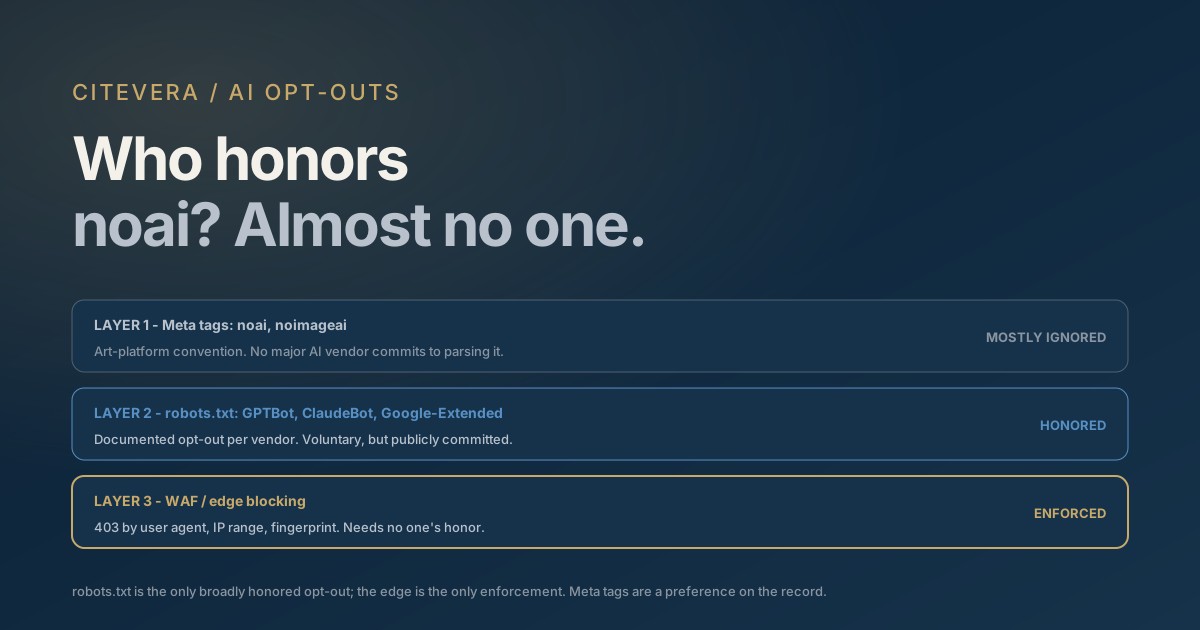
If you added <meta name="robots" content="noai, noimageai"> to your pages expecting AI companies to stop training on your content, here is the uncomfortable truth: almost none of them have ever committed to honoring it. The noai family of tags is a community convention that escaped its original context, not a standard any major AI vendor implements. The opt-out signals that demonstrably work sit elsewhere in the stack - robots.txt directives that OpenAI, Anthropic, and Google document honoring, and WAF-level blocking, which is the only mechanism that does not depend on anyone's honor at all.
This post traces where noai came from, maps which signal each major vendor has actually committed to, and ends with a decision framework - because the right move depends on whether you want to signal a preference, exercise a documented opt-out, or enforce a wall.
Where noai came from
The tags did not come from a standards body or a search engine. DeviantArt introduced noai and noimageai meta directives in November 2022, at the peak of the image-generation backlash, as a way for artists to label pages whose content should not be used for AI training. Other art platforms followed, and the convention spread as both a page-level meta tag and an HTTP header variant:
<meta name="robots" content="noai, noimageai">
X-Robots-Tag: noai, noimageai
The X-Robots-Tag header is a real, documented mechanism - for the directives crawlers define, like noindex and nofollow. The problem is the values: noai and noimageai are not part of any robots directive vocabulary that major crawlers document supporting. A directive only exists to the crawlers that parse it. Some open-source scraping tools in the image-dataset world adopted the convention - the tooling used to assemble large image datasets respects such opt-out headers by default - and that mattered for the art-scraping wave of 2022 and 2023. But the large commercial AI crawlers doing the bulk of collection in 2026 have never listed noai among the signals they parse.
That is the core distinction to carry through this post: a signal is only as good as a named party's public commitment to obey it, and enforcement is only real when it does not require obedience.
What the major vendors actually commit to
Check the primary documentation and a consistent pattern appears: every major vendor's documented opt-out is robots.txt, per user agent - not meta tags.
OpenAI documents its crawlers - GPTBot for training, OAI-SearchBot for search, ChatGPT-User for user-initiated fetches - on its bots page, and commits that content disallowed for GPTBot in robots.txt is not used for training its models. The page also lists published IP ranges, which makes verification and WAF rules practical.
Anthropic documents that ClaudeBot respects robots.txt disallow rules, in its crawler documentation, covering how site owners can block collection for training.
Google created the Google-Extended token, documented in its crawler overview, specifically so sites can opt out of Gemini training and grounding without touching normal Googlebot search crawling. Note the deliberate asymmetry Google preserved: AI Overviews ride on standard search indexing, so Google-Extended does not remove you from AI Overviews - only from model training and grounding uses.
None of these vendors documents parsing a noai meta tag. That does not make the tag harmful - it is inert bytes to a crawler that ignores it - but publishing it and believing you have opted out is a false sense of security, which is worse than no opt-out because it ends the conversation before the real controls get configured.
Robots.txt itself, standardized in RFC 9309, is still voluntary compliance - the file is a request, not a lock. Its value is that the specific companies above have publicly, checkably promised to obey it, which puts reputational and legal weight behind the promise. A meta tag nobody promised to read carries neither. For the per-agent syntax and a copy-paste policy covering the current crawler roster, see our robots.txt guide for AI crawlers.
The three-layer reality
Sort every opt-out mechanism by what actually backs it and you get three layers.
Layer 1 - preference signals: noai, noimageai, and cousins. Parsed by some dataset tooling, ignored by every major commercial AI crawler as far as any public documentation shows. Cost: near zero. Effect: near zero, outside the art-platform and open-dataset context the tags came from. Ship them if you want your preference on the record - some publishers do, reasoning that a recorded preference may matter in future disputes - but never mistake them for a control.
Layer 2 - documented opt-outs: robots.txt per user agent. Honored by the named vendors above, verifiable in your access logs (the crawler stops fetching), and granular - you can disallow training bots while allowing search-oriented fetchers, path by path. This is the highest-leverage layer: real commitments, zero infrastructure, reversible in one file edit. Its limit is coverage: a crawler that never published a commitment, or a scraper that fakes its user agent, is outside the honor system entirely.
Layer 3 - enforcement: WAF and edge blocking. The only layer that does not ask permission. CDN and WAF providers - Cloudflare most prominently, which introduced one-click AI crawler blocking and later made blocking the default for new sites - identify AI bots by user agent, published IP ranges, and behavioral fingerprinting, and return 403s regardless of what any crawler promises. This is the only mechanism that stops non-compliant scrapers. Costs: maintenance, occasional false positives, and the certainty that you are also invisible to every AI surface those bots feed.
The layers compose. A serious opt-out posture is robots.txt for the documented actors plus WAF rules for the rest - with the meta tags as an optional statement of intent on top, clearly understood as symbolic.
A decision framework
The prior question - should you be blocking AI crawlers at all - has its own strategic treatment; for most commercial sites the answer is no, because blocking removes you from the answers your buyers read. But when you have decided some content should not feed AI systems, choose the mechanism by what you are actually protecting.
"I want my objection on the record" -> Layer 1. Add the meta tags and headers. Understand this is expressive, not protective.
"I don't want my content training models, but AI search visibility matters" -> Layer 2. Disallow the training-specific agents - GPTBot, Google-Extended - while leaving search and user-fetch agents alone. This is the surgical option most publishers actually want, and it only exists because the vendors split their user agents by purpose.
"This content must not be collected, period" -> Layer 3, plus Layer 2. Paywalled archives, licensed data, user-generated content with contractual constraints: enforce at the edge, and keep the robots.txt rules so compliant crawlers never even hit the WAF.
"I want to verify, not trust" -> logs. Whatever you deploy, confirm behavior in your access logs: disallowed agents should stop appearing on disallowed paths within days. Trust the commitment, but check the logs - the vendors that honor robots.txt are exactly the ones whose absence you can confirm.
Frequently asked questions
Does Google honor the noai meta tag?
No. Google's documented mechanism for AI opt-out is the Google-Extended robots.txt token, which removes your content from Gemini training and grounding while leaving normal search crawling untouched. No Google documentation lists noai as a supported robots directive, in meta tags or X-Robots-Tag headers.
Is there any point in adding noai and noimageai at all?
As a statement of intent, maybe: it is cheap, harmless, and puts your preference on the record, which some publishers value for future licensing or legal contexts. As a control, no - no major AI vendor has committed to honoring it, so it should never be your only measure.
Can I opt out of AI training without losing AI search visibility?
Often, yes - because major vendors split crawlers by purpose. Disallowing GPTBot blocks OpenAI training while OAI-SearchBot handles search; Google-Extended governs Gemini training without touching Googlebot. The big caveat is Google AI Overviews, which ride on standard search indexing - the only way out of those is out of search itself.
What stops crawlers that ignore robots.txt?
Only enforcement: WAF or CDN rules that identify bots by user agent, IP range, and behavioral fingerprint and refuse to serve them. Robots.txt binds the companies that publicly committed to it; for everyone else it is a suggestion. If non-compliant scraping is your threat model, the edge is the only layer that answers it.
Know what your site actually declares
Most sites we audit are running some accidental mix of these layers - a noai tag someone added in 2023, a robots.txt that blocks a bot that no longer exists, nothing at all for the crawlers that matter now. Thirty seconds with our free AI crawler access checker shows you which of the current AI agents can reach any URL and exactly which robots.txt rule produces each verdict, so your opt-out posture matches your intent instead of your history. And if the strategic question is still open, a Citevera audit shows what the crawlers you allow are finding - which is usually the better problem to work on.