

dateModified Honesty: Freshness Signals Without Faking It
Stamping a new dateModified on every deploy destroys the one signal it carries. How engines cross-check dates against content diffs, and an honest update workflow.
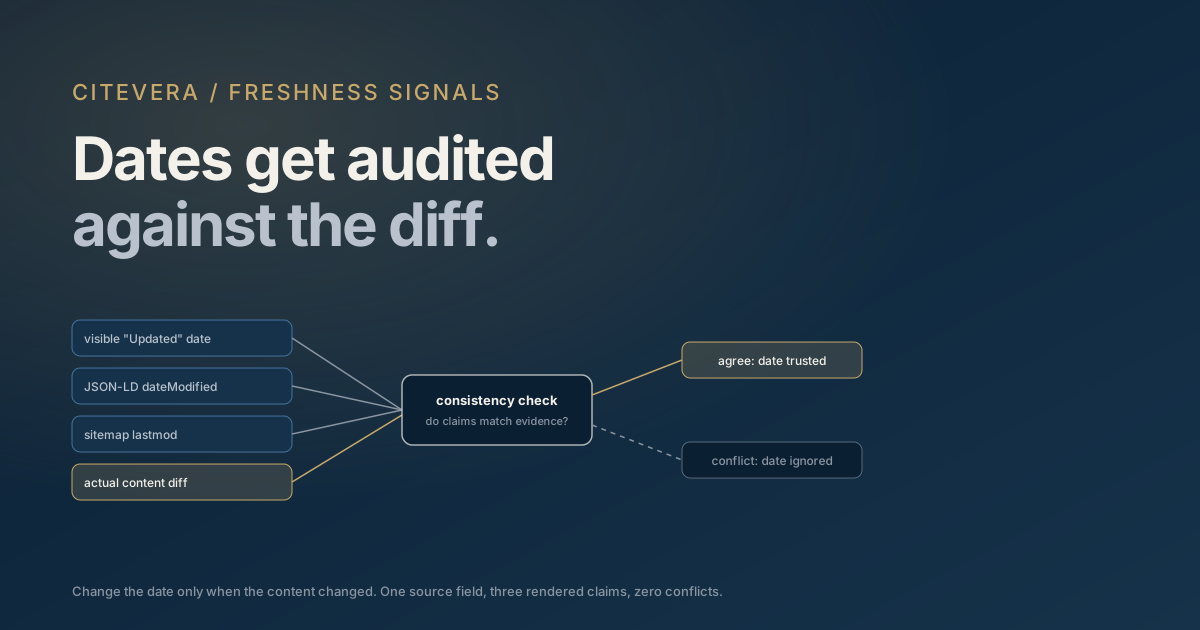
If your build pipeline stamps today's date into dateModified on every page every time you deploy, you do not have a freshness signal. You have noise, and engines treat noise exactly as it deserves: they stop reading it. The whole value of dateModified is that it separates pages you actually updated from pages you did not. A sitewide stamp erases that separation, which means your genuinely refreshed cornerstone article now carries the same date as 400 untouched posts, and none of them is believed.
The fix is not clever markup. It is honesty, enforced by workflow: only change the date when the content meaningfully changed, and make sure every surface that reports a date agrees. Here is how engines cross-check those surfaces, what blanket stamping costs you, and a workflow that keeps the signal alive.
Why blanket stamping destroys the signal
A date claim is only informative if it can be false. When every page on a domain reports dateModified equal to the last deploy, the claim is unfalsifiable and therefore worthless - and crawlers can see this pattern trivially. They hold your previous HTML. When 400 URLs all change their date on the same day while their content hashes stay identical, the conclusion writes itself: this domain's dates track deploys, not edits.
Google says this outright for the sitemap flavor of the same signal: its sitemap documentation states that lastmod is used when it is consistently and verifiably accurate, and ignored when it is not. Verification is a diff. You do not get to assert freshness; you get audited for it, retroactively, against fetch history.
The damage lands on your best pages. The one article your team spent two days rewriting has a legitimate claim to recrawl priority and to the "updated" framing in results. But its date now means nothing, because it is the same date everything else got for free.
The four surfaces engines cross-check
A modification date leaks out of your site in at least four places, and each is fetched and parsed independently.
- The visible date. "Updated August 12, 2026" in your template, readable by users and extractable by parsers.
- JSON-LD
dateModified. The machine-readable claim in your Article structured data, alongsidedatePublished. - Sitemap
lastmod. The per-URL timestamp in the sitemaps protocol, which is often the first thing a crawler consults when deciding what to refetch. - The content itself. The ground truth: what actually changed between the last stored copy and this fetch.
The first three are claims; the fourth is evidence. An engine that holds all four can run the obvious consistency checks, and inconsistency has a direction: dates that claim more change than the diff shows read as manipulation, while dates that claim less merely read as stale tooling. The classic failure is a static site generator emitting build time as dateModified - suddenly the JSON-LD says today, the sitemap says today, the visible byline says 2024, and the diff says nothing changed. Two claims are inflated, one is honest, and the honest one is the one engines can verify.
For AI engines the stakes are concrete. Answer engines prefer current sources for time-sensitive queries and often display a date next to a citation. A page whose date claims cannot be trusted loses its eligibility for exactly the "as of 2026" framing you refreshed it to earn. We cover the cadence half of this in the 30-day freshness rule; this post is about keeping the signal that cadence relies on truthful.
What counts as a meaningful change
You need a threshold, agreed on before anyone touches a date. A workable rule: dateModified changes when the answer a reader takes away changes.
Clears the bar:
- Updated facts, prices, version numbers, screenshots, or recommendations
- New sections, rewritten sections, or corrected claims
- Removing advice that no longer holds
Does not clear the bar:
- Template, CSS, or navigation changes
- Typo and formatting fixes
- Swapping a hero image, regenerating tags, or reordering unrelated widgets
- The deploy itself
The gray zone is real - a fixed typo in a command is substantive, a fixed typo in prose is not - which is why the threshold works best as an explicit editorial checklist item rather than a vibe. If you would not tell a returning reader "this article changed", the date does not change.
An honest update workflow
Step 1 - decouple dates from builds. The date lives with the content (frontmatter, CMS field), never computed at build time. A deploy must be able to run without touching a single dateModified. This is the single highest-leverage fix; it converts date changes from a side effect into a decision.
Step 2 - gate the decision at edit time. When an editor saves a change, they answer one question: does this change the reader's takeaway? Yes updates the modified date; no leaves it alone. In git-based workflows this is a frontmatter edit in the same commit as the content change, which makes every date change reviewable next to the diff that justifies it.
Step 3 - keep a visible changelog on updated pages. Two or three lines near the top or bottom: "Aug 2026 - re-tested against Cloudflare's current bot settings; updated the audit steps." This is the strongest honesty signal available, because it puts the evidence next to the claim - readers can see what changed, and parsers can see dated, specific edit notes that corroborate the diff. It is also genuinely useful content.
Step 4 - derive everything from one source. Visible date, JSON-LD, and sitemap lastmod all render from the same field. Never hand-maintain them separately; agreement should be structurally guaranteed, not achieved by discipline.
Step 5 - leave datePublished alone. The publish date is history, not a signal to optimize. Resetting it to look new orphans your page from its own citation history and is the most transparent fake of all, since archives and crawl history contradict it immediately.
This workflow pairs naturally with a pruning pass: pages not worth a real update may not be worth keeping, and the content pruning decision framework covers when a stale page should be refreshed, merged, or retired instead of cosmetically re-dated.
The risk framing: inconsistent dates read as manipulation
Freshness faking sits in the same category as markup that contradicts the visible page: a verifiable claim, made falsely, on a surface engines are known to check. Nobody outside the engines can tell you the precise penalty function, and we will not invent one. But the mechanism only runs in one direction. A domain whose dates always match its diffs gives an engine a cheap, reliable recrawl-priority signal, and reliability is rewarded with trust in the claim. A domain whose dates cry wolf forces the engine back to diff-based detection, at which point your dates are ignored at best. There is no upside branch where inflated dates keep working once checked.
The honest version costs you something real: most of your pages will wear old dates, truthfully. That is fine. An accurate 2024 date on a stable reference page is a better signal than a fake 2026 date, because it is consistent with everything else the engine can verify about you - and it makes the pages that do say 2026 believable.
Frequently asked questions
Should dateModified update for a typo fix?
Not for prose typos. If the typo changed the technical meaning - a wrong flag, a broken command, an incorrect number - the fix changes the reader's takeaway and earns the date. That distinction is the meaningful-change threshold doing its job.
Is it wrong that my whole sitemap regenerates on every deploy?
Regenerating the file is fine; regenerating the lastmod values is the bug. The sitemap should be rebuilt from stored per-page modification dates, so an untouched page carries the same lastmod through a thousand deploys. If your generator cannot do that, omitting lastmod is more honest than emitting build time.
Do AI engines actually read dateModified?
Treat it as one input among several rather than a switch. Answer engines demonstrably surface dates next to citations and prefer current sources for time-sensitive queries, and JSON-LD is the cheapest place to read a date from. The safe engineering assumption is that any date you publish can be read and cross-checked, which argues for making all of them true.
Can I backdate dateModified to match an old edit I never recorded?
Yes, and you should - accuracy runs both directions. If the page last materially changed in March and the field says last week's deploy, correcting it to March makes your claims match your history. Going forward, the edit-time gate prevents the gap from reopening.
Audit your date consistency
A Citevera audit checks the surfaces this post covers against each other: dateModified in your structured data, the visible date in your template, and sitemap lastmod, flagging pages where the claims disagree - the build-time-stamp bug shows up as a wall of identical dates within minutes of a scan. See where freshness fits among schema priorities, then fix the pipeline once and let the dates tell the truth on their own.