

Content Pruning for AEO: When to Delete, Merge, or Refresh Old Posts
Old content can hurt AEO citation flow when it competes with itself or sends weak signals. Here is the decision framework for pruning, merging, and refreshing.
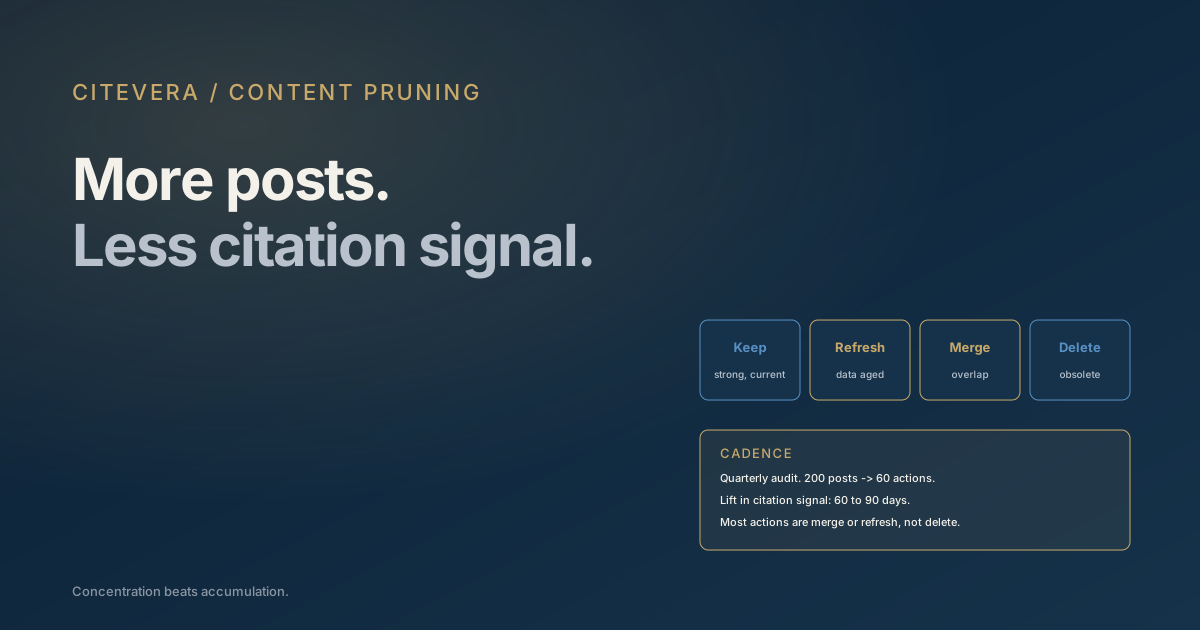
Most B2B content programs that have been running for 3+ years have a problem they do not see: their old content is hurting their new content. Posts compete for the same query, dilute citation signal, and create freshness drag. The intuition that "more content is always better" is wrong for AEO. The right discipline is regular pruning: delete what does not serve, merge what overlaps, refresh what still matters.
This post covers the decision framework for content pruning, the metrics that trigger each action, and the operational cadence that keeps a content corpus healthy.
Why pruning matters more for AEO than for SEO
Three reasons:
1. AI engines retrieve at the page level. When two of your pages compete for the same query, the engine picks one and the other contributes nothing. Two thin posts beat zero, but one strong post beats two thin posts. 2. Freshness is more strongly weighted by AI engines. A 4-year-old post with no updates is more visibly stale to AI engines than to Google, where ranking can persist on legacy authority. 3. Citation trust compounds at the domain level. A domain full of half-stale half-fresh content sends mixed signals. Pruning concentrates trust on what actually represents your current view.
The result: a 200-post corpus where 60 posts are pruned (deleted, merged, or refreshed) often outperforms the original 200 within 6 to 12 months.
The four decision categories
For every post in your corpus, the right action is one of four:
Keep as is
Strong post, current data, still aligned with your strategy. No action.
Refresh
Strong topic, but data, examples, or framing have aged. Update in place; bump dateModified.
Merge
Two or more posts cover overlapping topics and compete with each other. Combine into one canonical post; redirect the others.
Delete
Topic is no longer relevant, post is too thin to refresh, or content is misleading. 301 redirect to a relevant alternative or remove entirely.
The metrics that drive each decision
Five signals to evaluate per post:
Page age and last update
Posts older than 24 months without a refresh are candidates for action. Post-only-once posts older than 36 months are usually candidates for delete or merge.
Traffic and citation signal
Pages with no traffic and no citation signal in the last 90 days are candidates for delete. Pages with traffic but no citations are candidates for refresh or restructuring.
Topic overlap with newer content
If you have a 2024 post on "AEO basics" and a 2026 post on "AEO complete playbook", they compete. Merge into the playbook; redirect the basics post.
Quality vs current standards
If your editorial standards have improved (longer posts, better structure, schema markup), older posts may sit below your current quality bar. Refresh or merge.
Strategic alignment
Posts that no longer reflect your positioning, products, or worldview are candidates for action. Acceptable to refresh if the topic still fits; acceptable to delete if it does not.
When to delete a post
Five scenarios where delete is the right answer:
The topic is no longer relevant
A 2022 post about Google Helpful Content Update tactics is largely irrelevant for AEO. Delete and redirect to a current AEO playbook.
The data is wrong and refresh would gut the post
If correcting the data leaves only the title and a paragraph, the post was always thin. Delete; do not pretend a refresh.
The post duplicates a stronger version
Two posts on the same topic, one weak and one strong. Merge content if anything is salvageable, then delete the weak post and 301 to the strong one.
The post was published in error
Spam, off-brand, or incorrectly published. Remove cleanly with appropriate redirect.
The post represents a position you no longer hold
If you wrote in 2023 that something was best practice and now believe otherwise, you can either rewrite (refresh) or remove. Delete is appropriate when the rewrite would erase the post's identity.
When deleting:
- 301 redirect to the most relevant alternative URL on your site, not the homepage.
- Update internal links elsewhere to point at the redirect target directly (avoid lasting redirect chains).
- Remove from sitemap.
When to merge posts
Four scenarios:
Two thin posts on similar topics
> "Why AEO matters" + "What is AEO" + "AEO basics for marketers" - these three posts compete. Merge into one canonical "What is AEO?" pillar.
A pillar plus thin spokes
> A 2,500 word "AEO complete playbook" plus a 600 word "AEO checklist". The checklist is a section of the playbook. Either expand the checklist into a substantive standalone (with new value) or merge into the playbook with a section anchor.
Series content that should be one page
A 5-part series on schema markup that would be better as one comprehensive page. Combine; redirect parts 2-5 to the canonical with anchor fragments.
Refresh + neighboring post
When refreshing an old post, you sometimes find a neighboring post that fits naturally as a section. Merging during refresh is efficient.
When merging:
- Pick the URL with the strongest existing signal as the canonical destination.
- Migrate any unique value from the other posts into the canonical.
- 301 the merged-from URLs to the canonical.
- Update internal links.
When to refresh in place
Three scenarios:
Data is outdated but the structure is sound
Update statistics, examples, screenshots. Bump dateModified. Note "Updated [Month Year]" at the top.
The post needs current product or market context
Add a section addressing how the topic looks now versus when first written. This works especially well for posts on emerging topics.
Schema or structural improvements you can apply across the corpus
Bulk refresh: add Organization references, FAQ schema, H2 anchors. A small change applied to many old posts can refresh the corpus efficiently.
When refreshing:
- Update the dateModified visibly on the page and in Article schema.
- Add an "Updated [Month Year]" note near the top with what changed.
- Verify all internal and external links still resolve.
- Check that statistics are still defensible; replace if not.
Building a pruning audit
A scalable audit:
1. Export your full content inventory with URL, title, publish date, modified date, traffic, and any AEO-specific signals you track. 2. Filter for action candidates. Posts older than 24 months. Posts under 800 words. Posts with zero traffic. Posts with overlapping topic signals. 3. For each candidate, write a one-line action recommendation: "Delete - topic obsolete", "Merge into [URL]", "Refresh with 2026 data", "Keep as is". 4. Review with the content lead to ratify the actions before executing. 5. Execute in batches. A typical corpus of 200 posts requires 2 to 4 batches over 4 to 6 weeks.
The audit is repeatable. Schedule it twice a year as part of content operations rather than running it once and forgetting.
Operational cadence
Two cadence patterns work:
Quarterly pruning sprint
Block a week per quarter for pruning. Faster turnaround on individual decisions; produces noticeable corpus health improvement quarterly.
Always-on pruning
Build pruning into the regular content workflow. Every new pillar post triggers an audit of competing older posts. Slower but smoother.
For most teams, the quarterly sprint is easier to staff. Always-on works for larger content teams with dedicated content operations.
What pruning is not
Three misconceptions:
It is not about deleting weak content to please Google
The mechanism is not "Google sees less weak content and rewards me". It is "my readers and AI engines see a smaller, stronger corpus and concentrate trust accordingly".
It is not a one-time project
Content corpus health is ongoing. A 200-post corpus that gets pruned once and then grows for two years without pruning needs another audit.
It is not equivalent to deletion
Most pruning actions are merge or refresh, not delete. The framing of "pruning is deletion" leads to either over-aggressive cuts or paralyzed indecision.
Measuring pruning impact
Three signals to track in the 90 days after a pruning sprint:
- Citation flow concentration. Citations to the canonical posts should increase even as overall page count decreased.
- Average per-page traffic. Should rise as weak pages are removed and competing signals consolidate.
- Freshness perception. Manual query tests in AI engines often reveal that AI engines now treat your domain's content as "current" where they treated it as "mixed" before.
Pruning is one of the few AEO interventions where the lift is visible in 60 to 90 days for sites with mature content corpora.
Key takeaways
- Old content can hurt AEO when it competes with newer content or sends stale signals.
- Four decisions per post: keep, refresh, merge, or delete.
- Most pruning actions are merge or refresh, not delete.
- Run an audit twice a year as part of content operations, not as a one-time project.
- Lift from pruning is often visible within 90 days as citation signal concentrates.
What to do next
Run a free audit at scan.citevera.com to see which of your top topics have multiple competing posts and which signal-strong posts are aging without refresh. The report flags topic overlap as a high-impact corpus health issue.
For the related freshness pattern, content freshness and the 30-day rule covers refresh cadence on individual posts.