

Syndication and AI Citations: Who Gets the Credit?
Republishing on Medium, LinkedIn, or partner sites puts the same text at multiple URLs. Here is how AI engines pick which one to cite, and how to keep the credit.
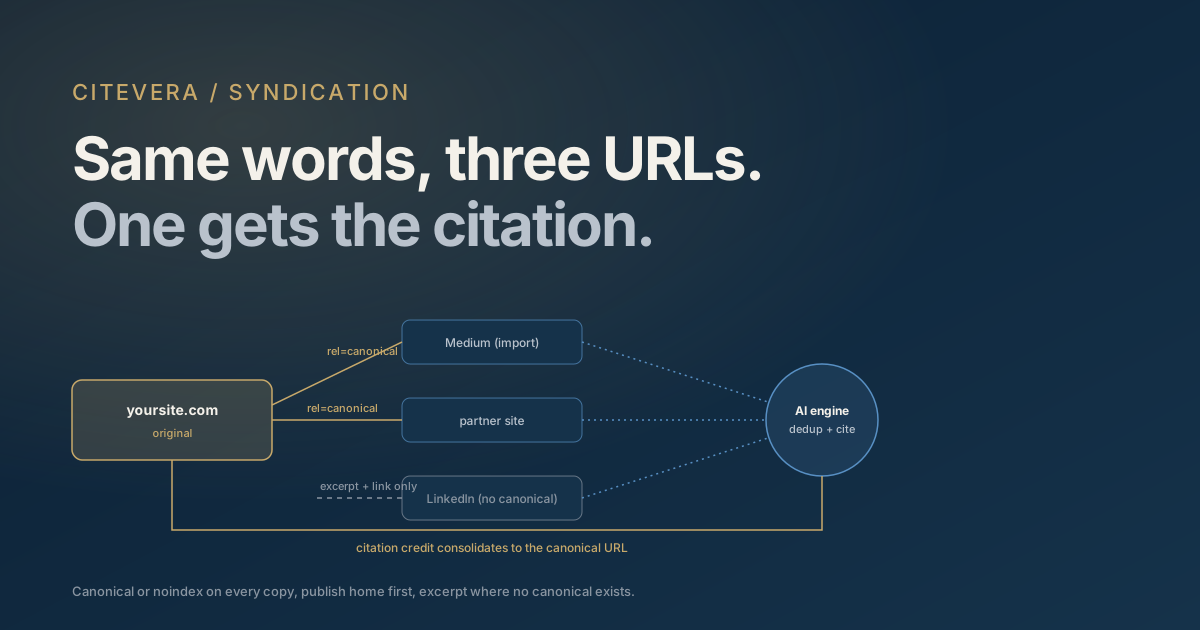
When the same article exists at your domain, on Medium, and on a partner site, an AI engine answering a question from it has to pick one URL to cite - and nothing obligates it to pick yours. The engine sees three documents with near-identical text and chooses by the signals it has: canonical declarations, domain authority, crawl accessibility, and which copy it found first. Syndicate carelessly and you can lose the citation to your own words on someone else's domain.
That is not an argument against syndication. Republishing on high-trust surfaces is one of the few legitimate ways to borrow distribution. It is an argument for controlling the deduplication signals every time you republish. Here is how attribution actually resolves, what each major platform lets you declare, and the rules that keep the credit routed home.
How engines attribute duplicated text
Retrieval systems deduplicate. When multiple URLs contain substantially the same passage, engines cluster them and select a representative - citing three copies of one paragraph as three sources would be an obviously broken answer. The question is which URL represents the cluster, and the mechanism runs on a few signals in rough order of strength.
- Canonical declarations. A copy that points
rel="canonical"at your original is explicitly conceding authority. Google documents cross-domain canonicals as the supported way to consolidate syndicated duplicates, and AI crawlers read the same tags - with some divergences we cover in canonical tags and AI crawlers. - Retrievability. An engine can only cite what it can fetch. If your origin blocks an AI crawler that Medium happily admits, the copy is the only version that exists for that engine, and the copy gets the citation by walkover.
- Authority and familiarity. Absent a canonical, a well-linked platform with a decade of trust routinely beats a small original. The engine is not adjudicating authorship; it is picking the URL its signals say is most reliable.
- Discovery order. First-seen matters at the margin. A copy that was crawled weeks before your original entered the index has history on its side.
Notice what is missing: any notion of fairness. Attribution is an emergent outcome of dedup heuristics, so the copy wins whenever you leave the strong signals unset and the weak ones favor the platform.
One more wrinkle: different engines resolve the same cluster differently. A retrieval-augmented engine doing a live web search may grab whichever copy its search index ranks first, while an engine answering from training data leans toward whichever version dominated the crawl months ago. You are not managing one attribution decision; you are managing a default across several systems, which is why the declared signals matter more than any single engine's current behavior.
What each platform lets you declare
The platforms differ sharply in how much control they give you, and the differences should drive where you syndicate.
- Medium supports canonical URLs when you bring content in through its import tool, which sets the canonical to your original. Pasting the article into a fresh draft does not. If you syndicate to Medium, the import path is the only correct one.
- DEV Community (dev.to) exposes a
canonical_urlfield directly in the editor and its frontmatter. Set it on every crosspost; it is the cleanest implementation of the bunch. - LinkedIn articles offer no canonical mechanism at all. A full-text LinkedIn article is an uncontrolled duplicate on a very high-authority domain - the single riskiest common syndication move. LinkedIn is the strongest argument for the excerpt-plus-link pattern below.
- Partner and industry sites are negotiable, and you should negotiate. A syndication agreement that does not specify "canonical to the original, or noindex the copy" is an agreement to compete with your own article. Put it in writing before the first repost.
When syndication helps
The case for syndication is that some surfaces carry trust you cannot quickly build on your own domain, and AI engines demonstrably lean on those surfaces - the same dynamic that makes Reddit and forum threads heavy citation sources. Publishing where the engines already look gets your ideas into answers even when your domain would not have been retrieved, and the humans who read the copy can still follow it back to you.
Syndication earns its keep when the copy is deduped correctly and the goal is reach: a developer-tools post on dev.to with canonical_url set, an imported Medium version of your cornerstone guide, a trade-publication reprint that canonicals home. You get the platform's audience and its crawl accessibility while the citation-relevant authority consolidates to your original. It also hedges a specific failure: if your own site has crawlability problems you have not fixed yet, a canonical-bearing copy on an open platform keeps your content retrievable while you repair the origin.
When syndication hurts
The loss modes are just the mechanism running against you.
- Canonical loss. Full text on a no-canonical surface, or a partner who "forgot" the tag, splits the cluster and invites the engine to crown the copy. You may keep human readers and still vanish from AI answers, because the citation slot goes to one URL.
- Answer substitution. Citations to the copy teach the engine that the platform, not you, is the source for this topic. Your share of voice accrues to medium.com.
- Freshness skew. You update the original; the copy keeps the old claims. Now the cluster contains contradicting versions, and an engine may ground on the stale one. Every syndicated copy is a maintenance liability with your name on it.
Practical rules for syndicating safely
Rule 1 - no canonical, no full text. If the platform cannot point canonical at your original and will not noindex the copy, publish an excerpt with a link instead: the setup, the key insight, and "the full walkthrough lives here". LinkedIn falls in this bucket permanently.
Rule 2 - delay the republish. Publish on your domain first and give crawlers time to fetch and index the original - days to a couple of weeks depending on your crawl frequency - before any copy appears. This puts discovery order on your side instead of the platform's. Never launch an article simultaneously everywhere.
Rule 3 - verify the canonical actually rendered. View source on the live copy and find the rel="canonical" pointing at your URL. Import tools change, partners run CMS migrations, and a canonical that silently disappeared is how you lose a cluster months later without noticing.
Rule 4 - vary the copy. A platform-specific intro and a trimmed body make the duplicate less identical, keep the platform's audience served, and leave the deepest version - the one worth citing - uniquely on your domain.
Rule 5 - watch who gets cited. Attribution is decided inside the engines, so check the output: prompt ChatGPT, Claude, and Gemini with the questions your article answers and note which URL each cites. If copies are winning, that is your signal to tighten canonicals or convert full-text deals to excerpts. Monitoring brand mentions across engines covers how to make this systematic instead of anecdotal.
Frequently asked questions
Does a canonical tag guarantee AI engines cite my original?
No. Canonical is a strong hint, not a command, and engines weigh it against retrievability and their own dedup heuristics. It is still the strongest signal you control, and combined with publishing first and keeping your origin crawlable it wins the large majority of the time. What is guaranteed is the converse: with no canonical, nothing routes the credit to you.
Is syndication a duplicate-content penalty risk?
Duplicate content is handled by consolidation, not punishment - Google has long said duplication itself is not a penalty, and dedup in AI retrieval works the same way. The real cost is misrouted credit: the cluster survives, but the wrong URL fronts it. Think of it as a routing problem, not a compliance problem.
Should I republish old posts on Medium to revive them?
Only the ones that still earn their keep, and only through the import tool so the canonical points home. A post that is stale on your domain does not improve by being duplicated; update the original first, then syndicate the updated version. Copies inherit whatever the original is - including its problems.
What about newsletters and RSS-driven republishers?
Email copies are invisible to crawlers and safe by construction. RSS scrapers that republish your feed without consent are a different case: you never agreed to a canonical, and they rarely set one. Full-content feeds make that scraping trivial, so if scrapers keep outranking you, consider excerpt-only feeds and takedowns for the worst offenders.
Know which URL is getting your credit
Every paid Citevera plan bundles citation monitoring across ChatGPT, Claude, and Gemini, which is exactly the instrument this problem needs: it shows which URLs the engines cite for your topics, so a copy quietly absorbing your citations shows up as data instead of a hunch. Pair that with an audit of your own crawlability - the failure that most often hands citations to syndicated copies in the first place - and syndicate as widely as you like, with the credit wired back to you.