

Canonical Tags and AI Crawlers: How to Avoid Duplicate-Content AEO Penalties
AI crawlers respect canonical tags differently than Googlebot. Here is how canonical signals affect AEO citation routing and the configurations that work.
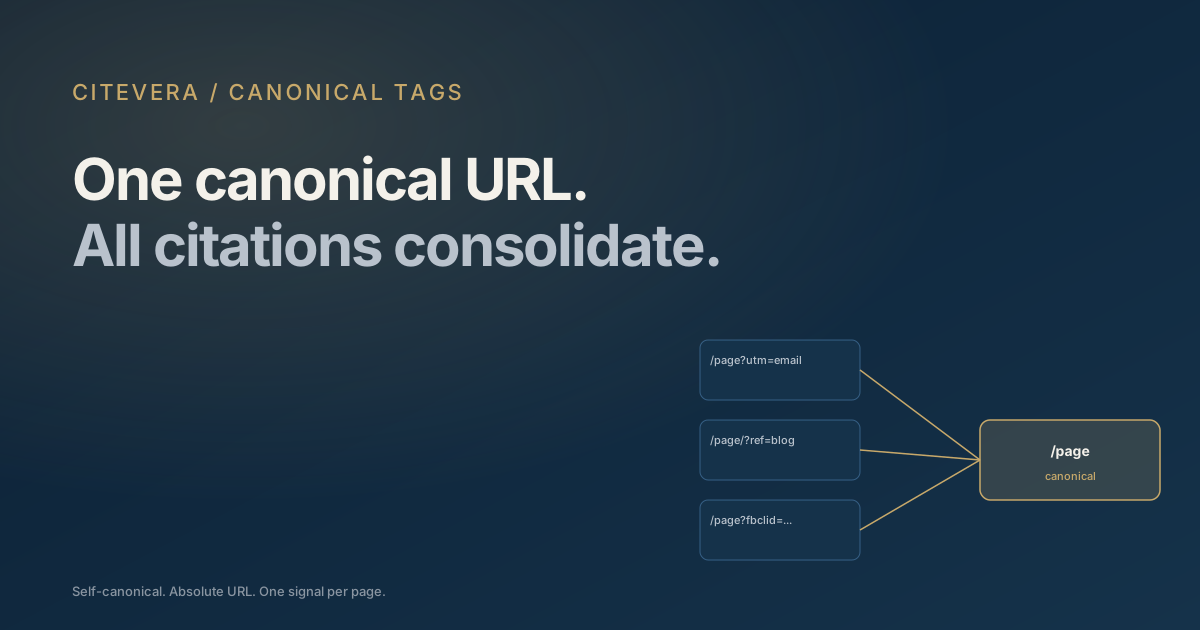
Canonical tags tell crawlers which URL is the authoritative version when content exists at multiple URLs. SEO teams understand canonical patterns deeply; AEO teams often inherit those patterns without re-validating that they work for AI crawlers. They mostly do, but the edge cases matter and the failure modes are different.
This post covers how AI crawlers handle canonical tags, where the behavior diverges from Googlebot, and the configurations that prevent citation routing problems.
What canonical tags do
A canonical tag is a <link rel="canonical"> element in the page head that declares the authoritative URL for the content:
<link rel="canonical" href="https://acme.example/blog/aeo-guide" />
When a crawler encounters a page at acme.example/blog/aeo-guide?utm_source=newsletter, the canonical tag tells it the authoritative URL is the parameter-less version. The crawler consolidates ranking signals to that URL rather than treating each parameter variant as separate.
For SEO this prevents diluted ranking signal across URL variants. For AEO it serves a similar purpose: the citation signal consolidates to the canonical URL rather than spreading across thin variants.
How AI crawlers handle canonicals: similarities to Googlebot
Three behaviors AI crawlers share with Googlebot:
1. They read canonical tags from the HTML head. Standard <link rel="canonical"> is recognized. 2. They respect cross-domain canonicals when appropriate. A page on a syndication partner pointing canonical to your domain consolidates signal back to you. 3. They consolidate parameter-variant signal. UTM parameters, session IDs, and tracking parameters get folded into the canonical when declared.
In the common case of "remove tracking parameters", AI crawlers behave like Googlebot. Most production canonical setups work for AEO without changes.
Where AI crawlers diverge from Googlebot
Three observed differences:
Multi-canonical scenarios
Googlebot has years of experience interpreting fuzzy canonical signals. AI crawlers are more literal. If your page declares one canonical in HTML and a different canonical in HTTP Link headers, Googlebot triangulates; AI crawlers may pick the wrong signal or treat the page as ambiguous and downweight it.
Best practice: declare canonical in exactly one place per page, the HTML head. Avoid mixing HTTP Link: rel="canonical" headers with HTML tags that disagree.
Redirected canonicals
Googlebot follows canonical-to-canonical chains gracefully. If page A canonicals to B, and B canonicals to C, Googlebot ends up at C. AI crawlers sometimes stop at the first canonical hop. Keep canonical chains flat: page declares canonical to its true authoritative URL, not to an intermediate.
Self-canonical on AMP/mobile pages
AMP and mobile-specific URLs sometimes self-canonical when the desktop version should be canonical. Googlebot understands the AMP relationship via additional <link rel="amphtml">. AI crawlers do not always parse the AMP relationship and may take the AMP self-canonical at face value.
If you serve AMP pages alongside desktop, the AMP version should canonical to the desktop URL, not self-canonical. The desktop version self-canonicals.
The configurations that work for AEO
Five rules:
One canonical per page in the HTML head
<link rel="canonical" href="https://acme.example/blog/aeo-guide" />
No HTTP header canonical. No JS-injected canonical. No conflicting tags. One line, one URL, in the HTML head.
Canonical points to the indexable, content-rich URL
The canonical should resolve to a 200 OK page with the full content. Pointing canonical to a 301-redirected URL or a 404 wastes crawl signal.
Canonical includes the full URL with protocol and trailing slash
https://acme.example/blog/aeo-guide not /blog/aeo-guide. Absolute URLs prevent ambiguity. Trailing slash should match your site's convention; pick one and stick to it across the canonical and the actual served URL.
Self-canonical for the authoritative URL
Every page that is itself canonical should still include a self-canonical. This is a positive signal that the page knows it is authoritative.
Cross-domain canonicals only for genuinely syndicated content
If you republish a partner's content with their permission, set the canonical to their URL. If they republish your content, request that they set canonical back to you. Avoid using cross-domain canonical to "claim" content you do not own.
Common canonical mistakes that hurt AEO
Six recurring patterns I see in audits:
Mismatch between canonical and served URL
The page is served at /blog/aeo-guide/ (with trailing slash) but the canonical declares /blog/aeo-guide (without). AI crawlers can detect the mismatch and treat it as a configuration error, downweighting the page.
Canonical pointing to homepage
A bug where every page on the site canonicals to the homepage. Disqualifies every page from citation. Surprisingly common after misconfigured CMS migrations.
Conflicting canonical and og:url
The og:url Open Graph property and the canonical tag should match. When they disagree (often after a URL structure change), engines pick one and may pick the wrong one.
Canonical on paginated pages
Page 2 of a paginated series should self-canonical (or canonical to itself), not to page 1. Canonicalizing paginated pages to page 1 collapses the entire series into one signal and loses the unique content on each page.
Canonical to a noindex page
If the canonical destination has <meta name="robots" content="noindex">, you have signaled that the canonical URL should not be indexed. This is a self-conflicting setup that confuses crawlers.
Canonical changed without 301
When a URL structure changes, set a 301 redirect from old to new and have the new URL self-canonical. Changing the canonical without a 301 leaves the old URL accessible and creates duplicate-content risk.
Canonical tags and parameterized URLs
Three patterns for handling URL parameters:
Tracking parameters (UTM, fbclid, gclid)
Canonical to the parameter-less URL. AI crawlers (and Googlebot) consolidate signal to the canonical.
Filter parameters on category pages
Filtered category pages (/products?color=red) should typically canonical to the unfiltered category (/products) unless the filtered version has unique content worth citing on its own. For most ecommerce sites, canonical-to-unfiltered is the safer default.
Pagination parameters
Page 2, 3, 4 of a paginated series should self-canonical. Pagination should also include <link rel="prev"> and <link rel="next"> when supported, although Google deprecated these signals in 2019 and they are inconsistently honored.
Canonical tags and the AEO content surface
Three pages where canonical decisions matter most for AEO:
- Pillar posts. Each pillar should self-canonical with the cleanest URL. Dedupe any old draft URLs.
- Comparison pages. "Acme vs Beta" and "Beta vs Acme" should canonical to one of the two, not both compete for the same query.
- Glossary entries. Each entry self-canonicals. The index page does not canonical to individual entries.
A clean canonical map makes citation routing predictable. Buyers searching for the term land on the canonical, citations accrue to the canonical, and signal compounds.
Validation and monitoring
Three checks worth running monthly:
- Crawl your sitemap and confirm every URL has a canonical pointing to itself or another sitemap URL. Off-sitemap canonicals are usually bugs.
- Curl-with-AI-crawler-UA on a sample of 20 pages and grep for
rel="canonical". Confirms the tag is in the initial HTML response, not JS-injected. - Diff canonical URLs against your
og:urland Twittercard:url. Mismatches indicate stale meta tags.
A simple script run weekly catches most canonical regressions before they damage citation flow.
Key takeaways
- AI crawlers respect canonical tags but are more literal than Googlebot in ambiguous cases.
- One canonical per page in the HTML head with the full absolute URL.
- Avoid canonical chains, conflicting HTTP/HTML signals, and AMP self-canonicals.
- Pagination self-canonicals; filter parameters typically canonical to the unfiltered URL.
- Validate weekly to prevent CMS regressions from breaking canonical signal.
What to do next
Run a free audit at scan.citevera.com to see whether your top pages have valid canonicals matching their served URLs. The report flags canonical/og:url mismatches and missing self-canonicals.
For more on the crawler side, SSR vs CSR for AI crawlers covers what crawlers can read in the first place.