

AI Referral Traffic: Fewer Visits, Better Visitors?
AI assistants send far fewer clicks than classic search, but the visitors who do arrive are often further along. Here is how to measure your own cohort in GA4.
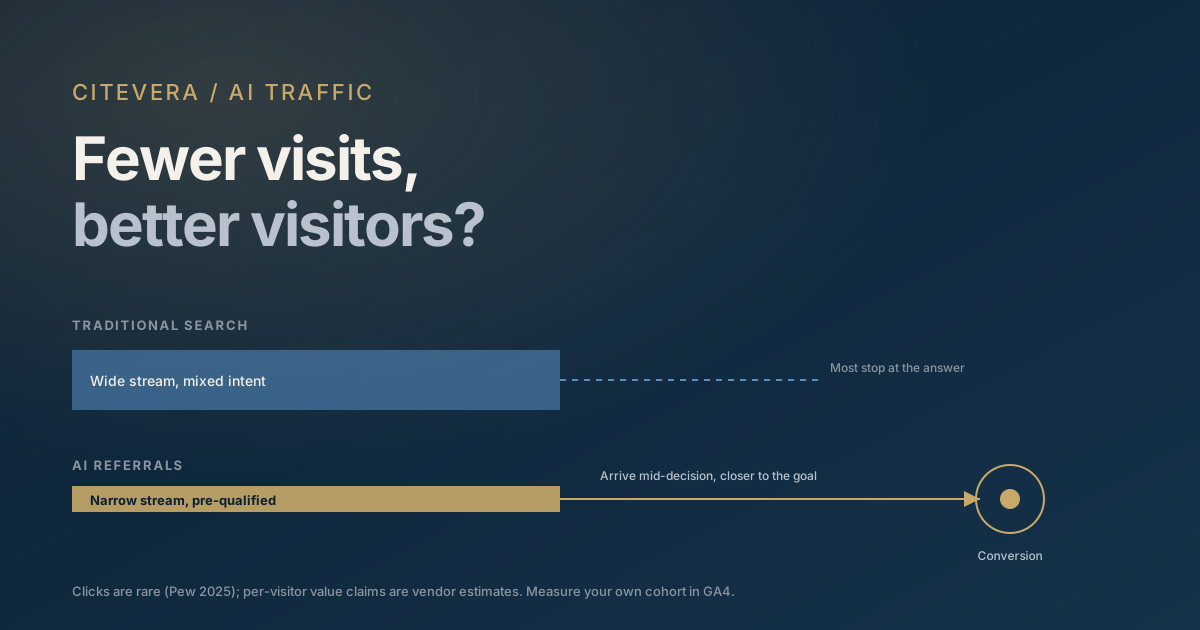
AI referral traffic is small and it converts differently. Both halves of that sentence matter, and most of the arguments you will hear about AI search pick only one. The click data says volume is low: in Pew Research Center's 2025 real-user panel, users who saw an AI summary clicked a traditional result on roughly 8% of visits versus roughly 15% without one, and clicks on links inside AI summaries happened on only about 1% of visits. The value data points the other way: Semrush, a vendor with an AI-visibility product to sell, reported AI search visitors as roughly 4.4x more valuable than traditional organic visitors.
Those two findings are not measuring the same thing - one counts clicks, the other estimates value per visitor - but they pull your strategy in opposite emotional directions, and neither one is a substitute for measuring your own cohort. This post lays out what each source actually claims, why the mechanism case for higher intent is plausible, and exactly how to segment and evaluate your own AI referral traffic in GA4 without fooling yourself with a small sample.
What the volume data actually says
Pew's panel study is the most credible click-behavior data published so far because it observed real users' browsers rather than surveying them or modeling from rank positions. Three numbers matter. AI summaries appeared in roughly 1 in 5 searches in the panel. When a summary appeared, users clicked a traditional result on about 8% of visits, compared with about 15% when no summary appeared. And links inside the AI summaries themselves were clicked on roughly 1% of visits.
Read plainly: the presence of an AI answer roughly halves the chance of a click to any site, and the citations inside the answer are clicked rarely. If your mental model of AI search is "a new referrer that will replace lost organic traffic click for click," the Pew data should end that model. The clicks are not coming back at the old volume.
What the Pew data does not tell you is anything about who the remaining clickers are. A 1% click rate on citation links is compatible with those clicks being low-value stragglers, and it is equally compatible with them being the most qualified visitors your site receives. Click counting cannot distinguish those worlds.
What the value claim actually says
Semrush's claim - AI search visitors worth roughly 4.4x a traditional organic visitor - is a vendor estimate, produced by a company whose product benefits when you believe it. That does not make it false. It makes it unverified by anyone without a stake, and it means you should treat it as a hypothesis rather than a planning input.
It is also worth being precise about the apparent conflict with Pew. The two findings conflict in spirit but not in arithmetic: Pew measured how often people click, Semrush estimated what a visitor is worth once they arrive. Both can be true at once - a much smaller stream of much better visitors. In fact that combination is exactly what the mechanism would predict, which is where the argument gets more interesting than dueling statistics.
The mechanism case for higher intent
Set the studies aside and reason about what has to happen before someone lands on your site from an AI assistant.
They asked a question in their own words. Nobody idly types a full conversational query into ChatGPT the way they might skim a search results page. The session started with articulated intent.
The AI already answered the surface question. The summary or chat response handled the definitional, top-of-funnel layer - the "what is X" and "how does X compare to Y" material that used to generate your highest-bounce organic visits. A visitor who clicks through after reading an answer is, by construction, someone the answer did not satisfy. They want depth, verification, pricing, or a next step.
The AI pre-qualified them on your behalf. If the assistant named your product in a recommendation or cited your page as the source, the visitor arrives having already seen you framed as an answer to their problem. That is closer to a referral from a trusted colleague than to a rank-ten blue link. This is the same dynamic we documented in how B2B buyers use AI search: the shortlist gets formed inside the chat, and the click happens after shortlisting, not before.
They arrive mid-decision. The research phase happened in the conversation. What lands on your site is the tail of the funnel, not the mouth of it.
None of this proves a 4.4x multiplier. It does mean higher per-visitor conversion is the expected outcome of the mechanism, not a marketing fantasy - and that the only number that should change your budget is your own.
Measuring your own cohort in GA4
GA4 will not separate AI referrals for you out of the box, but the referrer data is sitting there. Here is the practical setup - and for a deeper walkthrough of the setup itself, see our full guide to tracking AI referral traffic in GA4.
Step 1 - Identify the referrers. The major assistant domains that pass a referrer today include chatgpt.com, chat.openai.com, perplexity.ai, claude.ai, gemini.google.com, and copilot.microsoft.com. Google AI Overviews clicks are the awkward exception: they arrive bundled inside google / organic and cannot be cleanly separated in GA4, so your measured AI cohort will undercount reality. Say so in any report you share.
Step 2 - Build a segment or channel group. In Explore, create a segment where session source matches a regex like chatgpt\.com|openai\.com|perplexity\.ai|claude\.ai|gemini\.google\.com|copilot\.microsoft\.com. If you want this in standard reports rather than explorations, create a custom channel group with an "AI Referral" channel using the same source conditions. Custom channel groups apply from creation date forward, so build this now even if you plan to analyze later.
Step 3 - Compare conversion rate, not traffic. Put the AI segment next to organic search and compare session key event rate (session conversion rate) for the events that map to revenue - trial starts, demo requests, purchases - not scroll or engagement proxies. Comparing raw session counts recreates the volume-only mistake in your own dashboard.
Step 4 - Check assisted conversions. An AI referral that starts the relationship often does not close it; the user returns later via direct or branded search. In Advertising reports, look at attribution paths that include your AI Referral channel anywhere in the path, not just last click. If AI referrals appear early in converting paths, last-click reporting is hiding their value.
Step 5 - Log the landing pages. AI visitors disproportionately land on deep pages - comparison pages, docs, pricing - because that is what gets cited. Knowing which pages receive them tells you which content is doing the pre-qualification, and that feeds directly back into what you write next.
The small-sample trap
Here is where most teams overclaim in the other direction. If AI referrals are 2% of your sessions, your monthly cohort might be 60 visits. At that size, conversion rate is noise. Three conversions instead of one does not mean your AI traffic converts 3x better; it means small numbers moved.
Practical guardrails: accumulate at least a full quarter before quoting a conversion rate; compare cohorts over the same date range so seasonality cancels; and state the raw counts alongside every percentage you report internally. "AI referrals converted at 6.1% (11 of 180 sessions) vs 2.3% organic" is honest. "AI traffic converts 2.7x better" from the same data is how bad strategy gets funded. If your cohort is still tiny, the right conclusion is "promising, keep measuring," and the right action is to grow the cohort by earning more citations - not to reallocate budget on anecdote.
Frequently asked questions
Is AI referral traffic really higher intent than organic search traffic?
The mechanism strongly suggests it: visitors arrive after the AI has answered their surface question and often after it has recommended or cited you, so the remaining clickers skew toward people who need depth or a next step. But the only published value figure is a vendor estimate from Semrush, so treat higher intent as a hypothesis to verify in your own GA4 data rather than an established fact.
How do I see AI traffic in GA4?
Create a segment or custom channel group matching session source against the assistant domains - chatgpt.com, chat.openai.com, perplexity.ai, claude.ai, gemini.google.com, and copilot.microsoft.com. Then compare session key event rates and attribution paths against organic search. Google AI Overviews clicks stay bundled in google / organic and cannot be isolated.
Why is my AI referral traffic so small?
Because clicks from AI answers are genuinely rare. In Pew's 2025 panel, links inside AI summaries were clicked on roughly 1% of visits. Low volume is the norm, not a sign you are failing - the leverage is in being the source that gets cited and in converting the visitors who do arrive.
Can I trust the Semrush 4.4x figure?
Treat it as a directional vendor estimate, not a planning number. It measures value per visitor, which is a different axis from Pew's click-volume findings, but it has not been independently replicated. Your own cohort's conversion rate, measured over at least a quarter, is the number that should drive decisions.
Measure the cohort, then earn more of it
The honest position in 2026 is that AI referral traffic is small, probably higher intent, and only measurable site by site. Set up the GA4 segmentation this week, let it accumulate, and meanwhile work the supply side: you cannot convert AI visitors you never receive. That means being cited in the first place - extractable answers, clean schema, crawlable pages. A Citevera audit scores exactly those citation-readiness factors and ships copy-paste fixes, and the bundled citation monitoring shows whether ChatGPT, Claude, and Gemini actually mention you when your buyers ask. The full set of approved industry numbers, with sources and caveats, lives on our AI search statistics page.