

The Zero-Click AI Funnel: Marketing When Answers Don't Send Traffic
Pew's panel data shows AI answers rarely produce clicks. That makes the brand mention the conversion event - and forces measurement, content, and attribution to change with it.
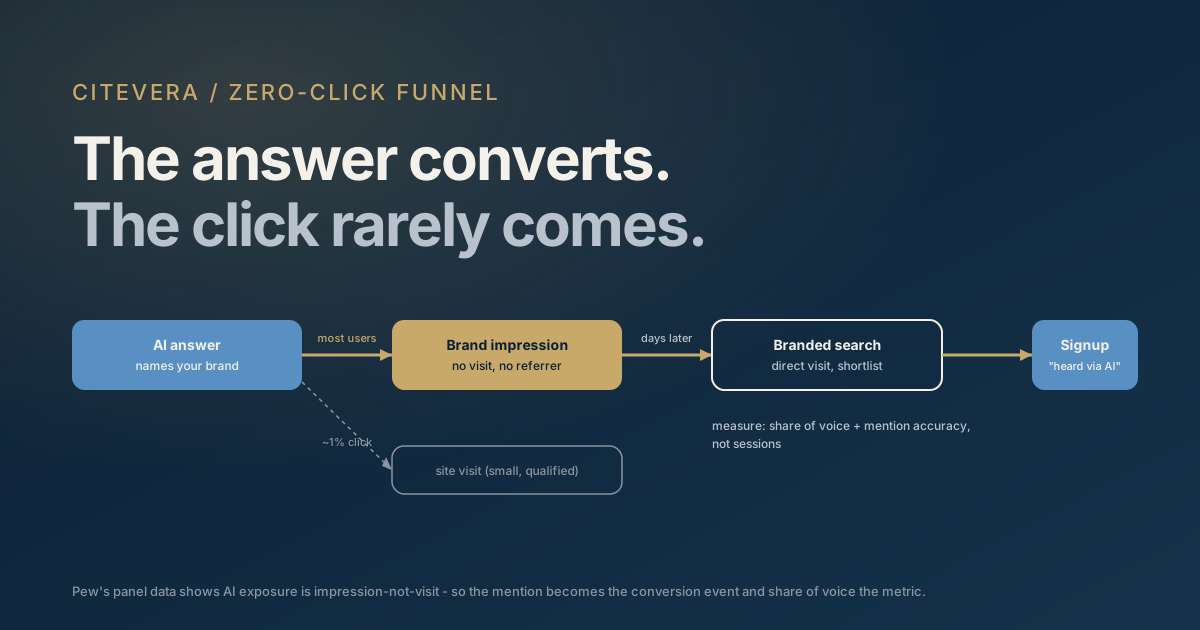
The click was never the point - it was a proxy for attention. AI search severs the proxy. Pew Research Center's 2025 real-user panel found AI summaries appeared in roughly 1 in 5 searches, and when users saw one, they clicked a traditional result on about 8% of visits versus about 15% without a summary. Clicks on links inside the AI summaries themselves ran around 1% of visits. The full numbers are on our AI search statistics page, but the shape is the message: when your brand appears in an AI answer, the overwhelmingly likely outcome is that nobody clicks anything.
That is not a reason to ignore AI search. It is a reason to stop modeling it as a traffic channel. Most AI exposure is an impression, not a visit - closer to how a billboard or a podcast mention works than how a blue link works. The funnel still exists; it just runs through the answer instead of through your site. This post is about operating in that funnel: what the conversion event becomes, what you measure instead of sessions, how content changes when its job is to be quoted rather than visited, and why your "how did you hear about us" field is suddenly valuable again.
The mention is the conversion event
In a click economy, the visit was the top of your measurable funnel. In an answer economy, the top of the funnel is the moment an engine says your name - accurately, in a relevant context, ideally as a recommendation.
Play the buyer's session forward. Someone asks Gemini for accounting tools that handle EU invoicing. The answer names three products with a sentence each. The buyer clicks nothing - Pew's data says that is the norm - but one of two things has happened. Either your product is now on their shortlist, described in the engine's words, or it does not exist for this buyer at all. The next observable event, maybe days later, is a branded search, a direct visit, or a "started trial" with no coherent referrer trail.
So the question that matters is not "how much traffic does AI search send" (little, and measuring only that will convince you to disinvest). It is "when the engines assemble a shortlist for my category, am I on it, and what do they say about me?" That is a presence-and-accuracy problem, and it compounds: engines that consistently describe you well keep retrieving the sources that describe you well. Being absent has a cost that never appears in analytics - we work through that arithmetic in the cost of AI search invisibility.
One honest complication: Semrush's vendor study reported AI search visitors as roughly 4.4x more valuable than traditional organic visitors. Treat that as a vendor estimate, and note it conflicts in spirit with Pew's low click rates - it measures value per visitor who does arrive, while Pew measures how rarely anyone arrives. Both can be true: tiny click volume, unusually qualified clickers. The strategic conclusion is the same either way - the mention does the persuading, and the rare click arrives pre-sold.
Measurement shifts from traffic to share of voice
If mentions are the conversion event, your dashboard needs mention metrics, and traffic reports will actively mislead you.
- Share of voice across a prompt panel. Pick the questions that matter commercially, run them on a schedule across ChatGPT, Claude, and Gemini, and track how often you appear versus each competitor. This is the AI-era rank tracker; the full methodology is in measuring AI search share of voice.
- Mention quality, not just presence. Are you named as the recommendation, one option among five, or a caveat? Is the description accurate and current? A confidently wrong description - old pricing, a feature you killed, a positioning you abandoned - converts against you at scale, invisibly.
- Branded search and direct traffic as the downstream echo. The buyer who was convinced by an answer resurfaces later as a branded query or a direct visit. A branded-search lift that tracks your share-of-voice trend is the mention funnel showing up in instruments you already have. It is inference, not attribution - but it is inference in the right direction, where session counts are precise measurement of the wrong thing.
- The small AI-referral stream, kept in proportion. Referrers from chatgpt.com, perplexity.ai, and gemini.google.com are worth segmenting - just remember Pew's ~1% in-summary click rate means this stream is the visible sliver of exposure, not the exposure itself.
You can start this without budget: a manual prompt panel and a spreadsheet, as laid out in monitoring AI brand mentions for free.
Content design shifts to being quoted accurately
When the answer is the interface, your content's job is to arm the answer. That changes what "good" looks like in specific ways.
- Write the sentence you want repeated. For every page, there should be a clean, self-contained sentence stating what you are, who you are for, and what makes you different. Engines compress; if you do not provide the compression, they improvise it. Author the quotable version yourself, high on the page, in plain declarative prose.
- Keep facts current everywhere they appear. In a zero-click world, a stale pricing figure on a forgotten comparison page does not just embarrass you on that page - it gets synthesized into answers where you will never see it. Fact consistency across your site (and across sources engines retrieve) becomes a maintenance discipline, not a nice-to-have.
- Make claims attributable. Passages with named sources, definitions, and concrete numbers get quoted because they are safe to quote. Vague marketing prose gets skipped for the same reason an editor would skip it.
- Accept that the best outcome is often invisible. A page can be your most valuable asset while its sessions flatline, because its job is feeding accurate language into answers. Judge answer-facing pages by citation and mention metrics, not by their traffic chart.
The dark funnel, and the return of "how did you hear about us"
Attribution systems were built on referrers and click IDs. The AI answer funnel emits neither. A buyer influenced by three ChatGPT sessions arrives, weeks later, as "direct" - which was already true of dark-social sharing and podcast ads, but AI search moves a mainstream research behavior into the dark.
The unglamorous fixes work.
Step 1 - put a free-text "how did you hear about us" field on signup or checkout. Not a dropdown - a dropdown without an AI option undercounts to zero, and one with it leads the witness. Free text captures "asked ChatGPT for alternatives to X" verbatim, and those verbatims are also prompt-research data telling you exactly which phrasings drive pipeline.
Step 2 - have sales ask, and log it. "What put us on your list?" is one sentence in a discovery call, and it reaches the buyers who skip forms.
Step 3 - reconcile self-reported channels against your share-of-voice trend quarterly. When "an AI recommended you" verbatims rise alongside your measured mention rate, you have as close to a causal story as this funnel allows.
Step 4 - re-weight your channel model. If self-reported attribution says AI influence is material while last-click says it is ~0%, the last-click model is what needs revising - the same correction display and podcast advertisers made years ago.
Frequently asked questions
Is zero-click search actually new?
No - featured snippets, knowledge panels, and instant answers pushed clickless outcomes for years before AI summaries. What changed is degree and depth: Pew's panel data shows measurably suppressed clicking when AI summaries appear, and the summaries handle multi-step research questions that snippets never touched. The strategies that worked around snippets - being the source, winning the mention - now apply to a much larger share of the journey.
If AI search sends so little traffic, why invest in AEO at all?
Because the exposure happens whether or not you participate - the engines answer category questions either way, naming someone. Absence means competitors get described on your keywords in conversations you cannot see. The investment case rests on mention share and description accuracy compounding into shortlists and branded demand, not on session growth - and the low-click data is precisely why the traffic chart cannot be the metric you judge it by.
How do I report zero-click AI results to leadership?
Report share of voice on a fixed prompt panel (your appearance rate versus named competitors), mention accuracy, branded-search trend, and self-reported attribution verbatims. Present AI-referral sessions as a deliberately minor line item with the Pew click context attached, so nobody anchors on it. The narrative is "are we on the shortlist engines produce", which leadership understands faster than a traffic graph anyway.
Do "how did you hear about us" fields really capture AI influence?
Imperfectly but usefully - self-report is noisy, memory is fuzzy, and many buyers skip the field. But it is one of the only instruments that reaches the dark funnel at all, and the failure mode is undercounting, so a rising AI-mention trend in the verbatims is a strong signal. Free-text beats dropdowns, and pairing form data with a sales-call question roughly doubles your coverage.
Does being cited (linked) still matter if nobody clicks the links?
Yes, for reasons other than traffic. Citations tell you retrieval selected your page, which correlates with being represented in the answer's substance; they lend the mention credibility inside the answer; and the ~1% of users who do click arrive unusually qualified. Track citations as evidence you are the source material, not as a click channel.
Instrument the funnel you actually have
Everything above reduces to one operational need: standing visibility into what engines say about you, because that is where your funnel now starts. Citevera's paid plans bundle citation and mention monitoring across ChatGPT, Claude, and Gemini on the prompt panel you define, alongside the audit that fixes what the engines retrieve - see how it works and pricing. Start by writing down the ten questions that should put you on a shortlist; whether the answers currently include you is the most important marketing metric you are not yet tracking.