

Redirects, 404s, and the Slow Death of Citations
AI engines cite URLs remembered from training and fetched at answer time. Move or delete a page carelessly and citations die slowly - here is the redirect hygiene that prevents it.
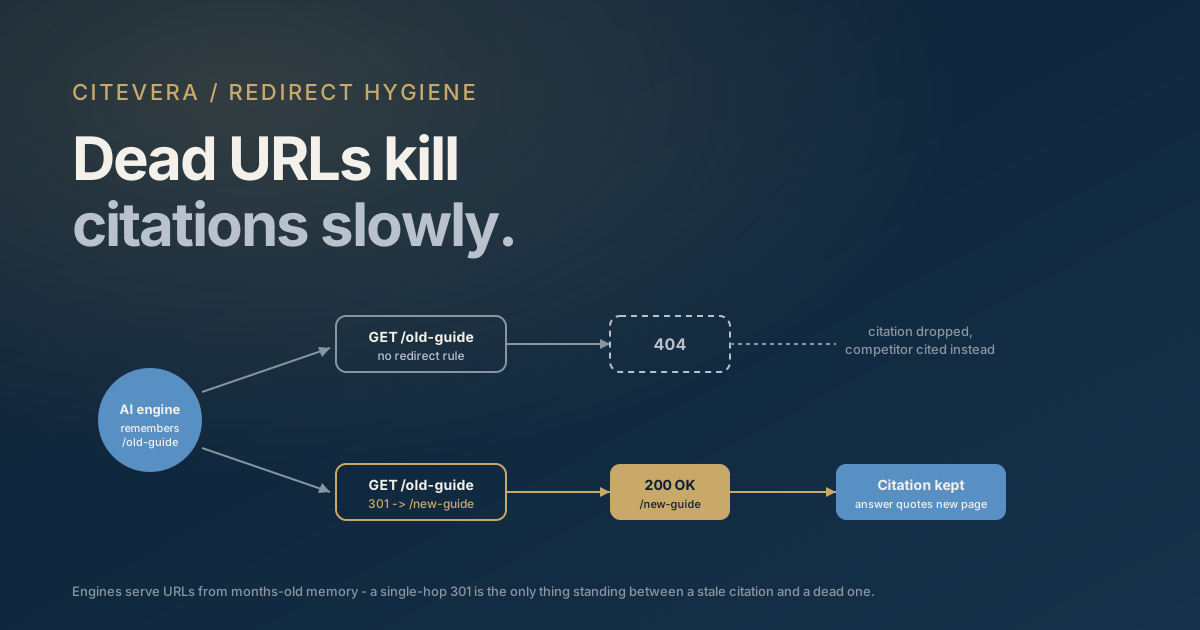
AI engines cite URLs from two places: what the model memorized during training, and what a retrieval bot fetches at answer time. Both break when you move or delete pages. A model trained eight months ago will keep recommending yoursite.com/old-guide long after you renamed it - and when a user or a retrieval bot follows that URL into a 404, the citation dies, the trust dies with it, and the engine quietly learns to route around you.
This is why site redesigns and content cleanups cost AEO more than teams expect. Classic search recovers from a botched migration in weeks because Google recrawls constantly and updates its index. AI citations lag reality by months: the URL lives inside model weights and cached retrieval indexes, and it keeps getting served until the next training cut or index refresh. The only defense is redirect hygiene rigorous enough that every URL you have ever published still resolves, in one hop, to the best live equivalent.
Where cited URLs actually come from
Training memory. Frontier models memorize URL patterns for pages that appeared often in their training corpus. Ask a chat model without browsing for "a good guide on X" and it will emit URLs from memory - some perfect, some subtly wrong, some pointing at pages that no longer exist. You cannot patch model weights. If /pricing-2024 was heavily linked when the corpus was cut, that string is what the model knows.
Retrieval indexes. ChatGPT search, Perplexity, and Gemini fetch live pages, but they discover candidate URLs through their own crawl indexes, which refresh on their own schedules. A URL you deleted last month can sit in a retrieval index for a long time, getting selected, fetched, and failing.
Answer-time fetches. When the engine actually fetches a candidate URL before citing it, your HTTP response decides everything. A 200 gets read and quoted. A 301 gets followed to the target, which gets read instead. A 404 or 410 gets nothing - the engine drops the source and picks a competitor's page for that slot in the answer.
The asymmetry matters: you control the last step completely. You cannot make engines forget old URLs, but you can make every old URL resolve.
What a 404 costs you, mechanically
A dead URL fails differently across the three paths, and each failure compounds.
- In answers with browsing, the retrieval bot fetches the URL, gets a 404, and excludes it. Your slot in the answer goes to whoever ranked next for that sub-query. Repeated over an index refresh cycle, engines simply stop selecting the URL - and there is no signal telling them your replacement page is its successor unless a redirect says so.
- In answers without browsing, the model cites the dead URL anyway. A user clicks, lands on your 404 page, and bounces. You lose the one visit AI search sent you, on the highest-intent click you will get all week.
- In future training runs, pages that vanish stop accumulating the links and mentions that made them citable. The authority your old URL earned evaporates instead of transferring.
Deleted content deserves a deliberate decision, not a silent 404. If a page has genuinely no successor, a 410 is at least honest. But for anything with citation history, the honest answer is usually a 301 to the closest living equivalent - the reasoning we walk through in content pruning for AEO applies double when the page has ever been cited.
Redirect hygiene that survives AI retrieval
The rules are the same ones Google documents for redirects, applied with less slack, because AI retrieval bots are less forgiving and less transparent than Googlebot.
- Use 301s, not 302s, for permanent moves. A 301 tells every consumer, per RFC 9110, that the resource has a new permanent home. Temporary codes leave old URLs alive in indexes indefinitely.
- One hop, never chains. Migrations stack: http to https, old slug to new slug, .com/de to de subdomain. Each hop adds latency and a failure point, and retrieval bots fetching under tight timeouts are exactly the client you should assume gives up early. Collapse every chain so the original URL 301s directly to the final destination. Audit with a crawler or a simple
curl -sILpass over your historical URL list. - Redirect to equivalents, not the homepage. A blanket redirect-everything-to-home rule is a soft 404: the engine fetches expecting an article about X and receives your homepage. Engines evaluating whether the fetched content supports the claim will discard it. Map each old URL to the page that actually answers the same question.
- Preserve the anchor-worthy content. If the old page had a definition, a statistic, or an FAQ that earned the citation, make sure the redirect target still contains it. A 301 into a page that dropped the quoted passage keeps the click but loses the re-citation.
- Keep redirects forever. There is no safe retirement date, because you do not control when each engine's training snapshot or retrieval index last saw the old URL. Redirect rules are cheap; re-earning a citation is not.
Redesigns and migrations: map before you move
Every domain change, CMS change, or URL-structure change needs a URL mapping built before launch, not reconstructed afterward from 404 logs.
Step 1 - inventory every URL that has ever been live. Your sitemap history, server logs, analytics, and any citation monitoring you run. The URLs AI engines know about include ones you forgot years ago.
Step 2 - map each to its successor. Explicit old-to-new pairs, reviewed by someone who knows the content. Flag pages with known AI citations for individual attention.
Step 3 - ship the 301s at cutover and immediately crawl the old URL list to verify single-hop resolution.
Step 4 - watch for the slow bleed. AI citations will keep pointing at old URLs for months. That is expected - the redirect makes each one land somewhere useful while the indexes catch up. What you are watching for is any old URL returning 404 instead of 301.
If your migration is part of a broader shift toward answer engines, the ordering advice in migrating from traditional SEO to AEO pairs with this checklist.
Monitor the 404s that AI traffic actually hits
You do not need to fix every 404 on a large site. You need to fix the ones receiving AI-referred humans and AI bot fetches, and your logs already tell you which those are.
- Filter 404s by referrer. Hits with referrers like
chatgpt.com,perplexity.ai, orgemini.google.comare users who clicked a citation and hit a wall. Every one of these is a URL an engine is actively serving to real users - redirect it today. - Filter 404s by user agent. GPTBot, ClaudeBot, PerplexityBot, and Google-Extended requests hitting 404s show you which dead URLs still live in crawl schedules and retrieval indexes. OpenAI's bot documentation lists the exact user-agent strings to match.
- Make it a standing report, not a one-off. A weekly "404s with AI referrer or AI user agent" report catches new breakage - a renamed slug, a dropped trailing-slash rule - while the citation is still warm.
A citation that starts failing is one of the classic silent losses; the full diagnostic tree in the anatomy of a lost citation starts, not coincidentally, with checking HTTP status.
Frequently asked questions
Do AI engines follow 301 redirects?
Yes. Retrieval bots are HTTP clients, and following a 301 to its target is standard client behavior; documented crawlers like GPTBot behave like conventional crawlers in this respect. What you cannot count on is patience - long chains and slow hops risk timeouts. Keep every redirect single-hop and fast.
How long do AI engines keep citing a moved URL?
Expect months, not weeks. The old URL persists in model training memory until a future training run and in retrieval indexes until their own refresh cycles pass - neither on a schedule you can see or influence. That lag is exactly why permanent 301s matter: they make the stale reference land correctly for as long as it keeps being served.
Should I use a 410 for deleted content?
Only when the content has no meaningful successor and you want it gone from indexes - a 410 signals deliberate permanent removal. For anything that ever earned citations or links, a 301 to the closest equivalent preserves the value. Redirecting to an unrelated page just to avoid a 404 backfires, because engines treat irrelevant redirect targets as soft 404s.
Are redirect chains really a problem if they resolve eventually?
Yes. Each hop adds a request round-trip and a failure point, and answer-time fetches run under tight time budgets - a bot that abandons a slow chain treats the URL as dead even though a patient browser would get through. Chains also accumulate silently as migrations stack, so audit and flatten them to one hop.
Can I find out which of my 404s come from AI engines?
Your server logs already contain it. Cross-reference 404 responses with AI referrer domains (chatgpt.com, perplexity.ai, gemini.google.com) to find dead URLs users are clicking from answers, and with AI crawler user agents (GPTBot, ClaudeBot, PerplexityBot) to find dead URLs still in retrieval indexes. Both lists are your priority redirect queue.
Make the audit routine
Redirect decay is a maintenance problem, and maintenance problems need standing checks, not heroics after a redesign. Citevera's audit flags broken internal links, redirect chains, and crawlability failures alongside its AEO and GEO scoring, and the free tools - including the AI crawler access checker - let you verify in seconds that the URLs engines are trying to fetch actually resolve for the bots doing the fetching. Run them before the citations go quiet, because by the time they do, the indexes that matter have already moved on.