

Healthcare and YMYL AEO: Higher Bars, Different Signals, Real Stakes
Healthcare and other YMYL (Your Money or Your Life) topics face a higher AEO bar. Here is what AI engines weight more strictly in these verticals and how to meet the bar.
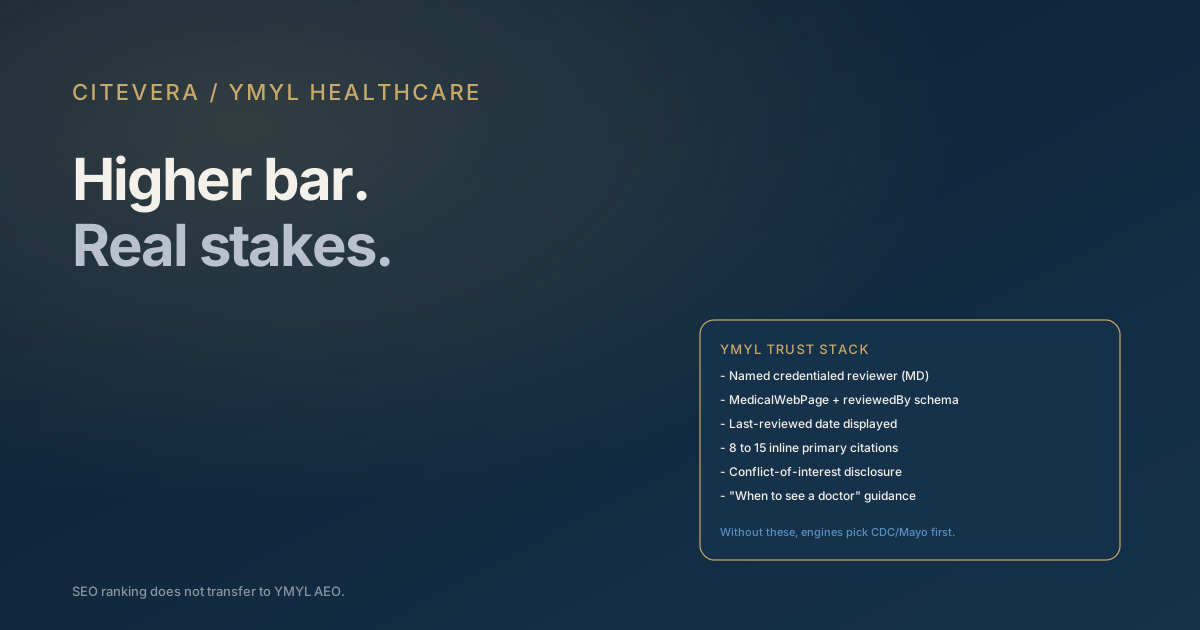
YMYL (Your Money or Your Life) topics include health, medical, financial, legal, and safety content where bad information can directly harm a reader. AI engines apply stricter selection thresholds in these verticals, weighting credentials, source quality, and methodology more heavily than they do in general content. For healthcare specifically, the bar is high enough that most consumer health content fails to qualify regardless of SEO ranking.
This post covers what AI engines weight differently in YMYL contexts, the specific signals healthcare and finance content needs to demonstrate, and the structural patterns that move YMYL pages above the citation threshold.
Why YMYL contexts trigger different selection logic
Three reasons:
1. Direct harm potential. A wrong answer about medication interactions can hurt people. Engines are aware of liability and reputational risk and select sources accordingly. 2. Established institutional authority. YMYL topics have well-known authoritative bodies (CDC, NIH, AMA, FDA, NHS for health; SEC, FINRA for finance). Engines bias toward these sources. 3. Reader stakes are visible. When a user asks "what are the symptoms of a stroke", the engine understands the answer matters. Selection becomes more conservative.
The implication: YMYL AEO is not generic AEO with extra schema. It is a different bar that requires demonstrable expertise and institutional alignment.
What AI engines look for in healthcare content
Six signals weighted more strongly in medical contexts:
Author credentials with verification
A "reviewed by [physician name, MD, board certification]" line near the top of medical content materially affects citation. Generic author bylines (writer or editor without medical credentials) get lower citation weight.
Citation density and quality
Medical content with 8 to 15 inline citations to peer-reviewed sources, NIH, CDC, or major medical institutions outperforms content with no citations. The stat citations and source links pattern matters more in medicine than in any other vertical.
Date of last review
Medical guidance changes. Pages with explicit "last reviewed [date] by [credentialed reviewer]" signal active maintenance. Pages without review dates get downweighted, even if recently published.
Disclaimers framed as informational not commercial
A disclaimer that the content is informational and not medical advice, with a recommendation to consult a healthcare provider, signals appropriate scope. Engines recognize this framing as responsible publishing.
Conflict-of-interest transparency
If the publisher has commercial relationships (selling supplements, drugs, devices), disclosing them transparently outperforms hiding them. Engines that detect undisclosed commercial relationships in medical content downweight the source.
Reading-level appropriate for the audience
Consumer-facing medical content at a reasonable reading level (not overly technical) gets cited for general queries. Highly technical content gets cited for clinician-targeted queries. Match the reading level to the intended audience and engine queries cluster appropriately.
The structural patterns that work in healthcare AEO
Five elements every healthcare content page should ship:
Author and reviewer block at the top
<div class="author-block">
  <p>Written by Sarah Chen, RN, BSN</p>
  <p>Medically reviewed by Dr. Michael Patel, MD, Board Certified in Internal Medicine</p>
  <p>Last reviewed: April 15, 2026</p>
</div>
This block is high-yield citation fuel. Engines extract the credentials and the review date when answering.
Schema markup with MedicalWebPage and reviewedBy
{
  "@context": "https://schema.org",
  "@type": "MedicalWebPage",
  "lastReviewed": "2026-04-15",
  "reviewedBy": {
    "@type": "Physician",
    "name": "Michael Patel, MD",
    "jobTitle": "Internal Medicine",
    "memberOf": {"@type": "MedicalOrganization", "name": "Mayo Clinic"}
  },
  "specialty": "Internal Medicine"
}
MedicalWebPage is the schema.org type for medical content. reviewedBy with a Physician object is the structured-data anchor for credentialed review.
Inline citations with linked sources
Every medical claim that goes beyond common knowledge should be cited inline:
> "Studies show that statins reduce cardiovascular events by approximately 25% in high-risk patients [1]."
Footnote-numbered with a references list at the bottom. The references list should include DOIs or PubMed IDs where available.
Symptom and condition pages with structured-data tagging
For symptom-and-condition content, MedicalCondition schema provides additional structure:
{
  "@type": "MedicalCondition",
  "name": "Type 2 diabetes",
  "code": {"@type": "MedicalCode", "code": "E11", "codingSystem": "ICD-10"},
  "signOrSymptom": [
    {"@type": "MedicalSymptom", "name": "Increased thirst"},
    {"@type": "MedicalSymptom", "name": "Frequent urination"}
  ]
}
This structures the medical entity in a way that engines can resolve to clinical knowledge graphs.
A "when to see a doctor" section with explicit guidance
A clear section telling readers when to seek professional care. This is both responsible content design and a citation hook for queries about urgency.
What AI engines look for in financial content
Similar logic, different specifics:
Author or reviewer with financial credentials
CFP, CFA, Series 7, JD with finance specialty. Generic financial bloggers without credentials get less citation weight.
Disclosure of regulatory status
If you are a registered investment advisor or broker-dealer, state it. If not, state that the content is informational and not personalized advice.
Citations to primary financial sources
SEC filings, FINRA, IRS, Federal Reserve, peer-reviewed economics literature. Citations to other content marketing pieces do not carry weight.
Date of last review and applicable jurisdiction
Tax law, securities regulations, and financial planning guidance vary by jurisdiction and change over time. State the date and the jurisdiction explicitly.
Legal content in YMYL AEO
Legal content faces similar constraints:
- Author should be a JD with relevant practice area, or content should be reviewed by one.
- Jurisdiction should be explicit. "California labor law" is more useful than "labor law".
- Date of last review matters because case law changes.
- Disclaimer that content is informational and not legal advice.
E-E-A-T (Experience, Expertise, Authoritativeness, Trust) in YMYL
Google's E-E-A-T framework was originally designed for YMYL content quality assessment. AI engines have inherited similar logic. Four signals:
- Experience. First-hand experience with the topic. For medicine, clinical practice. For finance, advising clients. For law, litigating cases.
- Expertise. Credentials and demonstrated knowledge.
- Authoritativeness. Recognition by other authoritative sources (citations, awards, institutional affiliations).
- Trust. Transparent ownership, accurate information, conflict-of-interest disclosure.
Pages that demonstrate all four get cited in YMYL contexts. Pages missing one or more get downweighted.
The E-E-A-T signals for AI search post covers the broader framework. In YMYL contexts the signals matter more, not less.
Common YMYL AEO mistakes
Five recurring failures:
Generic author names without credentials
"By the [Brand] Team" or "By Sarah Smith" without job title, credentials, or background. In YMYL, this fails the expertise signal.
Affiliate-stuffed health content
Pages that intersperse medical content with affiliate links to supplements, devices, or services. Engines detect commercial framing and downweight, sometimes severely.
Out-of-date content presented as current
Medical guidance from 2019 republished without review in 2026. Engines factor recency in YMYL more heavily than in general content.
Missing or buried disclaimers
A disclaimer hidden in the footer in 8-point grey text does not signal responsibility. Disclaimers should be near the content, in readable type.
Anonymous "reviewed by our medical team"
"Reviewed by our medical advisory board" without naming the reviewers fails the verifiability test. Name the reviewer with credentials or do not claim review.
When YMYL AEO is worth the investment
Three trigger conditions:
1. Your business operates in a YMYL vertical. Hospitals, clinics, advisory firms, law firms, financial services companies. 2. Your content addresses YMYL topics for compliance reasons. Patient education, financial literacy, legal aid. 3. Your audience explicitly seeks credentialed sources. Professional B2B audiences within YMYL verticals.
If your business is adjacent to YMYL but not deep in it (a B2B SaaS that serves healthcare, for example), focus on company-facing content rather than competing for direct medical content citations.
Key takeaways
- YMYL topics trigger stricter AI engine selection thresholds; SEO ranking does not transfer.
- Author and reviewer credentials with named individuals materially affect citation in healthcare, finance, and legal.
- MedicalWebPage and reviewedBy schema provide the structured-data anchors for medical content.
- Inline citations with linked primary sources are critical for YMYL AEO.
- Disclaimers, jurisdiction, and last-review dates round out the trust signals.
What to do next
Run a free audit at scan.citevera.com to see whether your YMYL content has named credentialed authors, citation density, and last-reviewed dates. The report flags missing YMYL signals as high-impact gaps.
For the broader trust framework, E-E-A-T signals for AI search covers the underlying principles applicable across verticals.