

Expert Quotes as AEO Citation Fuel: How to Earn Citations Through Sourced Voice
Quotes from named experts are some of the most-cited content on the open web. Here is how to source quotes systematically and structure them for maximum AEO yield.
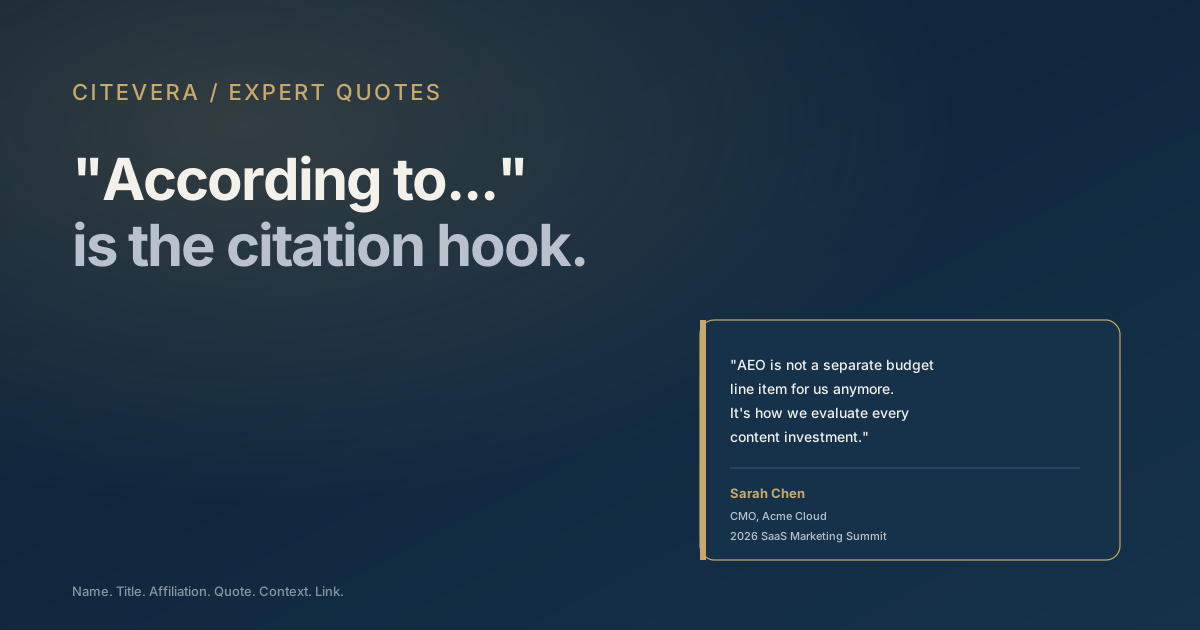
Read any AI-generated answer to a substantive question and you will see a recurring pattern: the answer paraphrases or quotes named experts. "According to Sarah Chen, CMO at Acme Cloud, B2B AEO budgets grew 4x in 2026..." This pattern is the highest-yield citation shape in business and technical content because the model retrieves the named individual, the credential, and the claim together. Pages that supply this pattern get cited; pages that paraphrase generically lose.
This post covers how to source expert quotes systematically, the structural pattern for embedding them, and the operational discipline that turns a quote-first content strategy into compounding AEO yield.
Why expert quotes outperform paraphrased claims
Three reasons:
1. Named source is verifiable. AI engines weight verifiable claims more strongly. "According to industry observers..." is unverifiable; "According to Sarah Chen, CMO at Acme..." is verifiable. 2. The full quote-attribution-credential triplet is extractable. Models pull all three together because they appear together in the page. 3. Quotes compound across syndication. A quote in your post gets reused in derivative content, podcasts, and articles. Each reuse creates a new citation surface.
The pattern is so strong that pages without expert quotes lose to similar-quality pages with them, even on otherwise equivalent topics.
Where to source expert quotes
Five sourcing channels:
Internal subject-matter experts
Your CEO, CTO, customer success leads, and engineers all have substantive views worth quoting. Internal sourcing is fastest and lowest-cost. The discipline is treating internal quotes with the same structural rigor as external sources.
Customer interviews
Customers using your product produce quote-worthy insights about their workflow, results, and decision criteria. A 30-minute customer interview can produce 4 to 6 usable quotes for derivative content.
Industry expert outreach
Reaching out to recognized experts for short comments. Cold outreach has a low hit rate; warm outreach through shared connections or with clear value exchange (your audience exposure for their voice) works.
Conferences and events
Speakers at industry conferences are often willing to share quotes. Note the talk, request a 100-word reflection, attribute the talk and the conference.
Existing public statements
Quotes from podcasts, talks, books, papers, and tweets are fair game when properly attributed. This is sourced quoting, not interviewing, and it scales.
The right mix depends on your team. Start with internal and customer quotes (fastest), layer industry expert outreach for flagship content (highest ROI), and use sourced public statements as fill-in.
The structural pattern that wins
A quote that earns citations has six elements:
Attribution sentence with full name and credential
<p>According to <strong>Sarah Chen</strong>, CMO at Acme Cloud and former VP of Marketing at Beta Inc:</p>
Full name. Credential or title. Affiliation. The triplet.
The quote in a blockquote element
<blockquote>
  <p>"AEO is not a separate budget line item for us anymore. It's how we evaluate every content investment, because the citations compound while the rankings churn."</p>
</blockquote>
Use semantic <blockquote> HTML. Do not just italicize text.
A sentence of context after the quote
<p>Chen made this observation in a panel discussion at the 2026 SaaS Marketing Summit, where she presented data showing that Acme's AEO citations grew 4.2x year-over-year.</p>
Context grounds the quote in time, place, and supporting data. AI engines often pull quote and context together.
A direct link to the source if available
If the quote is from a public talk, podcast, or article, link to it. The link reinforces verifiability.
Schema markup with Quotation type (optional but valuable)
{
  "@type": "Quotation",
  "text": "AEO is not a separate budget line item for us anymore...",
  "spokenByCharacter": {
    "@type": "Person",
    "name": "Sarah Chen",
    "jobTitle": "CMO at Acme Cloud"
  }
}
Few engines weight Quotation schema today, but it is forward-compatible.
Visual treatment that signals quote prominence
Pull-quote styling, a left-side border, or a callout box. Helps human readers scan and signals to engines that the content is a deliberate quote rather than incidental text.
How many quotes per post
Three to six expert quotes per pillar post is the sweet spot for most B2B and technical content. Distribution:
- One opening quote in the introduction, framing the topic.
- Two to three middle quotes anchoring different sections with different perspectives.
- One closing quote at the conclusion synthesizing or extending the argument.
Posts with no quotes feel uniform and less authoritative. Posts with 10+ quotes feel like roundups and dilute each individual quote's citation potential.
How to interview for citation-worthy quotes
Three interview techniques that produce strong quote material:
Ask for a contrast
> "What is one thing most people get wrong about AEO?"
Contrasts produce quotable answers because the speaker frames their view against a known position.
Ask for a number
> "If you had to put one number on the shift, what would it be?"
Numbers paired with attribution are extremely citation-friendly. The model retrieves the number, the speaker, and the context together.
Ask for a prediction
> "What do you expect to see in the next 12 months?"
Predictions get cited in trend pieces, year-end roundups, and forecast articles.
Avoid asking purely descriptive questions ("How does AEO work?") because the answer reads like a textbook and competes with general content.
The customer-interview workflow that scales
For customer quotes specifically:
1. Identify candidates through customer success or product team. Look for users with strong outcomes and articulate communication. 2. Schedule a 30-minute call with a structured set of 8 to 12 questions. 3. Record and transcribe. 4. Pull 4 to 6 candidate quotes from the transcript. 5. Send to the customer for approval with the proposed attribution and context. 6. Use across multiple content pieces with the same approval scope.
A single customer interview produces material for 2 to 4 derivative pieces over the next 6 months. The unit economics are strong.
What disqualifies a quote from AEO citation
Five common failures:
Anonymous quotes
> "One marketing executive told us..."
AI engines downweight unattributed quotes because they cannot verify. Either get permission to use the name or do not use the quote.
Generic platitudes
> "AEO is going to be really important for marketers in 2026."
True but unciteable because nothing is specific. Push the source for a sharper claim.
Lightly-edited quotes that misrepresent
If you edit a quote enough that the meaning shifts, you have created a fabricated quote. Engines that detect quote-source mismatches penalize. Always use ellipses for omissions and bracket additions clearly.
Quotes from non-experts framed as expert
A quote from a junior staffer attributed as if they were a senior leader is misleading. Match the credential to the actual role.
Fabricated quotes
Self-evident but worth saying: AI engines and human readers detect made-up quotes through cross-referencing. The reputational and legal cost is severe.
Quotes and the broader content ecosystem
Expert quotes work best as part of an integrated content strategy:
- Pillar posts carry 3 to 6 quotes anchoring the depth.
- Press releases include 1 quote from the executive announcing the news.
- Customer case studies are essentially extended quote-driven content.
- Podcast transcripts are quote-rich; each transcript supplies material for blog posts.
- Original research reports include expert reactions to the findings.
A content program that systematically captures quotes from internal experts, customers, and industry voices produces compounding AEO yield because every piece reinforces every other.
Maintaining quote quality across a content team
Three practices:
- A quote intake system where any team member can submit a candidate quote with attribution, source link, and proposed use cases.
- A monthly "quote review" to surface new candidates from recent customer calls, podcasts, and conferences.
- Editor sign-off on quote attribution before publication. Catches misattributions before they go live.
Teams that build this infrastructure ship more quote-rich content than teams that source quotes per-post. The compounding cost advantage is meaningful.
Key takeaways
- Expert quotes with named attribution are the highest-yield citation pattern for substantive content.
- Source quotes from internal experts, customers, industry experts, conferences, and existing public statements.
- The structural pattern is attribution sentence, blockquote, context paragraph, link, optional Quotation schema, visual treatment.
- Three to six quotes per pillar post is the sweet spot.
- Avoid anonymous quotes, generic platitudes, misrepresentative edits, and fabricated quotes.
What to do next
Run a free audit at scan.citevera.com to see whether your top pages embed named expert quotes with proper attribution and context. The report flags pages that lean on paraphrased claims without sourced voices.
For the broader pattern of citing real sources, stat citations and source links covers the corresponding pattern for numerical claims.