

Comparison Tables for AEO: How to Structure Tables AI Engines Will Cite
Comparison tables are an under-leveraged AEO format. Here is the structural pattern that turns a table into a citable answer for buyer-research queries.
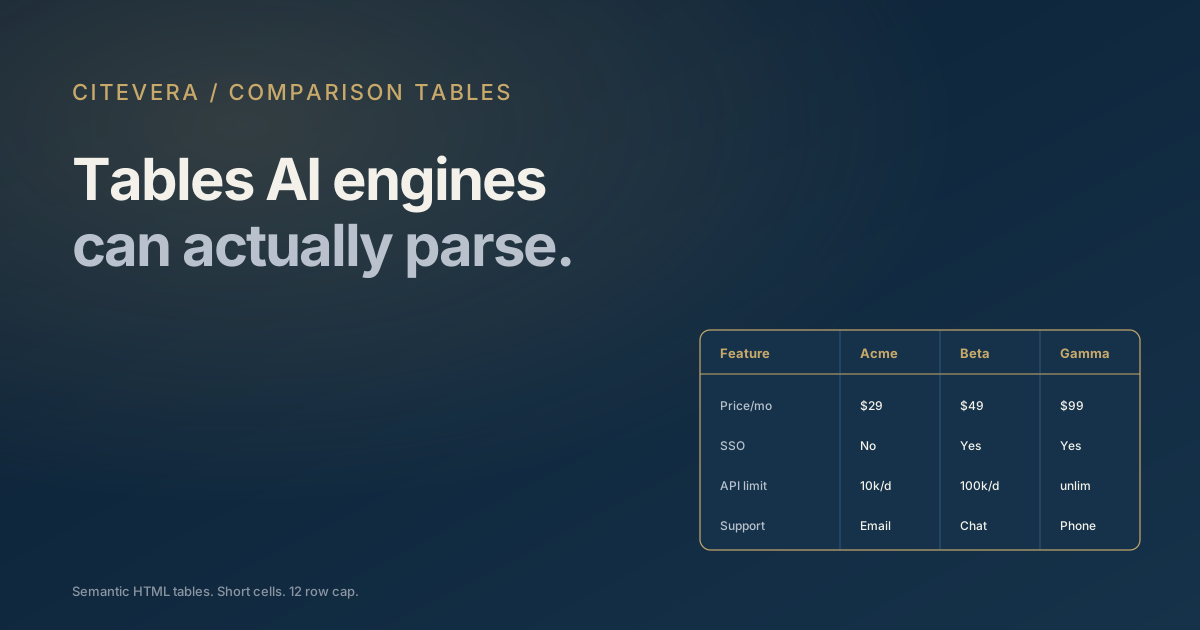
When a buyer asks an AI engine "what is the difference between Tool A, Tool B, and Tool C", the engine retrieves comparison content. Pages with well-structured comparison tables get cited disproportionately because the table is exactly the shape the model wants to render in the answer pane. The catch: most comparison tables on the open web are structurally bad, and the engine cannot extract them cleanly.
This post covers the table structure that wins citations, the prose that has to surround the table, and the schema that complements it.
Why comparison tables are an AEO opportunity
Three reasons:
1. Direct match to query intent. Comparison queries make up roughly 15 to 25% of B2B AI search volume in 2026 based on shop-around-stage buyer behavior. A table is the canonical answer shape. 2. High extraction success. A clean HTML table with proper headers is one of the easiest structures for a model to parse and re-render. 3. Low competitive density. Most teams write narrative comparison content. Table-first posts are rarer and outperform per-impression.
The opportunity exists because tables are easy to write badly. Most web tables are styled divs or images. Both are unciteable.
What "structurally bad" comparison tables look like
Five common failure modes:
- Tables rendered as images. A screenshot of a table in your design tool, exported as PNG. Models cannot extract.
- Div-based "tables" with CSS grid. Visually a table, semantically nothing. Models that parse semantic HTML skip these.
- Tables with merged cells everywhere. Beautiful in design, unparseable in extraction. Each row should be self-contained.
- Tables without
<th>headers. The model needs explicit column and row headers to map cells to attributes. - Tables with prose dumps in cells. A 200-word paragraph in a single cell defeats the structural advantage.
Fixing these is the floor. The rest of this post covers how to make a table that goes beyond floor and actively wins citations.
The structural pattern that wins
Six structural elements:
Use semantic HTML
<table>
  <thead>
    <tr>
      <th scope="col">Feature</th>
      <th scope="col">Acme Cloud</th>
      <th scope="col">Beta Cloud</th>
      <th scope="col">Gamma Cloud</th>
    </tr>
  </thead>
  <tbody>
    <tr>
      <th scope="row">Starting price</th>
      <td>$29/mo</td>
      <td>$49/mo</td>
      <td>$99/mo</td>
    </tr>
  </tbody>
</table>
<thead> and <tbody>, <th scope="col"> and <th scope="row">, no merged cells. This is the floor for citation extraction.
Keep cells short
Each cell should be a noun phrase, a number, a yes/no, or at most a single-clause sentence. Prose dumps in cells defeat scannability and extractability. If the comparison detail needs more space, link to a full section in the body that follows the table.
Use consistent cell phrasing across columns
If column 1's row says "$29/month including support", column 2's row should say "$49/month including support" not "Forty-nine dollars per month with support included". The parallel phrasing helps the model construct a clean comparison output.
Include a meaningful row order
Order rows by relevance to buyer decisions: pricing first, then primary differentiators, then secondary features. A randomly ordered table reads worse and extracts worse.
Cap rows at 12 to 15
Tables with 30+ rows lose their punch. The model will still extract them but the citation is lower-impact because a buyer cannot scan 30 rows in an answer pane. For longer comparisons, split into two tables (e.g., "core features" and "advanced features").
Provide a table caption
A <caption> tag (or an H3 immediately above the table) anchors the table to a query intent: "Pricing comparison: Acme, Beta, and Gamma" rather than a generic "Comparison table". Engines use the caption as a signal of the table's subject.
The prose that should surround the table
A naked table cited with no surrounding context can be misinterpreted. Three pieces of prose pay for themselves:
A 2 to 3 sentence framing paragraph above the table
> The three platforms compete in different segments. Acme targets startups under 50 employees with the lowest entry price. Beta targets mid-market with deeper integration features. Gamma targets enterprise with custom contracting.
This gives the engine a verbal summary it can pair with the table when answering a query.
A short interpretation paragraph below the table
> For most teams under 50 employees, Acme offers the best price-to-feature ratio. For teams above 200 employees with custom integration needs, Gamma's enterprise tier is usually the right fit despite the higher price.
This produces the "verdict" sentence that AI engines often cite directly when summarizing comparison content.
A "how we evaluated" subsection
Explain your evaluation methodology in 3 to 5 sentences. What dimensions you considered, what you ignored, when the data was last verified. This adds trust signal that helps the page win against thinner competitor pages.
When to add structured-data markup to comparison tables
Schema.org has Table markup but it is rarely used and most engines do not weight it highly. Higher-yield options:
- FAQPage schema for the questions the comparison answers. "Which is cheapest?", "Which integrates with X?".
- HowTo schema if the comparison includes a "how to choose" section with sequential steps.
- Article schema with
aboutreferencing each compared product as a Thing.
Do not embed Product schema for competitor products you do not represent. Stick to your own product's Product schema if applicable, and reference competitors in prose.
Common comparison-page anti-patterns that hurt AEO
Five patterns that consistently underperform:
- Vendor-biased "comparisons" that pretend to be neutral. Models detect imbalanced framing and downweight the source.
- Comparison pages that ignore your weaknesses. A balanced comparison that admits your tool's gaps earns more citations than a one-sided pitch.
- Tables with no winners declared. "It depends" answers are weaker than "for X buyers, A wins; for Y buyers, B wins". Be specific.
- Stale data with no last-verified date. A 2024 comparison cited in 2026 is worse than no comparison. Date the page and update quarterly.
- Comparison tables embedded only in PDFs. PDFs sometimes get crawled but extraction is unreliable. Always provide an HTML version.
How comparison tables interact with the broader AEO content stack
Comparison tables work best as part of a hub-and-spoke structure. The hub is a long pillar page on the topic ("how to evaluate X tools"). The spokes are individual head-to-head pages ("Acme vs Beta", "Beta vs Gamma"). Each spoke carries one or two tables.
The comparison pages and vs-page patterns post covers the broader architecture. Tables are the structural unit; the page architecture is what compounds the citation flow across queries.
Maintenance: keeping comparison tables current
A stale table is worse than no table. Two maintenance practices:
- Quarterly review. Walk every comparison page once a quarter. Update prices, feature checks, and version numbers.
- Auto-flagging on price changes. If your platform watches competitor pricing pages, set alerts that ping you when a competitor changes price so you can update before stale data starts producing wrong citations.
Pages that fail to maintain freshness lose citations to newer comparison content within 60 to 90 days based on observed turnover patterns.
Key takeaways
- Comparison tables are an under-leveraged AEO format with high citation yield on buyer-research queries.
- Use semantic HTML with
<thead>,<tbody>,<th>headers and short cell content. - Surround the table with framing, interpretation, and methodology prose.
- Cap rows at 12 to 15 and order them by buyer-decision relevance.
- Maintain quarterly to avoid losing citations to fresher competitor pages.
What to do next
Run a free audit at scan.citevera.com to see whether your comparison pages use semantic HTML tables and whether the surrounding prose includes framing and interpretation paragraphs.
For the full architecture beyond individual tables, comparison pages and vs-page patterns covers the hub-and-spoke approach.