

Case Study Format for AEO: Structuring Customer Stories AI Engines Will Cite
Most case studies are sales collateral with no AEO yield. Here is the structural format that turns customer stories into citation surfaces and trust signals.
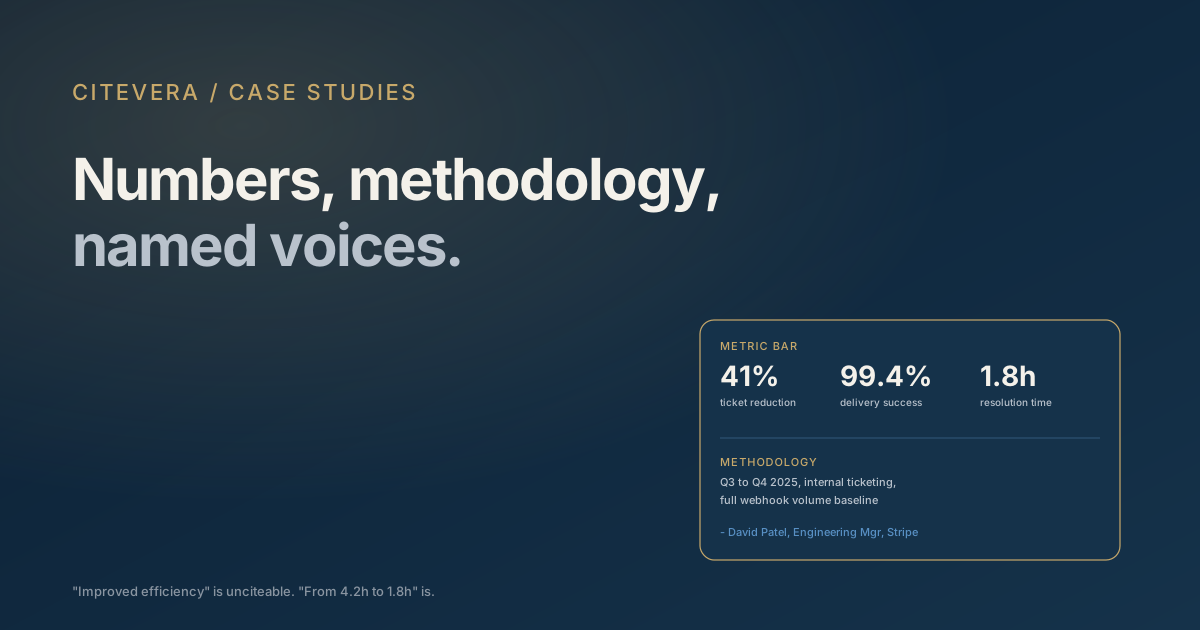
Case studies are typically the worst-performing AEO asset on a B2B SaaS site despite being the most-produced. Marketing teams ship glossy 800-word stories with vague metrics ("significant improvement", "huge wins") and no methodology. AI engines retrieve almost none of this content because nothing is verifiable, specific, or extractable. A different format - the AEO-optimized case study - turns customer stories into both sales tools and citation surfaces.
This post covers the case study format that earns citations, the metrics framing that makes outcomes citable, and the operational discipline that produces case studies people and engines both read.
Why most case studies fail at AEO
Three reasons:
1. Vague outcome statements. "Improved efficiency" is unciteable. "Reduced ticket resolution time from 4.2 hours to 1.8 hours" is citable. 2. Marketing-coded language. "Acme transformed our business" reads like a testimonial designed for the homepage carousel, not as a citable claim. 3. Missing methodology. Reader has no idea how the customer measured the outcome, over what period, or under what conditions. Engines cannot cite something they cannot verify.
The fix is not more writing. It is different writing with a structural discipline.
The case study format that earns citations
Eight elements in order:
Headline with the customer name and quantified outcome
> "How Stripe reduced API ticket volume 41% by switching to Acme Cloud's webhook delivery"
Specific customer. Specific number. Specific mechanism. Compare to:
> "Stripe transforms developer experience with Acme Cloud"
The first version is citable; the second is unciteable.
A 60 to 80 word executive summary at the top
The summary should include:
- Customer name and category (e.g., "Stripe, payments infrastructure for online businesses").
- The challenge in one sentence with specifics.
- The solution in one sentence.
- The outcome with the headline metric.
This block is the citation candidate for queries about the customer or the outcome.
A "challenge" section with quantified pain
> Before adopting Acme Cloud, Stripe handled 1,800 webhook delivery support tickets per quarter. Ticket resolution averaged 4.2 hours, with 23% requiring engineering escalation.
Numbers, not adjectives. The challenge becomes a citable benchmark for "how bad was it" queries.
A "solution" section with implementation specifics
What the customer implemented, how long it took, who was involved, what changes were made. Specifics matter; "they implemented Acme Cloud" tells the engine nothing.
A "results" section with quantified outcomes
The headline metric and 3 to 5 secondary metrics. Each metric should be specific:
> - Webhook delivery success rate increased from 92.3% to 99.4%. > - API ticket volume dropped 41% within 6 months. > - Engineering escalations decreased from 23% to 4%. > - Average resolution time fell from 4.2 hours to 1.8 hours.
Numbers with comparison anchors. Bullet format for scannability.
A methodology subsection
> Outcomes were measured by Stripe's developer support team using their internal ticketing system across Q3 2025 and Q4 2025. Webhook delivery success was measured against Stripe's full webhook volume during the same period.
Methodology answers "how do we know this?". Models cite case studies with explicit methodology more confidently than ones without.
Direct customer quotes with named attribution
<blockquote>
  <p>"The webhook delivery improvements alone would have justified the contract.
  What surprised us was how much support time we got back."</p>
</blockquote>
<p>- David Patel, Engineering Manager, Developer Experience, Stripe</p>
Quote, name, title, company. Same pattern as expert quotes.
A "what's next" section
Forward-looking notes from the customer about how they will continue using the solution. This signals living relationship, not a one-time win.
Quantified metric framing that earns citations
The single biggest improvement most case studies need is sharper metric framing. Five patterns:
Before-and-after comparisons
> "Resolution time dropped from 4.2 hours to 1.8 hours."
Before-and-after reads as causal even when the writer is careful with attribution. It also extracts cleanly.
Percent improvements with absolute baselines
> "41% reduction in ticket volume, from 1,800 to 1,062 tickets per quarter."
Percent and absolute together let the reader (and engine) judge significance.
Time-bounded claims
> "Within 6 months of deployment, the team observed..."
The time bound prevents the metric from being misread as instant or perpetual.
Compounding metrics where applicable
> "Year over year, webhook delivery improved 7.1 percentage points; over two years it improved 11.5 percentage points."
Compounding metrics make case study findings reusable in trend pieces and forecast content.
Counterfactual framing where defensible
> "Without the change, projected ticket volume by Q4 2026 would have been 2,400 per quarter. Actual volume is 1,062."
Counterfactuals are powerful but require defensible assumptions. Use sparingly and document the assumption.
Schema markup for case studies
Three options:
Article + ProfessionalService combination
Article schema for the case study itself, with a related ProfessionalService entity referencing your offering.
Review schema
If the case study includes a structured review or rating from the customer, Review schema ties the customer voice to your Organization or Product.
CaseStudy is not a schema.org type
Worth noting: schema.org does not currently have a CaseStudy type. Use Article with appropriate articleSection: "Case Studies" and rich publisher/about references.
{
  "@type": "Article",
  "articleSection": "Case Studies",
  "about": {
    "@type": "Organization",
    "name": "Stripe"
  },
  "publisher": {"@id": "https://acme.example/#organization"}
}
Visual elements that lift case study citations
Three visual patterns:
A metrics bar at the top
A horizontal strip with 3 to 5 key metrics in large type. Each metric has a number, a label, and a comparison anchor. Designed for scanning and screenshot-sharing.
Charts with absolute values labeled
A line chart showing ticket volume over time, with the before-and-after periods marked. The chart should label the y-axis with absolute numbers, not just percentages.
Customer logo and product screenshot
Standard but worth doing well. The logo confirms the customer's identity; the screenshot grounds the implementation specifics.
Where case studies fit in the AEO content stack
Case studies are not standalone content. They work as part of an integrated stack:
- Pillar posts reference case studies inline as supporting evidence.
- Pricing pages link to case studies that justify the price.
- Comparison pages cite case studies to support claims about your tool's outcomes.
- Annual research reports include case studies as exemplars of trends in the data.
Treat case studies as reusable assets, not point-in-time launches. Refresh them annually with updated numbers as the customer relationship continues.
Sourcing and approval workflow
A scalable case study program:
1. Customer success identifies candidates quarterly, prioritizing customers with quantified outcomes and articulate champions. 2. Marketing schedules a 45 to 60 minute interview with structured questions covering challenge, solution, results, and methodology. 3. Draft the case study with quantified outcomes and customer quotes. 4. Customer reviews and approves the metrics, quotes, and attribution. 5. Legal and compliance review if required for the customer's industry. 6. Publish on the domain with full schema markup and internal links from related content.
Most B2B teams produce 4 to 8 substantive case studies per year. The cost-per-case-study is $2,000 to $5,000 in editorial and design time; the AEO and sales value typically exceeds 10x within 18 months.
Common case study mistakes
Six recurring failures:
- Vague outcomes like "improved performance" or "saved time" without numbers.
- No methodology section. Engines cannot verify the claim.
- Anonymous quotes. "One developer said..." instead of named attribution.
- One-way attribution. The case study mentions the customer; the customer's site mentions nothing about you. Reciprocal mentions reinforce the entity link.
- Single-page-locked content. Case studies behind email gates lose all AEO yield. Open them.
- Stale metrics. A 2023 case study presented in 2026 without an updated relationship note feels frozen. Refresh annually.
Key takeaways
- Most case studies fail at AEO because they use vague language and skip methodology.
- The format that wins includes headline with customer + outcome + mechanism, quantified challenge and results, methodology, and named quotes.
- Quantified metric framing (before/after, percent + absolute, time-bounded) lifts citations.
- No CaseStudy schema type exists; use Article with appropriate
articleSectionand publisher reference. - Refresh case studies annually rather than letting them go stale.
What to do next
Run a free audit at scan.citevera.com to see whether your case studies use quantified metrics with methodology and named customer quotes. The report flags soft-language case studies as missed AEO opportunities.
For the broader pattern of sourced voice in content, expert quotes as AEO citation fuel covers quote structure in detail.