

How AI Engines Build 'Best X' Lists (and How to Get On Them)
When users ask AI for the best tools in a category, engines synthesize from existing listicles, review sites, and forums. Consensus across sources is the mechanism.
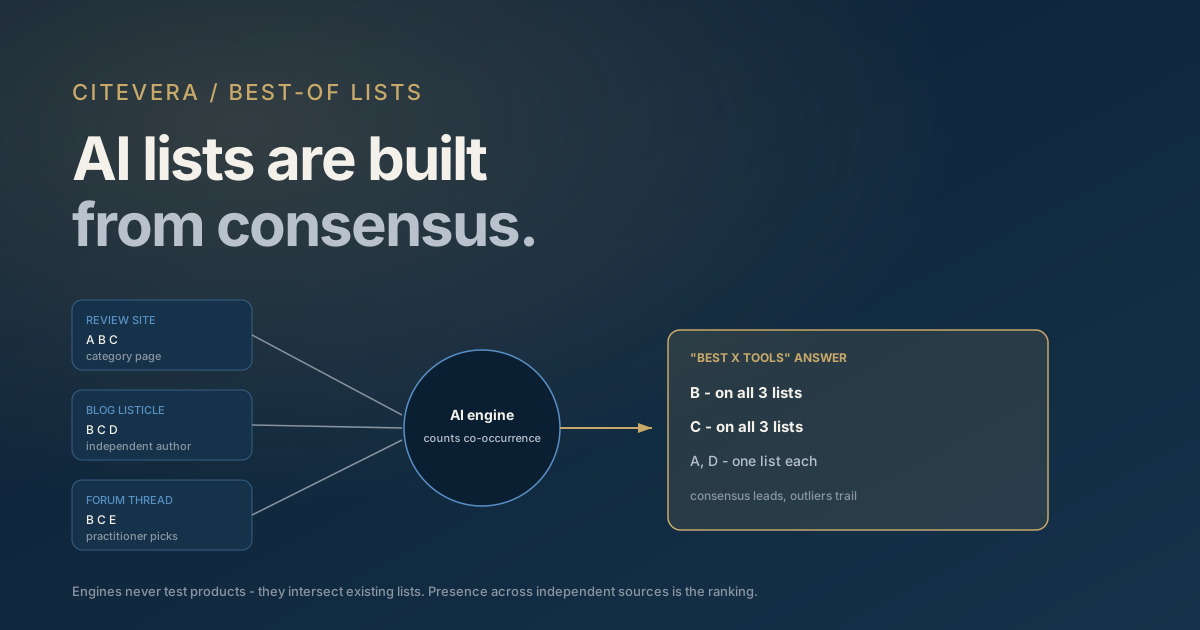
When someone asks ChatGPT, Perplexity, or Gemini for "the best AEO tools" or "top form plugins for WordPress", the engine doesn't evaluate products. It has never installed your software, run your onboarding, or hit your rate limits. What it does is retrieve pages that already answer the question - existing listicles, review aggregators, comparison pages, forum threads - and synthesize a consensus from them. The products that appear in the answer are, overwhelmingly, the products that already appear across multiple independent sources.
That single fact should reorganize how you chase AI recommendations. The goal isn't to convince a model your product is good. It's to be present, consistently described, in the specific pool of documents the model reads when it builds the list. This post breaks down how that pool is assembled, why publishing your own "best X" listicle almost never gets you onto other lists (and why you should write one anyway), and what actually moves the needle.
What happens when a user asks for "best X"
Mechanically, a "best tools" query triggers the same retrieval pipeline as any other question, with one twist: the query shape strongly favors pages that are already lists. A search for "best project management tools" retrieves listicles from software blogs and media sites, category pages on review aggregators like G2 and Capterra, comparison posts, and community threads where practitioners argue about their stacks.
The model then composes an answer from those passages. Faced with six retrieved lists that partially overlap, the cheapest and safest synthesis is intersection-plus-union: lead with the products that appear on most of the lists, pad with distinctive picks that had strong supporting descriptions, and attach whatever attributes ("best for enterprise", "cheapest", "open source") the sources repeated.
Notice what never happened in that pipeline: no crawl of your product pages, no evaluation of your feature set, no judgment call about quality. Your homepage matters for how you're described once you're in the answer. Whether you're in the answer at all is decided by third-party documents.
Consensus is the ranking algorithm
The engines' behavior creates a de facto ranking signal: co-occurrence across independent sources. A product that shows up on one list out of eight retrieved might make the answer. A product on five of eight almost certainly does, and probably leads it.
This is why the mechanism rewards breadth over any single placement. One glowing feature in a major publication is worth less, for AI list inclusion, than modest presence across six mid-tier roundups, two review aggregators, and a handful of Reddit threads. Each additional independent source raises the probability that any given retrieval pass includes you more than once - and repeated appearance is what the synthesis step treats as consensus.
Independence matters as much as count. Five listicles that all syndicated the same original article collapse into one source in practice, because they describe you in identical language and the model recognizes the duplication. Five genuinely separate authors who each chose to include you, describing you in their own words, are five votes.
There's a corollary about consistency: if source A calls you a "form builder", source B a "data connector", and source C a "spreadsheet sync tool", the model has trouble binding those mentions into one entity with one identity. Products with a crisp, repeated one-line category description accumulate consensus faster. We cover the deeper version of this problem in why competitors get cited and you don't.
Why your own "best X" listicle rarely gets you listed
The tempting shortcut is to publish "The 10 Best X Tools" on your own blog with your product at number one. Understand what this does and doesn't do.
It usually doesn't get you into AI-generated lists, for two reasons. First, retrieval pools for "best X" queries are competitive, and a vendor's self-ranking is one document among many - it doesn't create the cross-source consensus that drives inclusion, it's a single vote from the least credible voter. Second, engines and their training pipelines are increasingly attentive to source interest. A page on yourdomain.com ranking your own product first is the textbook case of a self-serving source, and answers that lean on it get worse, so systems learn to discount it.
But the listicle is still worth writing, because it wins a different prize: category citations. A genuinely useful comparison page - honest criteria, real trade-offs, competitors described fairly - is exactly the kind of document engines cite for adjacent informational queries: "what should I look for in an X tool", "X tool comparison", "difference between X and Y approaches". Those citations put your domain in front of buyers mid-research and establish you as a source on the category, even when the specific "best" list came from elsewhere. The play is honest coverage of the category on your site, and presence on other people's lists for the inclusion game. Our guide to AEO for SaaS covers how buyers actually move through these queries.
The source classes that feed the lists
Four classes of documents dominate "best X" retrieval pools, and they respond to different tactics.
- Editorial listicles on software blogs, media sites, and newsletters. These are written by identifiable authors who take briefings. They're the most reachable through direct outreach.
- Review aggregators - G2, Capterra, and their category pages. These rank on almost every commercial software query, and their category pages are effectively pre-built listicles with structured data. A claimed, complete profile with genuine reviews is table stakes; an empty profile reads as a dead product.
- UGC threads - Reddit, Hacker News, niche forums, Stack Exchange. Engines lean on these hard for "what do people actually use" queries because they encode practitioner consensus. You can't astroturf your way in (and shouldn't try - more below), but you can earn presence by being genuinely active where your users already are. We go deep on this in Reddit, Quora, and forum citations.
- Comparison and alternatives pages - "X vs Y" and "X alternatives" pages, both yours and third parties'. These document the competitive set, which is exactly the entity graph a model consults when assembling a category list.
Audit yourself against these four classes for your primary category query. Run the query in two or three engines, collect every source they cite, and mark which ones mention you. That list of gaps is your roadmap, and it's usually shorter and more concrete than any generic "build authority" advice.
Outreach that gets you onto lists
List authors update their posts - freshness pressure from both Google and AI engines means the good ones revise annually or better. That's your opening. What works:
- Target lists that already rank or get cited for your category query, not every listicle on the internet. The retrieval pool is what matters; a list nothing retrieves is worthless.
- Make inclusion effortless. Send a tight fact block: one-sentence category description, three differentiators, current pricing, a screenshot, a link. Authors include products they can describe accurately in five minutes.
- Give them a real reason. A capability their current list doesn't cover, a pricing tier that fills a gap in their coverage, a use case their readers ask about. "Please add us" without an angle gets deleted.
- Keep your own descriptions consistent everywhere - site, profiles, briefing docs - so every resulting mention reinforces the same entity and category phrasing.
What doesn't work: paying for placement on low-quality "best of" content farms. Those pages rarely enter retrieval pools, and when they do, their duplicated boilerplate descriptions don't add an independent vote.
Honest positioning is a survival trait
The temptation in this game is manufactured consensus: fake reviews, astroturfed Reddit comments, sockpuppet forum accounts. Beyond platform bans, there's a mechanical reason this backfires in AI answers specifically: engines synthesize sentiment along with inclusion. If the thread an engine retrieves is your astroturf getting called out - and Reddit is ruthless at calling it out - the "consensus" the model reads is that your product is the one that fakes reviews. You don't just miss the list; you get described negatively in the answer, to a buyer, at the exact moment of decision.
The durable version of this strategy is slower and simpler: be accurately describable, be present where your category is discussed, and let real users generate the language that engines will eventually repeat. Worth remembering how small the click funnel is anyway - in Pew Research Center's 2025 panel, clicks on links inside AI summaries happened on roughly 1% of visits (see the AI search statistics roundup). The recommendation itself, not the click, is the prize - which is exactly why the description attached to your name matters so much.
Frequently asked questions
How do I find out which sources AI engines use for my category?
Ask the engines your category question directly - "best X tools for Y" - in ChatGPT with search, Perplexity, and Gemini, and record every cited source. Repeat across a few phrasings and a few days, because retrieval varies. The union of those citations is your actual target list, specific to your category and far more actionable than guessing.
Does being number one on a single big list matter more than being on many small ones?
For AI list inclusion, breadth usually beats a single strong placement. The synthesis step counts appearances across independently retrieved sources, so six modest inclusions typically outweigh one flagship feature. The flagship feature still matters for humans, links, and how prominently you're described once included.
Should I write a "best X tools" post that includes my own product?
Yes, if you do it honestly: disclose the affiliation, describe competitors fairly, and rank by stated criteria rather than self-interest. Expect it to earn citations for category and comparison queries rather than to place you on other engines' "best" lists. That's still valuable - it's your entry into the research phase of the same buyers.
How long does it take to show up in AI "best of" answers?
There's no fixed timeline, and anyone quoting one is guessing. The dependencies are observable, though: new mentions must be published, crawled, and enter retrieval pools, and answers refresh at different rates per engine. Track it empirically - monitor your category prompts weekly and watch for first appearance, rather than waiting on a predicted date.
Know when the lists start including you
You can't manage a consensus you can't see. Citevera's citation monitoring - bundled with every paid plan - runs your category prompts across ChatGPT, Claude, and Gemini on a schedule and shows you exactly when you enter or drop out of the answers, alongside the site audit that keeps your own pages citable. Start with the category query you most need to win, and measure instead of wondering.