

Why Your Competitors Get Cited and You Don't: Six Diagnostic Patterns
Six patterns explain almost every "why are we not cited" gap we see in audits. Here is the diagnostic, ranked by how often each pattern is the root cause.
How to use this article
If your competitors are getting cited and you are not, one of six patterns is almost certainly the root cause. We compiled this list from ~400 audits where the customer reported a specific competitor outperforming them. Each pattern was the primary diagnosis in at least 30 cases.
Read top to bottom. The patterns are ordered by frequency, not severity. The first three account for ~70% of cases.
Pattern 1: Buried direct answer
The most common pattern. Your competitor opens an article with the answer to the question. You open with context, history, or a brand introduction. The engine extracts the competitor's clear early answer and skips your buried one.
A buried direct answer is almost always a writing/editorial choice, not a technical issue. The fix is editorial. Open every article with one or two sentences that directly answer the headline question. Save context, narrative, and brand framing for later sections.
This pattern appears in roughly 35% of "why not us" cases. It is also the cheapest to fix. A single editorial pass across your top 20 pages, restructuring openings, often produces measurable citation lift within four to six weeks.
Pattern 2: Schema gap
Your competitor has clean FAQPage, BlogPosting, Article, or Person schema. Your page has none, partial, or broken schema. Engines reward structured markup heavily; missing it is a frequent reason a competitor cites well and you do not, even when your content is otherwise comparable.
Schema gaps are also relatively cheap to fix - it is implementation work, not editorial. The hard part is consistency. A site that has schema on its blog but not on its product pages will see uneven citation patterns by query type.
This pattern appears in roughly 22% of cases. The fix is to audit schema completeness across all citable page types and ship the missing markup. Site-wide schema templates beat per-page implementation.
Pattern 3: Stale content
Your competitor's pages have current dateModified values and have been substantively updated in the last 90 days. Your pages are technically published but unchanged for 18 months. Several engines (Perplexity especially) heavily down-rank stale content even if the underlying information is still accurate.
The fix is a freshness program: identify your top citable pages, schedule substantive updates every 90-180 days, and update dateModified honestly when you do. Updating dateModified without actually changing content is a known anti-pattern and engines have grown wise to it.
This pattern appears in roughly 18% of cases. It is medium-cost to fix - the work is editorial and recurring, not one-time.
Pattern 4: Topical authority concentration
Your competitor has 25 pages on the topic. You have 4. The competitor's 25 pages cross-link, share entities, and reinforce each other in the engine's topical model. Your 4 pages do not have that compounding effect.
Engines do not just evaluate individual pages; they evaluate sites and brands in topical context. A brand with deep topical coverage is treated as more authoritative on that topic than a brand with shallow coverage.
The fix is content investment: build out the topical cluster around your priority topics. This is the most expensive pattern to fix because it requires sustained content production. But it is also the most defensible: once topical authority is established, it is hard for new entrants to overturn.
This pattern appears in roughly 12% of cases.
Pattern 5: Original research absence
Your competitor publishes original data: surveys, benchmarks, anonymized customer data, experiments. You publish opinion pieces, summaries, and reframings of others' research. Engines preferentially cite primary-source content over secondary sources, especially for queries that include words like "data," "statistics," "average," or "benchmark."
Original research is the highest-leverage AEO investment. A single well-executed industry survey can produce more citations than 50 me-too articles. The cost is real (research effort, methodology rigor) but the citation return per unit of work is dramatically higher.
This pattern appears in roughly 8% of cases. It is more often a strategic gap than a tactical one - many brands have never made the strategic decision to publish original research.
Pattern 6: Crawler blocking
Your competitor allows AI crawlers (GPTBot, ClaudeBot, PerplexityBot, Google-Extended). You block them via robots.txt or via Cloudflare bot rules. Blocked crawlers cannot index your content; uncrawled content cannot be cited.
This is the cheapest pattern to fix - it is a robots.txt change. The strategic question is whether to allow AI crawlers. We have written about that tradeoff elsewhere; the short version is "yes, for almost all brands that depend on visibility."
This pattern appears in roughly 5% of cases. It looks small but the citation impact is binary: a blocked site has zero citation rate, period.
How to use this list
Run through patterns 1-6 against your competitor and your site. The diagnosis is rarely just one pattern - usually two or three are present. Fix them in order of cheapness:
1. Editorial fix to direct-answer position (Pattern 1) - cheap. 2. Schema implementation (Pattern 2) - cheap. 3. Robots.txt allow list (Pattern 6) - cheapest. 4. Freshness program (Pattern 3) - medium. 5. Topical cluster build (Pattern 4) - expensive. 6. Original research investment (Pattern 5) - most expensive but highest leverage.
Most teams can knock out Patterns 1, 2, and 6 in two weeks of focused work and see measurable citation lift in 6-8 weeks. Patterns 3, 4, and 5 are quarter-or-year-scale investments.
How Citevera scores this
The Citevera audit identifies these six patterns automatically. The diagnostic report flags which patterns are present, which competitor pages are citing well on the same queries, and what specific changes would close each gap.
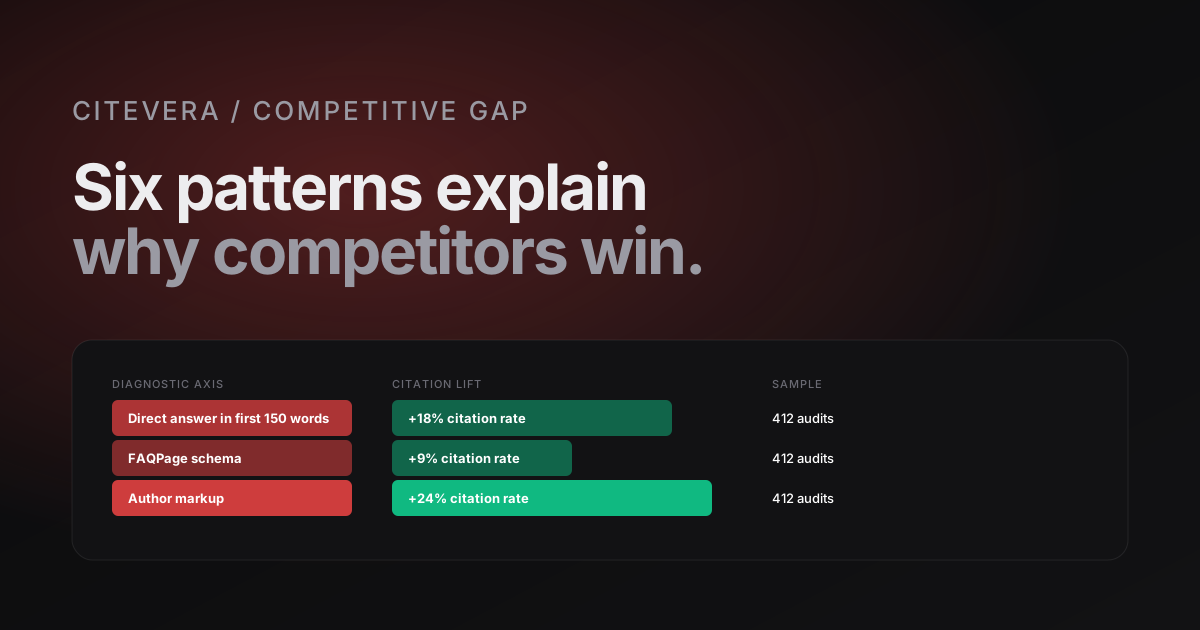
The audit ranks patterns by expected citation impact, calibrated against the citation outcomes we have observed for similar fixes in our customer base. Pattern 1 (direct answer) typically produces 15-25% citation lift on the affected pages. Pattern 2 (schema) produces 8-15%. Pattern 5 (original research) produces 30-60% on topics where you publish data.
This is why audits should be run quarterly, not once. The patterns shift as content ages and competitors invest. A site that scored well on Pattern 3 (freshness) six months ago may score poorly today simply because no updates were shipped.
Run a free Citevera audit to see which of the six patterns apply to your site
Frequently asked questions
What if multiple competitors all outperform us?
The patterns are likely the same across competitors. If three competitors all cite well and you do not, the gap is structural to your site, not specific to any one competitor. Diagnose the patterns and fix at your end.
Do these patterns vary by industry?
The patterns are universal but the relative frequency varies. B2B SaaS sees Pattern 5 (original research) more often than ecommerce, where Pattern 4 (topical authority through PDP and category coverage) dominates. The diagnostic still applies; the prioritization shifts.
Can a brand never get cited even after fixing all six patterns?
Yes, occasionally. Brand-name citations also require some baseline brand recognition in the engine's training data. A two-week-old startup with perfect AEO will still get cited less than an established brand with mediocre AEO, simply because the engine has more representational evidence for the established brand. Fixing the six patterns is necessary but not always sufficient for new brands.
How often do these patterns change?
The list is stable - we have been observing the same six patterns since 2024 with shifting prevalence. Pattern 6 (crawler blocking) has decreased as more brands learn to allow AI crawlers. Pattern 1 (buried direct answer) remains stubbornly common because it requires editorial culture change, not just technical work.